Southern European Kids No Longer Eating  Mediterranean Diet, And It Shows

“Countries in Southern Europe, famed for the Mediterranean diet that is held up around the world as an example of healthy eating, now have the highest rates of childhood overweight and obesity, a major survey indicates. The high rate is largely due to the almost complete of loss traditional eating habits in the young.”

Source: Southern European Kids Show Loss of Mediterranean Diet

Nuttin’ But Salads N=1 Experiment: Week 17 Summary and Wrap-Up

Not a salad, but a sunrise from my hospital in the Sonoran desert

It’s over. Four months of mostly nothing but salads.

I wanted to lose some weight. I started at 175.5 lb (79.8 kg) and have ended at 162 lb (73.6 kg). So call it down 13 pounds. Not quite a stone (14 lb), as they say in England.

No regrets. It’s been fun, an adventure, especially since my wife was involved. My suit pants fit again. My family bought me an expensive sturdy belt that will support my holster, and it fits for the first time.

As a reminder: I’ve just been eating twice daily, without snacking in-betweeen meals. Compared to thrice daily meals plus snacking, twice daily meals makes more sense to me from an evolutionary and physiological viewpoint. Eating just twice daily may increase autophagy.

What’s Next?

Avoiding weight regain! And trying to maintain or improve my health as I age. I feel like I’ve really been “eating healthy.” My plan is to continue eating just two meals a day, one of which will be a gourmet salad. The other will include animal proteins, cooked vegetables, legumes, and fruit. I tend to prefer low-carb types of fruits and vegetables.

High Blood Pressure

I don’t remember if I’ve shared with you the effect of this diet on my blood pressure. Starting in January 2017, my blood pressures were hitting 160/110, 150/100 more commonly. Sometimes 170 systolic. For a few years before that, pressures were borderline high. I’m old school, so tend to define hypertension as 140/90 or higher on multiple occasions. In 2017, the American Heart Association re-defined hypertension as pressures over 130/80.  Those numbers make half of the U.S. adult population hypertensive and candidates for drug therapy! And it runs in my family.
That’s more like it…

I started an antihypertensive drug, amlodipine, in late December  2017. Before that, I tried magnesium supplements and hibiscus tea: no help. I reduced alcohol consumption: no help. My amlodipine dose initially was 5 mg/day, then 10 mg/day. The higher dose caused some minor but definite swelling in my feet. To decrease the swelling (edema), I reduced the dose to 5 mg/day. On Feb 6, 2018, I started this Nuttin’ But Salads experiment. That dose reduction indeed reduced my edema. On Feb 12, my records show the lower dose still controlling my pressure.

After nine weeks of the Nuttin’ But Salads experiment, I noticed my pressures were 120/85 or lower. I stopped amlodipine April 9. By April 21, pressures were rising a little but no higher than 130/90. Edema gone almost immediately.
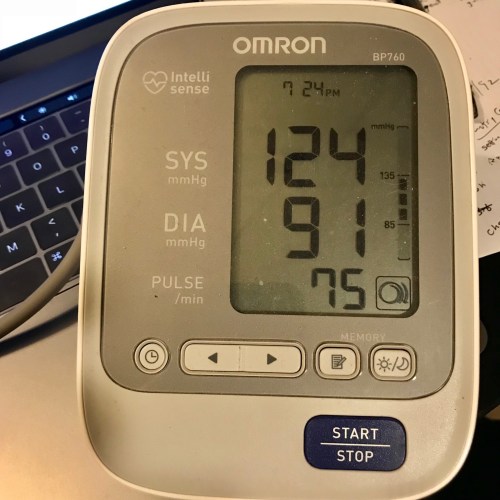
My Omron unit

As I write this, my BP after a 12-hr shift at the hospital is 124/91. The recent average is about 130/92. Not great, but I’m happy with it and not inclined to go back on drug therapy.
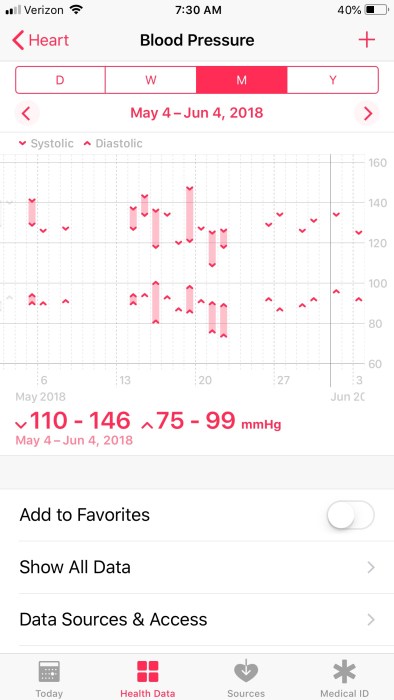
Screenshot of the free Health app on my iPhone

Why is my BP lower now? It may well be the salad diet. But also consider my weight loss or much lower alcohol consumption. I’m still drinking hibiscus tea and taking a magnesium supplement, but I was doing that before the salad experiment. I’ll also admit my stress levels may be lower, too.

One of these days I’ll do a nutrient analysis of my salad diet and probably share it with you. I’d love to know if others would see reduced blood pressure with this way of eating, whether or not weight loss was involved or needed.

Steve Parker, M.D.

P.S. I wouldn’t be surprised if my diet has been “deficient” in calcium and vitamin D. Whether or not that matters is another issue.


Nuttin’ But Salads N=1 Experiment: Week 16 Summary

A vegan salad

One more week to go after today. Weight is steady at 162 lb (73.6 kg).

Compliance-busters

I’ll admit my compliance has not been great during the last month. E.g., yesterday I had three donuts and some candy.

Not vegan: Back in the saddle…

My last couple workouts have been easier than usual even though I haven’t made any changes to my program. Could be easier because I’m exercising more regularly, or simply 13 lb lighter.

Steve Parker, M.D.

Is 40% of Dietary Research Giving Us Wrong Results?

I don’t know who Patrick Clinton is, but he writes:

“There’s a reason everyone’s confused about whether coffee causes cancer, or whether butter’s good for you or bad. Food research has some big problems, as we’ve discussed here and here: questionable data,  untrustworthy results, and pervasive bias (and not just on the part of Big Food). There’s reason to hope that scientists and academic journals will clean up their acts, and that journalists will refine their bullshit detectors and stop writing breathlessly about new nutrition “discoveries” that are anything but.  Until that happens, though, we all need to get better at filtering for ourselves.”

Source: Almost 40% of peer-reviewed dietary research turns out to be wrong. Here’s why | New Food Economy

It’s OK to Start Eating Romaine Lettuce Again

I dodged the bullet, but my wife wasn’t so lucky.

“If you’ve avoided romaine lettuce because of the E. coli outbreak, you can start buying it again.After weeks of warnings from the Centers for Disease Control and Prevention to toss out romaine grown in the Yuma, Ariz., region, the CDC says there are no longer any greens coming from this region.

The romaine that’s for sale now in restaurants and supermarkets nationwide is coming from California’s Salinas Valley.

Source: Hey, Salad Lovers: It’s OK To Eat Romaine Lettuce Again : The Salt : NPR

Nuttin’ But Salads N=1 Experiment: Week 15 Summary

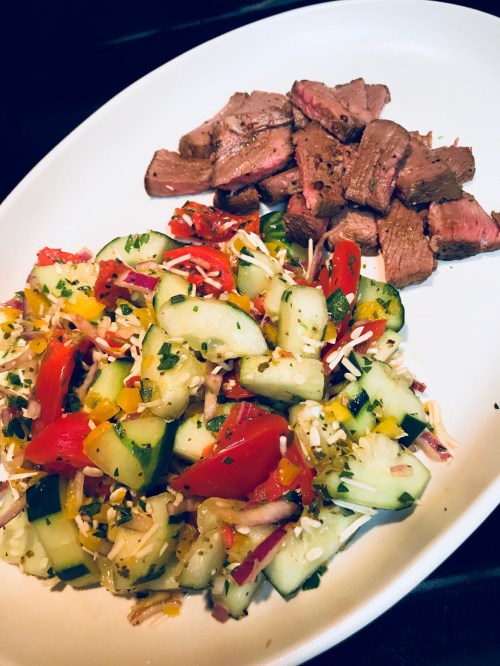
This steak is fully cooked. Doing it sous vide-style leaves it looking rare.

Still going strong. Weight is stable at 161.8 lb (73.5 kg). Two more weeks to go.

Cucumber salad

One Woman’s Experience With the Mediterranean Diet

Click the link below for details and good food photos.

“I never once felt like I was “dieting” on the Mediterranean eating plan. That said, my goal wasn’t weight loss — I was looking for improved energy levels and food that was filling and delicious. The Mediterranean diet accomplished both of those goals for me. I’d like to stick with it for a long time.”

Source: Best diet for body and brain is Mediterranean: Here’s how to do it – Business Insider

Mediterranean Diet Protects Against Macular Degeneration

A view from Humphreys Peak, Arizona

I thought we knew this already. Another reason to love the Mediterranean diet. Macular degeneration is a leading cause of blindness in the developed world. Prevention is much better than treatment.

High adherence to a Mediterranean diet and regular physical activity seem to be protective factors for AMD in a Portuguese population. The effect of the diet is likely driven by the increased consumption of vegetables, fruits, and nuts.

Source: Adherence to a Mediterranean diet and its association with age-related macular degeneration. The Coimbra Eye Study–Report 4 – Nutrition

Hmmm…No mention of heart-healthy whole grains.

Nuttin’ But Salads N=1 Experiment: Week 14 Summary

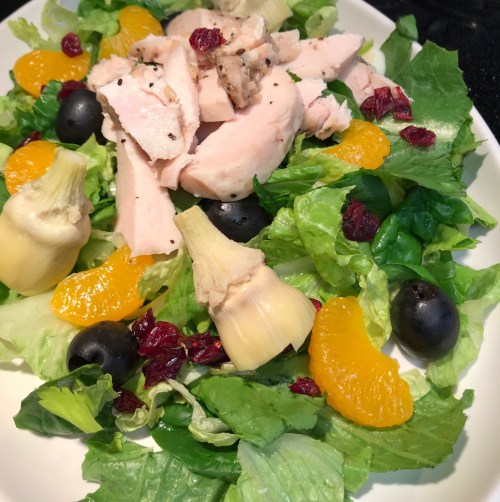
A new salad ingredient for me, front and center: artichoke hearts

Good compliance for me this week. Nevertheless, weight is up to 163.8 lb (74.5 kg) compared to 160.2 lb (72.8 kg) last week. Last weeks weight was unusually low.

I feel good. Workouts are going well. No performance deterioration with this plant-based diet.

June 5 will by my four-month anniversary on this diet. I’ll stop at that point, after 17 weeks. That’s adequate as a proof-of-concept. Haven’t decided how I’ll transition off. Tempted to continue with only two meals daily, one being a large salad, but what of the other? Considering a protein (meat, chicken, fish, eggs) plus cooked vegetables (low-carb or not?) and/or legumes.

Steve Parker, M.D.

One More Reason to Lift Weight: Less Depressive Symptoms

I’m not surprised.

“Resistance exercise training significantly reduced depressive symptoms among adults regardless of health status, total prescribed volume of resistance exercise training, or significant improvements in strength.”

Source: Association of Efficacy of Resistance Exercise Training With Depressive Symptoms: Meta-analysis and Meta-regression Analysis of Randomized Clinical Trials | Depressive Disorders | JAMA Psychiatry | JAMA Network