Tsunami of Diabetes About To Hit California

Almost half of adults in California—46%—have prediabetes, according to researchers at UCLA. The LA Times has the story.

“Our genes and our environment are kind of on a collision course,” said Dr. Francine Kaufman, the former head of the American Diabetes Assn., who was not involved with the research. “It’s not stopping.”

The problem with prediabetes is that it often evolves into full-blown diabetes. It’s also associated with increased risk for cardiovascular disease such as heart attack and stroke. The Times article says “up to 70% of those with prediabetes develop diabetes in their lifetime.” I’d never heard that vague number before; I say vague because “up to 70%” could be anything between zero and 70. It’s more accurate to note that one in four people with prediabetes develops type 2 diabetes over the course of three to five years.

Prediabetes is defined as:

  1. fasting blood sugar between 100 and 125 mg/dl (5.56–6.94 mmol/l), or
  2. blood sugar level 140–199 mg/dl (7.78–11.06 mmol/l) two hours after drinking 75 grams of glucose

How To Prevent Progression of Prediabetes Into Diabetes

  • If you’re overweight or obese, lose excess fat weight. How much should you lose? Aim for at least 5% of body weight and see if that cures your prediabetes. For instance, if you weigh 200 lb (91 kg), lose 10 lb (4.5 kg).
  • If you’re sedentary, start exercising regularly.
  • Cut back on your consumption of sugar-sweetened beverages, other sugar sources, and other refined carbohydrates like wheat flour.

Steve Parker, M.D.


Ludwig Versus Guyenet: Why Are We Fat?

Neither Ludwig nor Guyenet

Neither Ludwig nor Guyenet

Dr. David Ludwig and Dr. Stephan Guyenet recently debated why we get fat. Ludwig favors the Carbohydrate-Insulin-Obesity Theory. Guyenet thinks leptin plays a central role although it’s by no means the only piece of the puzzle. It’s a gross oversimplification, but let’s just call it the Leptin Theory.

Guyenet published a critique of Ludwig’s proposition, then Ludwig released a response. This would be a good time to click and read the Ludwig response link unless you’re already bored.

Guyenet’s explanation of overweight and obesity “acknowledges the fact that body weight is regulated, but the regulation happens in the brain, in response to signals from the body that indicate its energy status. Chief among these signals is the hormone leptin, but many others play a role (insulin, ghrelin, glucagon, CCK, GLP-1, glucose, amino acids, etc.).”

Rather than paraphrase Guyenet’s response to Ludwig’s response, I’m just going to quote the most pertinent parts:

Here is a simplified schematic overview of how the system works, from a 2012 review paper I wrote with my scientific mentor Mike Schwartz, titled “Regulation of food intake, energy balance, and body fat mass” (1). This figure summarizes more than a century of research in our field:

https://advancedmediterranean.com/wp-content/uploads/2016/03/93210-fig2b2.jpg

(graphic from Dr. Guyenet’s blog)

Here’s the gist of it: there are negative feedback loops between the brain and fat tissue, and between the brain and the gut. These are what regulate body fatness and appetite. The primary known feedback signal that regulates body fatness is leptin– a fact that has remained scientifically unchallenged since shortly after its identification in 1994. Insulin plays a role as well, acting directly on the brain in a manner similar to leptin, although much less powerfully. As you can see, this model doesn’t resemble the CICO model– or the insulin model.

Regulation happens principally as a result of the brain changing the number of calories entering and leaving the body (in humans, mostly entering)– so the much-maligned calorie maintains a central role in the process. Even though calories aren’t the first link in the causal chain, they are nevertheless a critical link.

Most people in my field also believe that calorie intake is determined both by hunger (homeostatic eating), and factors other than hunger (non-homeostatic eating). I agree with them.

Why does it matter which of the theories, or some other hypothesis, is correct? Well, if we want to cure or reverse the overweight and obesity epidemic, it might be helpful if we know the cause. Then we address the cause directly. For example, if I have a patient with fever, my treatment plan depends on whether the fever is caused by cancer, an overactive thyroid, adverse drug effect, environmental heat exposure, a broken thermometer, or infection.

Steve Parker, M.D.

Steve Parker MD, Advanced Mediterranean Diet

Two diet books in one

QOTD: Kipling On God and Soldiers

In times of war and not before,
God and the soldier we adore.
But in times of peace and all things righted,
God is forgotten and the soldier slighted.

—Rudyard Kipling

Seafood Consumption May Protect Against Alzheimers Dementia

…according to an article at the Journal of the American Medical Association. The study involved Chicago-area residents who had provided information about their eating habits. After death, their brains were biopsied, looking for typical pathological findings of Alzheimers Disease.

fresh salmon and lobsters

Rich sources of omega-3 fatty acids include salmon, sardines, herring, trout, and mackerel

Participants who ate seafood at least once a week had fewer Alzheimers lesions in their brains, but only if they were carriers of a particular gene the predisposes to Alzheimers. The gene is called apolipoprotein E or APOE ε4.

You’ve heard that seafood may be contaminated with mercury, right? The seafood eaters in this study indeed had higher brain levels of mercury, but it didn’t cause any visible brain damage.

The Mediterranean diet, relatively rich in seafood, has long been linked to a lower risk of dementia.

A weakness of the study is that the researchers didn’t report results of clinical testing for dementia in these participants before they died. You can have microscopic evidence of Alzheimers disease on a biopsy, yet no clinically diagnosis of dementia.

Steve Parker, M.D.

Steve Parker MD, Advanced Mediterranean Diet

Two diet books in one

Alcohol Consumption May Protect Against Type 2 Diabetes

…according to an article in the American Journal of Clinical Nutrition. A review of the scientific literature looked at various populations at baseline, noting alcohol consumption,  then determined who developed type 2 diabetes over subsequent years. Folks with light to moderate alcohol consumption were 20% less likely to develop diabetes.

Beautiful woman smiling as she is wine tasting on a summer day.

Wine is one of the potentially healthy components of the Mediterranean diet

This doesn’t prove that alcohol prevents diabetes. Alcohol intake may instead just be a marker for other factors that do prevent diabetes. For instance, maybe drinkers are genetically less susceptible to diabetes, or they exercise more.

Steve Parker, M.D.

Dr. Eades: Why We Got Fat

Dr. Michael Eades of Protein Power fame thinks he knows why we’ve gotten fat starting 35 years ago (at least in the U.S.:

Along with carbohydrates, vegetable oils have increased dramatically in the typical American diet. Over the same time period, we’ve all started eating away from home more and more, so that we’ve lost control of exactly what kinds of fats we’ve been eating.

Click the link for the details of his hypothesis, which involves the effects of various dietary fats and carbohydrates on intracellular energy metabolism and insulin resistance.

Steve Parker, M.D.

Steve Parker MD, Advanced Mediterranean Diet

Two diet books in one

What the Heck Is a Turkish Get-Up?

I’m going to start doing Turkish get-ups again. I fell out of the habit a couple years ago. Turkish get-ups promote flexibility, balance, joint range of motion, and strength. If you’re just doing the Big Five exercises, TGUs will strengthen some of the smaller muscles (and portions of major muscles) you may be neglecting.

Below are a couple YouTube examples. They are not complete tutorials. You can use a dumbbell or kettlebell. Start with either no weight in your hand, or just a small one. Then work up to higher weights as you get stronger.

These videos may only show how to work one side of the body; you work both sides, of course, and call it a pair. I used to do only five pairs with a 25-lb dumbbell. In weightlifting lingo, you’d call that 1 set of five reps (repetitions). It was exhausting.

Do enough reps and it will be both strength and aerobic training.

Steve Parker, M.D.


QOTD: Exercise or Die?

What fits your busy schedule better, exercising 30 minutes a day or being dead 24 hours a day?

—Randy Glasbergen in a 2008 cartoon

Is Insulin the Reason You’re Always Hungry?

So easy to over-eat!

So easy to over-eat! Is it the insulin release?

No, insulin probably isn’t the cause of constant hunger, according to Dr. Stephan Guyenet. Dr. G gives 11 points of evidence in support of his conclusion. Read them for yourself. Here are a few:

  • multiple brain-based mechanisms (including non-insulin hormones and neurotransmitters) probably have more influence on hunger than do the pure effect of insulin
  • weight loss reduces insulin levels, yet it gets harder to lose excess weight the more you lose
  • at least one clinical study (in 1996) in young healthy people found that foods with higher insulin responses were linked to greater satiety, not greater hunger
  • billions of people around the world eat high-carb diets yet remain thin

An oft-cited explanation for the success of low-carbohydrate diets involves insulin, specifically the lower insulin levels and reduced insulin resistance seen in low-carb dieters. They often report less trouble with hunger than other dieters.

Here’s the theory. When we eat carbohydrates, the pancreas releases insulin into the bloodstream to keep blood sugar levels from rising too high as we digest the carbohydrates. Insulin drives the bloodstream sugar (glucose) into cells to be used as energy or stored as fat or glycogen. High doses of refined sugars and starches over-stimulate the production of insulin, so blood sugar falls too much, over-shootinging the mark, leading to hypoglycemia, an undeniably strong appetite stimulant. So you go back for more carbohydrate to relieve the hunger induced by low blood sugar. That leads to overeating and weight gain.

Read Dr. Guyenet’s post for reasons why he thinks this explanation of constant or recurring bothersome hunger is wrong or too simplistic. I tend to agree with him on this.

The insulin-hypoglycemia-hunger theory may indeed be at play in a few folks. Twenty ears ago, it was popular to call this “reactive hypoglycemia.” For unclear reasons, I don’t see it that often now. It was always hard to document that hypoglycemia unless it appeared on a glucose tolerance test.

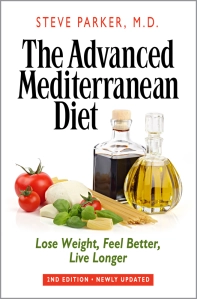
Regardless of the underlying explanation, low-carb diets undoubtedly are very effective in many folks. That’s why I offer one as an option in my Advanced Mediterranean Diet. And low-carbing is what I always recommend to my patients with carbohydrate intolerance: diabetics and prediabetics.

Steve Parker, M.D.

front cover

front cover

Steve Parker MD, Advanced Mediterranean Diet

Two diet books in one

front cover

front cover

YOU Are the First Responder

Not the police, firemen, or EMTs. They are second responders.

So as the Boy Scouts say, “Be prepared.”

Learn first aid and cardiopulmonary resuscitation. Keep first aid supplies in your home and vehicle. Have at least one fire extinguisher in your home. If you’ll be out in extremes of weather, know how to survive, whether or not something goes wrong. Learn how to protect yourself when confronted by a violent criminal. When seconds count, the police are only minutes away.

Etc.

Steve Parker, M.D.

Steve Parker MD, Advanced Mediterranean Diet

Two diet books in one