Reduced Heart Failure Incidence Linked to Higher Blood levels of Omega-3 Fatty Acids

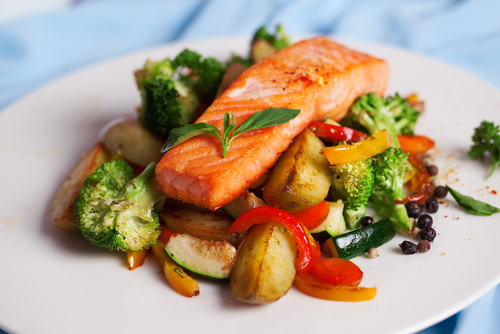
Salmon, a cold-water fatty fish, is a rich source of omega-3 fatty acids


Higher blood levels of omega-3 fatty acid are associated with reduce risk of heart failure. How do you get higher levels os blood omega-3 fatty acids? One way is to eat cold-water fatty fish.

Here’s an abstract from JACC: Heart Failure:

Objectives

The aim of this study was to determine if plasma eicosapentaenoic acid (EPA) abundance (%EPA) is associated with reduced hazard for primary heart failure (HF) events in the MESA (Multi-Ethnic Study of Atherosclerosis) trial.

Background

Clinical trials suggest that omega-3 polyunsaturated fatty acids (ω3 PUFAs) prevent sudden death in coronary heart disease and HF, but this is controversial. In mice, the authors demonstrated that the ω3 PUFA EPA prevents contractile dysfunction and fibrosis in an HF model, but whether this extends to humans is unclear.

Methods

In the MESA cohort, the authors tested if plasma phospholipid EPA predicts primary HF incidence, including HF with reduced ejection fraction (EF) (EF <45%) and HF with preserved EF (EF ≥45%) using Cox proportional hazards modeling.

Results

A total of 6,562 participants 45 to 84 years of age had EPA measured at baseline (1,794 black, 794 Chinese, 1,442 Hispanic, and 2,532 white; 52% women). Over a median follow-up period of 13.0 years, 292 HF events occurred: 128 HF with reduced EF, 110 HF with preserved EF, and 54 with unknown EF status. %EPA in HF-free participants was 0.76% (0.75% to 0.77%) but was lower in participants with HF at 0.69% (0.64% to 0.74%) (p = 0.005). Log %EPA was associated with lower HF incidence (hazard ratio: 0.73 [95% confidence interval: 0.60 to 0.91] per log-unit difference in %EPA; p = 0.001). Adjusting for age, sex, race, body mass index, smoking, diabetes mellitus, blood pressure, lipids and lipid-lowering drugs, albuminuria, and the lead fatty acid for each cluster did not change this relationship. Sensitivity analyses showed no dependence on HF type.

Conclusions

Higher plasma EPA was significantly associated with reduced risk for HF, with both reduced and preserved EF. (Multi-Ethnic Study of Atherosclerosis [MESA]; NCT00005487)

Source: Predicting Risk for Incident Heart Failure With Omega-3 Fatty Acids | JACC: Heart Failure

Most of my recommended diets include twice weekly servings of cold-water fatty fish.

Steve Parker, M.D.
Steve Parker MD, Advanced Mediterranean Diet

Click the pic to purchase at Amazon.com

Dr Harriet Hall Isn’t a Green Tea Advocate

Most of the green teas I’ve tried aren’t green colored

From her letter to the editor at American Family Physician:

A rigorously scientific analysis of all the green tea research can be best interpreted as telling us there is no good evidence to support its use for conditions such as cancer, weight loss, or cardiovascular disease. The Natural Medicines Comprehensive Database, a resource for evidence-based, clinical information on natural medicines, rates green tea as only “possibly effective.” This rating is below their ratings of “effective” and “probably effective.”3 It raises a number of concerns about safety and interactions with other drugs, laboratory tests, and diseases. Additional concerns are that the dosage from brewed tea is variable, and commercial green tea extracts are classified as “diet supplements” under the Diet Supplement Health and Education Act and are not regulated for safety, purity, and content. Contamination and inconsistency of such products is common. In my opinion, we should not recommend green tea to our patients unless more convincing evidence is found.

Source: More Evidence of Green Tea’s Effectiveness Is Needed – Letters to the Editor – American Family Physician

Steve Parker MD, Advanced Mediterranean Diet

Click the pic to purchase at Amazon.com

Are Proton Pump Inhibitors Safe?

Previous studies suggest proton pump inhibitors, which dramatically reduce stomach acid, have many adverse effects. A recent report in the journal Gastroenterology indicate otherwise:

In a large placebo-controlled randomized trial, we found that pantoprazole is not associated with any adverse event when used for 3 years, with the possible exception of an increased risk of enteric [intestinal] infections.

Source: Safety of Proton Pump Inhibitors Based on a Large, Multi-year, Randomized Trial of Patients Receiving Rivaroxaban or Aspirin. – PubMed – NCBI

I still suspect there are good reasons our stomachs produce lots of acid, like killing bacteria in our food and water.

Steve Parker, M.D.

PS: I wonder who funded this study. PPI manufacturers?

Steve Parker MD, Advanced Mediterranean Diet

Click the pic to purchase at Amazon.com

 

Older Women Don’t Need the Proverbial 10,000 Steps a Day for Longevity

Overton trail near Scottsdale, AZ

Among older women [average age 72], as few as approximately 4400 steps/d was significantly related to lower mortality rates compared with approximately 2700 steps/d. With more steps per day, mortality rates progressively decreased before leveling at approximately 7500 steps/d. Stepping intensity was not clearly related to lower mortality rates after accounting for total steps per day.

Source: Association of Step Volume and Intensity With All-Cause Mortality in Older Women | Geriatrics | JAMA Internal Medicine | JAMA Network

10,000 steps is about five miles, depending on stride length. 6,000 steps would be about three miles. Walking at two miles per hour, a leisurely stroll, it would take 90 minutes to walk three miles.

Steve Parker, M.D.

Steve Parker MD, Advanced Mediterranean Diet

Click the pic to purchase at Amazon.com

Vegetarians Less Healthy Than Omnivores

From Independent:

Vegetarians are less healthy than meat-eaters, a controversial study has concluded, despite drinking less, smoking less and being more physically active than their carnivorous counterparts.

A study conducted by the Medical University of Graz in Austria found that the vegetarian diet, as characterised by a low consumption of saturated fat and cholesterol, due to a higher intake of fruits, vegetables and whole-grain products, appeared to carry elevated risks of cancer, allergies and mental health problems such as depression and anxiety.

While not mentioned in the Independent article, the full PLOS One report defined “vegetarian”:

While 0.2% of the interviewees were pure vegetarians (57.7% female) [vegan, then?], 0.8% reported to be vegetarians consuming milk and eggs (77.3% female), and 1.2% to be vegetarians consuming fish and/ or eggs and milk (76.7% female).

I haven’t read the whole thing, but if you’re a vegetarian, you should digest it. Note the study was done in Austria. And if vegetarians are so unhealthy, why do Seventh Day Adventists in Loma Linda, CA, seem to have a longevity benefit. Do ya think maybe there’s more involved than diet, like culture or genetics?

Steve Parker, M.D.

Steve Parker MD, Advanced Mediterranean Diet

Click the pic to purchase at Amazon.com

Are Ketogenic Diets Nutritionally Deficient?

From the journal Nutrition:

Objective

A 12-week ketogenic diet was shown to have many beneficial effects in healthy obese adults, but it is not clear if the supply of micronutrients is adequate.

Methods

In 35 adult individuals with BMI above 30, the intakes of minerals and their serum levels were analyzed at baseline and at weeks 4 and 12 of the ketogenic diet intervention. The intake of vitamins and serum antioxidative potential were also investigated.

Results

Throughout the diet the intakes of magnesium, calcium, iron, phosphorus and potassium were below recommended values, but their serum levels always remained within the reference range. Nevertheless, the level of calcium decreased significantly (from 2.52 ± 0.10 mmol/L at baseline to 2.36 ± 0.07 mmol/L at week 12, P < 0.001) which could be due to the omission of legumes and reduced dairy intake or due to the high fat intake alone. The levels of phosphate increased concomitantly. Calcium serum levels were negatively associated with ω-6 but not with ω-3 unsaturated fatty acid intake. The intakes of water-soluble vitamins were also too low. However, the antioxidative potential of serum did not change during intervention.

Conclusion

Careful choice of foods which would provide the necessary micronutrients is of utmost importance when consuming ketogenic diet. In the 12 weeks the decreased intakes did not reflect in serum values, but special attention to calcium should be advised if such diet is recommended through longer periods.

Source: Assessment of micronutrients in a 12-week ketogenic diet in obese adults – ScienceDirect

Steve Parker, M.D.

A ketogenic diet — including a “careful choice of foods which would provide the necessary micronutrients” — is one of two options in The Advanced Mediterranean Diet.

Steve Parker MD, Advanced Mediterranean Diet

Click the pic to purchase at Amazon.com

Wealth Inequality In the U.S.: It’s a Problem

From The Big Picture (emphasis added):

Yes, America is wealthier than ever, especially if you are in the top 10% of households. The Fed [Federal Reserve] found that the top 1% of American households held wealth of $32.5 trillion. That works out to be an average household asset value of about $25 million each. The rest of the top 10% (90th to 99th wealth percentiles) held total wealth of $42.8 trillion. Add the top 1% to this group and we get a total of $75.3 trillion, with an average household wealth of $5.8 million. To be sure, this is an average and is skewed by the enormous wealth of those at the very top; the median, or midpoint, would be lower.

The next 40% (50th to 90th percentiles) has total assets of $35.3 trillion. The 63.8 million households in the top half of America have average household total wealth of $1.72 million apiece. Note this does not include liabilities such as mortgages, student loans, consumer credit, which offsets some of this.

Where things get interesting is when we look at the bottom 50% of households in America by wealth. They own total assets of $6.86 trillion. That reflects wealth (before liabilities) of a mere $107,523 per household.Let’s dig a bit deeper: The top decile of America holds almost about 70% of the national wealth — 31% is held by the top 1%, while the rest of the top 10% holds about 39%.

Source: Wealth Distribution Analysis – The Big Picture

Is Subclinical Hypothyroidism Real and Should It Be Treated?

From JAMA Network:

Subclinical hypothyroidism is common [up to 10% of adults] and most individuals can be observed without treatment. Treatment might be indicated for patients with subclinical hypothyroidism and serum thyrotropin [TSH]  levels of 10 mU/L or higher or for young and middle-aged individuals with subclinical hypothyroidism and symptoms consistent with mild hypothyroidism.

Source: Subclinical Hypothyroidism: A Review | Cardiology | JAMA | JAMA Network

Steve Parker MD, Advanced Mediterranean Diet

Click the pic to purchase at Amazon.com

Low-Carb, High-Fat Diet Improves Metabolic Syndrome Even Without Weight Loss

My monitor works well

“Metabolic syndrome” may be a new term for you. It’s a collection of clinical features that are associated with increased future risk of type 2 diabetes and atherosclerotic complications such as heart attack and stroke. One in six Americans has metabolic syndrome. Diagnosis requires at least three of the following five conditions:

  • high blood pressure (130/85 or higher, or using a high blood pressure medication)
  • low HDL cholesterol:  under 40 mg/dl (1.03 mmol/l) in a man, under 50 mg/dl (1.28 mmol/l) in a women (or either sex taking a cholesterol-lowering drug)
  • triglycerides over 150 mg/dl (1.70 mmol/l) (or taking a cholesterol-lowering drug)
  • abdominal fat:  waist circumference 40 inches (102 cm) or greater in a man, 35 inches (89 cm) or greater in a woman
  • fasting blood glucose over 100 mg/dl (5.55 mmol/l)

One approach to improving the numbers is a LCHF diet. Here’s a journal article abstract from JCI Insight:

BACKGROUND. Metabolic syndrome (MetS) is highly correlated with obesity and cardiovascular risk, but the importance of dietary carbohydrate independent of weight loss in MetS treatment remains controversial. Here, we test the theory that dietary carbohydrate intolerance (i.e., the inability to process carbohydrate in a healthy manner) rather than obesity per se is a fundamental feature of MetS.

METHODS. Individuals who were obese with a diagnosis of MetS were fed three 4-week weight-maintenance diets that were low, moderate, and high in carbohydrate. Protein was constant and fat was exchanged isocalorically for carbohydrate across all diets.

RESULTS. Despite maintaining body mass, low-carbohydrate (LC) intake enhanced fat oxidation and was more effective in reversing MetS, especially high triglycerides, low HDL-C, and the small LDL subclass phenotype. Carbohydrate restriction also improved abnormal fatty acid composition, an emerging MetS feature. Despite containing 2.5 times more saturated fat than the high-carbohydrate diet, an LC diet decreased plasma total saturated fat and palmitoleate and increased arachidonate.

CONCLUSION. Consistent with the perspective that MetS is a pathologic state that manifests as dietary carbohydrate intolerance, these results show that compared with eucaloric high-carbohydrate intake, LC/high-fat diets benefit MetS independent of whole-body or fat mass.

TRIAL REGISTRATION. ClinicalTrials.gov Identifier: NCT02918422.

FUNDING. Dairy Management Inc. and the Dutch Dairy Association.

Source: JCI Insight – Dietary carbohydrate restriction improves metabolic syndrome independent of weight loss

Steve Parker, M.D.

Steve Parker MD, Advanced Mediterranean Diet

Click the pic to purchase at Amazon.com

Problematic Liver Fat? Low-Carb Mediterranean Diet Works Better Than Low-Fat Diet

From an article at International Business Times:

Reducing hepatic [liver] fat or fat around the liver by 30%, along with moderate weight loss is an important part in reducing obesity-related health risks from a long-term perspective, the researchers of the study said. In addition to moderate weight loss, visceral fat or fat stored within the abdominal cavity was reduced by 25% and fat around the heart decreased by 11%. Fat in and around the muscle and pancreas was also reduced by 1 to 2%.

“Reduction in liver fat is a better predictor of long-term health than reduction of visceral fat, which was previously believed to be the main predictor,” Professor Shai explained in a press release. “The findings are a significant contributor to the emerging understanding that for many obese individuals, excess liver fat is not merely a sign of health risks associated with obesity, including cardiovascular disease and diabetes, but is likely also a cause.”

Source: Scientists Reveal Most Effective Diet For Weight Loss, And It’s Not Keto

Click for details of the study.

Steve Parker, M.D.

Steve Parker MD, Advanced Mediterranean Diet

Click the pic to purchase at Amazon.com