Is the Paleo Diet Just a Fad?

Stockholm Palace

The paleo diet—aka Stone Age, caveman, or hunter-gatherer diet—has been growing in popularity since 2009.  Do we have firm evidence that it’s a healthy way of eating?

Swedish investigators at Karolinska Institutet found diminished weight, body mass index, blood pressure, and waist circumference in 14 healthy medical students eating a paleo diet for three weeks.

Published in 2008, this seems to be one of the seminal scientific studies of the paleo diet in modern Europeans.

Their version of the paleo diet:

  • Allowed ad lib: All fresh or frozen fruits, berries and vegetables except legumes, canned tomatoes w/o additives, fresh or frozen unsalted fish and seafood, fresh or frozen unsalted lean meats and minced meat, unsalted nuts (except peanuts – a legume), fresh squeezed lemon or lime juice (as dressing), flaxseed or rapeseed oil (as dressing), coffee and tea (w/o sugar, milk, honey, or cream), all salt-free spices.
  • Allowed but with major restrictions: dried fruit, salted seafood, fat meat, potatoes (two medium-sized per day), honey, cured meats
  • Prohibited: all milk and dairy products, all grain products (including corn and rice), all legumes, canned food except tomatoes, candy, ice cream, soft drinks, juices, syrups, alcohol, sugar, and salt

What Did They Find After Three Weeks?

  • Average weight dropped from 65.2 kg (144 lb) to 62.9 (139 lb)
  • Average body mass index fell from 22.2 to 21.4
  • Average waist circumference decreased from 74.3 cm (29.25″) to 72.6 cm (28.58″)
  • Average systolic blood pressure fell from 110 to 104 mmHg
  • plasminogen activator inhibitor-1 decreased from 5.0 kIE/l to 2.8 kIE/l
  • All of these changes were statistically significant

The researchers looked at a number of other blood tests and didn’t find any significant differences.

Five men and three women completed the study. Of the 20 who originally signed up, one could not fulfill the diet, three became ill (no details), two failed to show up.

So What?

That’s a remarkable weight loss over just three weeks for slender people eating ad lib.

The study authors concluded that these paleo diet-induced changes could reduce risk for cardiovascular disease. They called for a larger study with a control group. (If it’s been done, I haven’t found it yet.)

Sounds reasonable.

It’s too soon to say whether the paleo diet is just a fad.  It will depend somewhat on short- and long-term health effects of paleo-style eating, which may take years to clarify.  On the other hand, it’s hard to imagine large swaths of the population giving up grains, legumes, and dairy products, even if it’s a healthier way of eating.

Steve Parker, M.D.

PS: You’d think they would have said more about the three participants who got sick, rather than leave us wondering if the diet made them ill.

PPS:  I’m considering whether the paleo diet is healthy for people with diabetes.  Follow my progress at PaleoDiabetic.com.

Reference: Österdahl, M; Kocturk, T; Koochek, A; Wändell, PE. Effects of a short-term intervention with a paleolithic diet in healthy volunteers. European Journal of Clinical Nutrition, 62 (2008): 682-685.

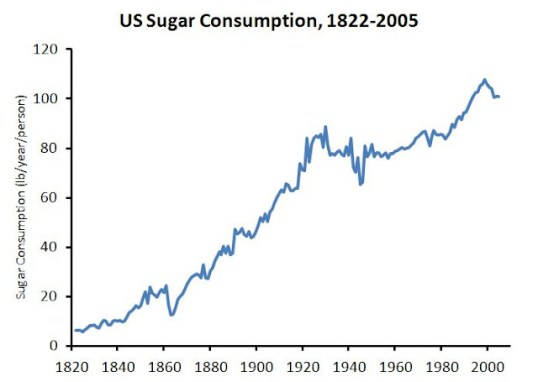
173 Years of U.S. Sugar Consumption

Thanks to Dr. Stephan Guyenet and Jeremy Landen for this sugar consumption graph.  I’d never seen one going this far back in time. 

 Dr. Guyenet writes:
It’s a remarkably straight line, increasing steadily from 6.3 pounds per person per year in 1822 to a maximum of 107.7 lb/person/year in 1999.  Wrap your brain around this: in 1822, we ate the amount of added sugar in one 12 ounce can of soda every five days, while today we eat that much sugar every seven hours.
The U.S. Department of Agriculture estimates that added sugars provide 17% of the total calories in the average American diet.  A typical carbonated soda contain the equivalent of 10 tsp (50 ml) of sugar.  The average U.S. adult eats 30 tsp  (150 ml) daily of added sweeteners and sugars.
 
Note that added sugars overwhelmingly supply only one nutrient: pure carbohdyrate without vitamins, minerals, protein, fat, antioxidants, etc.
 
Do you think sugar consumption has anything to do with diseases of affluence, also known as diseases of modern civilization?  I do.
 
Was our pancreas designed to handle this much sugar?  Apparently not, judging from skyrocketing rates of diabetes and prediabetes.
 

Actor Alec Baldwin Eliminates Sugar, Loses 30 Pounds

Mother Nature Network last January reported Alec Baldwin’s successful weight loss effort.  An excerpt:

“I gave up sugar,” he told Access Hollywood. “I lost 30 pounds in four months. It’s amazing.”
“(I do) Pilates, spin, not as much yoga as I’d like,” he added. “When we’re shooting (’30 Rock’) it’s tough…When we’re shooting and I can’t work out, I just have to eat less. So, I’m very conscious of that. But sugar was the real killer for me — that was the problem.”


Is Organic Food Worth It?

The American Council on Science and Health in 2008 published a skeptical article on organic food benefits.  If you have updated references, feel free to note them in the comments section below.

I’m neither endorsing nor repudiating the ACSH’s positions, but they are certainly worth serious consideration.

Steve Parker, M.D.

Random Thoughts On Paleo Eating for People With Diabetes

Not really pertinent, but I like buffalo

I was interviewed recently by Amy Stockwell Mercer, author of Smart Woman’s Guide to Diabetes. All I knew beforehand was that she was interested in my thoughts on the paleo diet as applied to diabetes.

In preparation, I collected some random thoughts and did a little research.

What’s the paleo diet?

Fresh, minimally processed food. Meat (lean or not? supermarket vs yuppiefied?), poultry, eggs, fish, leafy greens and other vegetables, nuts, berries, fruit, and probably tubers.

Non-paleo: highly processed, grains, refined sugars, industrial plant/seed oils, legumes, milk, cheese, yogurt.

Is the paleo diet deficient in any nutrients?

A quick scan of Loren Cordain’s website found mention of possible calcium and vitamin D deficits. Paleoistas will get vitamin D via sun exposure and fish (especially cold-water fatty fish). Obtain calcium from broccoli, kale, sardines, almonds, collards. (I wonder if the Recommended Dietary Allowance for calcium is set too high.)

What About Carbohydrates and Diabetes and the Paleo Diet?

Diabetes is a disorder of carbohydrate metabolism. In a way, it’s an intolerance of carbohydrates. In type 1 diabetes, there’s a total or near-total lack of insulin production on an autoimmune basis. In type 2 diabetes, the body’s insulin just isn’t working adequately; insulin production can be high, normal or low. In both cases, ingested carboydrates can’t be processed in a normal healthy way, so they stack up in the bloodstream as high blood sugars. If not addressed adequately, high blood glucose levels sooner or later will poison body tissues . Sooner in type 1, later in type 2. (Yes, this is a gross over-simplification.)

Gluten-rich Neolithic food

If you’re intolerant of lactose or gluten, you avoid those. If you’re intolerant of carbohydrates, you could avoid eating them, or take drugs to help you overcome your intolerance. Type 1 diabetics must take insulin. Insulin’s more optional for type 2’s. We have 11 classes of drugs to treat type 2 diabetes; we don’t know the potential adverse effects of most of these drugs. Already, three diabetes drugs have been taken off the U.S. market or severely restricted due to unacceptable toxicity: phenformin, troglitazone, and rosiglitazone.

Humans need two “essential fatty acids” and nine “essential” amino acids derived from proteins. “Essential” means we can’t be healthy and live long without them. Our bodies can’t synthesize them. On the other hand, there are no essential carbohydrates. Our bodies can make all the carbohydrate (mainly glucose) we need.

Since there are no essential carbohydrates, and we know little about the long-term adverse side effects of many of the diabetes drugs, I favor carbohydrate restriction for people with carboydrate intolerance. (To be clear, insulin is safe, indeed life-saving, for those with type 1 diabetes.)

That being said, let’s think about the Standard American Diet (SAD) eaten by an adult. It provides an average of 2673 calories a day. Added sugars provide 459 of those calories, or 17% o the total. Grains provide 625 calories, or 23% of the total. And most of those sugars and grains are in processed, commercial foods. So added sugars and grains provide 40% of the total calories in the SAD. (Figures are from an April 5, 2011, infographic at Civil Eats.)

Anyone going from the SAD to pure Paleo eating will be drastically reducing intake of added sugars and grains, our current major sources of carbohydrate. Question is, what will they replace those calories with?

That’s why I gave a thumbnail sketch of the paleo diet above. Take a gander and you’ll see lots of low-carb and no-carb options, along with some carb options. For folks with carbohydrate intolerance, I’d favor lower-carb veggies and judicious amounts of fruits, berries, and higher-carb veggies and

Will these cause bladder cancer? Pancreatitis?

tubers. “Judicious” depends on the individual, considering factors such as degree of residual insulin production, insulin sensitivity, the need to lose excess weight, and desire to avoid diabetes drugs.

Compared to the standard “diabetic diet” (what’s that?) and the Standard American Diet, switching to paleo should lower the glycemic index and glycemic load of the diet. Theoreticlly, that should help with blood sugar control.

A well-designed low-carb paleo diet would likely have at least twice as much fiber as the typical American diet, which would also tend to limit high blood sugar excursions.

In general, I favor a carbohydrate-restricted paleo diet for those with diabetes who have already decided to “go paleo.” I’m not endorsing any paleo diet for anyone with diabetes at this point—I’m still doing my research. But if you’re going to do it, I’d keep it lower-carb. It has a lot of potential.

Are There Any Immediate Dangers for a Person With Diabetes Switching to the Paleo Diet?

It depends on three things: 1) current diet, and 2) current drug therapy, and 3) the particular version of paleo diet followed.

Remember, the Standard American Diet provides 40% of total calories as added sugars and grains (nearly all highly refined). Switching from SAD to a low-carb paleo diet will cut carb intake and glycemic load substantially, raising the risk of hypoglycemia if the person is taking certain drugs.

Drugs with potential to cause hypoglycemia include insulin, sulfonylureas, meglitinides, pramlintide, and perhaps thiazolidinediones.

Who knows about carb content of the standard “diabetic diet”? Contrary to poplular belief, there is no monolithic “diabetic diet.” There is no ADA diet (American Diabetes Association). My impression, however, is that the ADA favors relatively high carbohydrate consumption, perhaps 45-60% of total calories. Switching to low-carb paleo could definitely cause hypoglycemia in those taking the aforementioned drugs.

One way to avoid diet-induced hypoglycemia is to reduce the diabetic dug dose.

A type 2 overweight diabetic eating a Standard American Diet—and I know there are many out there—would tend to see lower glucose levels by switching to probably any of the popular paleo diets. Be ready for hypoglycemia if you take those drugs.

Paleo diets are not necessarily low-carb. Konner and Eaton estimate that ancestral hunter-gatherers obtained 35 to 40% of total calories from carbohydrates. I’ve seen other estimates as low as 22%. Reality likely falls between 22 and 65%. When pressed for a brief answer as to how many carbohydrate calories are in the paleo diet, I say “about a third of the total.” By comparison, the typical U.S. diet provides 50% of calories from carbohydrate.

Someone could end up with a high-carb paleo diet easily, by emphasizing tubers (e.g., potatoes), higher-carb vegetables, fruits, berries, and nuts (especially cashews). Compared with the SAD, this could cause higher or lower blood sugars, or no net change.

A diabetic on a Bernstein-style diet or Ketogenic Mediterranean Diet (both very-low-carb) but switching to paleo or low-carb paleo (50-150 g?) would see elevated blood sugars. Perhaps very high glucoses.

Any person with diabetes making a change in diet should do it in consultation with a personal physician or other qualified healthcare professional familiar with their case.

Steve Parker, M.D.

Fun Facts!

  • A typical carbonated soda contain the equivalent of 10 tsp (50 ml) of sugar.
  • The typical U.S. adult eats 30 tsp (150 ml) daily of added sweeteners and sugars.
  • U.S total grain product consumption was at record lows in the 1970s, at 138 pounds per person. By 2000, grain consumption was up by 45%, to 200 pounds per person.
  • Total caloric sweetener consumption (by dry weight) was 110 pounds per person in the 1950s. By 2000, it was up 39% to 150 pounds.
  • Between 1970 and 2003, consumption of added fats and oils rose by 63%, from 53 to 85 pounds. (How tasty would that be without starches and sugars? Not very.)
  • In 2008, “added fat” calories in the U.S. adult diet were 641 (24% of total calories).

Fun Facts provided by the U.S. Department of Agriculture.

(The paleo diet is also referred to as the Paleolithic, Old Stone Age, Stone Age, Ancestral, Hunter-Gatherer, or Caveman diet.)

Baseline Measurements Before Starting a Fitness Progam

Impressive jump!

Before beginning or modifying a fitness program, it’s important to take some baseline physical measurements.  Re-measure periodically.  That way you’ll know whether you’re making progress, holding steady, or regressing.  Seeing improvement in the numbers also helps to maintain motivation.   

Not taking measurements would be like starting a weight loss plan without a baseline and subsequent weights.

Around this time last year, I finished a home-based, 15-week, six-days-a-week fitness program called Core Performance, designed by Mark Verstegen.  I was pleased with the results.  The only problem is that it’s very time-consuming.  Perhaps fitness just has to be that way.

I regret that I didn’t take any fitness measurements before and after starting Core Performance.

For much of the last year, I modified Core Performance to a thrice weekly, then twice weekly program, until a couple months ago when I pretty much abandoned it.  I miss the benefits now, but just didn’t want to put in the time to achieve them.  In other words, I lost my motivation.

Who needs this much flexibility?

Intellectually, I know that regular exercise is important.  I’m starting to get motivated again.  Not sure why.  Perhaps because I’ve read that you can be fairly fit with as little as 30 minutes of exercise a week.  I’m not convinced yet.  I’ll be test-driving some of these time-efficient programs soon.

This new style of fitness is promoted by the likes of Dr. Doug McGuff, Chris Highcock, Skyler Tanner, Nasim Taleb,  and Jonathan Bailor, among others.

What to Measure

  1. Weight
  2. Blood pressure
  3. Resting heart rate (first thing in the AM before getting out of bed)
  4. Waist circumference (upright and supine)
  5. Height
  6. Body mass index
  7. Mid-arm circumference, both arms, hanging relaxed at your sides
  8. Maximal calf circumference, both calves, while standing at ease
  9. Maximum number of consecutive pull-ups
  10. Maximum number of consecutive push-ups
  11. Maximum number of consecutive sit-ups
  12. Run/walk one mile as fast as you can
  13. Maximum vertical jump (stand by a tall wall then jump and reach up as high as you can with one arm, noting the highest point above ground your fingers can reach)
  14. Can you touch your toes?  Stand up straight, locking knees in extension, then bend over at your waist and touch your toes with your fingertips.  If you can touch toes, can you flatten your palms against the floor?  If you can’t reach your toes, measure the distance from your fingertips to the floor.
  15. Optional blood work for special situations: fasting blood sugar, hemoglobin A1c, triglycerides, cholesterols (total, HDL, LDL, sub-fractions)

The particular aspects of fitness these measure are strength and endurance in major muscle groups, cardiovascular and pulmonary endurance, a little flexibility, and a hint of body composition. 

You may appreciate an assistant to help you measure some of these.

Record your numbers.  Re-test some or all of these periodically.  If you’re in fairly poor condition at the outset, you’ll see some improved numbers after a couple or three weeks of a good exercise program.  It takes months to build significant muscle mass; you’ll see improved strength and endurance before mass. 

Am I missing anything?

Steve Parker, M.D. 

Update April 4, 2012:  I added the sit-ups today after finding out that’s one of the measurements the U.S. Army monitors in soldiers twice yearly.

Does Olive Oil Protect Against Stroke?

Older adults with high olive oil consumption have a lower risk of stroke, according to French investigators.

Caprese salad: mozzarella cheese, tomatoes, basil, extra virgin olive oil

The Mediterranean diet, rich in olive oil, has long been linked to lower rates of stroke.  The French researchers wondered if that might be attibutable to higher olive oil consumption.  Triglyceride esters of oleic acid comprise the majority of olive oil, and oleic acid blood levels reflect olive oil consumption.

Have you heard of monounsaturated fatty acids?  Oleic acid is one.

Methodology

Over 7,000 older adults without history of stroke were surveyed with regards to olive oil consumption.  Oleic acid plasma levels were measured in over a thousand of the study participants.  Over the course of five years, 175 strokes occurred.

Compared with those who never used olive oil, those with the highest consumption had a 41% lower risk of stroke.  The researchers made adjustments for other dietary variables, age, physical activity, and body mass index.

In looking at the plasma oleic acid levels, those in the highest third of levels had 73% lower risk of stroke compared to those in the lowest third.

Comments

Results suggest that the olive oil in the Mediterranean diet  may help explain the diet’s protection against stroke.  They also support my inclusion of olive oil in the Low-Carb Mediterranean Diet and Advanced Mediterranean Diet.

Steve Parker, M.D.

Reference:  Samieri, C. et al.  Olive oil consumption, plasma oleic acid, and stroke incidence: the Three-City StudyNeurology, Published online before print June 15, 2011, doi: 10.1212/WNL.0b013e318220abeb

KMD Now Available in Book Form

A number of my patients and blog readers have asked for a more comprehensive presentation of the Ketogenic Mediterranean Diet, a free abbreviated version of which is at my Diabetic Mediterranean Diet blog. The KMD, as you may be aware, is the cornerstone of the Low-Carb Mediterranean Diet. Both of them are in The Advanced Mediterranean Diet (2nd Edition) and Conquer Diabetes and Prediabetes: The Low-Carb Mediterranean Diet.

Odd cover, huh?

The new book is geared for folks who don’t have diabetes, but want to lose weight with a very-low-carb diet. It’s called KMD: Ketogenic Mediterranean Diet. Readers of Conquer Diabetes and Prediabetes  and Advanced Mediterranean Diet (2nd Edition) will get nothing out of the new book: they’ve seen it all before. Here’s the book description from Amazon.com:

Dr. Steve Parker presents the world’s first low-carbohydrate Mediterraneandiet.  Nutrition experts for years have recommended the healthy Mediterranean diet.  It’s linked to longer life span and reduced rates of heart attack, stroke, cancer, diabetes, and dementia.  Dr. Parker (M.D.) has modified the Mediterranean diet to help you lose excess weight while retaining most of the healthy foods in the traditional Mediterranean diet.  What’s the secret?  Cut back on the fattening carbohydrates such as concentrated sugars and refined starches.

You’ll discover how to manage your weight without exercise, without hunger, without restricting calories, while eating fish, meat, chicken, vegetables, fruits, wine, olive oil, nuts, and cheese.

The book includes advice on how to avoid weight regain, instruction on exercise, a week of meal plans, special recipes, a general index, a recipe index, and scientific references.  All measurements are given in both U.S. customary and metric units.  Are you finally ready to lose weight while eating abundantly and without counting calories?

♦ ♦ ♦

KMD: Ketogenic Mediterranean Diet is available for purchase at Amazon.com (Kindle edition here, also) or Barnes and Noble (Nook version here). The ebook version is available in multiple formats at Smashwords.

Steve Parker, M.D.

Do We Need Supplements Because Our Soils Are Now So Depleted?

In my recent review of The Blood Sugar Solution, I noted the numerous supplements recommended by Dr. Mark Hyman: between 11 and 16 supplements.  And one of those supplements is a multivitamin/multimineral supplement that has 20 or so different components.

One reason we need the supplements, according to Dr. Hyman, is because the soils in which we grow food over the years has been depleted of minerals and other basic plant building blocks.

I know one doctor who told his patients the same thing while selling them over-priced supplements straight from his office.

So is there any truth to the “soil depletion” argument for supplements?

 Not much, if any, according to Monica Reinagel.  She reviewed the topic in 2010 at her Nutrition Diva blog: http://nutritiondiva.quickanddirtytips.com/are-fruits-and-vegetables-getting-less-nutritious.aspx.  I trust Monica.  In the same article, you’ll find links to her opinion on whether organic vegetables are healthier and worth the cost.

I’ve not done a comprehensive review of the soil depletion issue myself.   It’s quite a difficult area to research; try it and you’ll see.  The Soil Science Society of America, founded in 1936, sounds like a great place to find the answer.  No such luck.

The U.S. is a huge country with lots of different soil types and usage histories.   Soils in one field may be depleted in certain components whereas the field across the road may be quite rich.  Soils are not static.  Farmers are always making amendments to the soil, either with fertilizers or other additives, or by rotating crops.

Wouldn’t you think farmers, whether small family units or huge corporate enterprises, would do what’s necessary to keep their soils productive? 

Another way to look at soil depletion would be to look at the nutrient content of the plants and animals that depend on soil for life.  The U.S. Department of Agriculture did that in its 2004 publication, “Nutrient Content of the U.S. Food Suppy, 1909-2000.”  This paper includes 10 vitamins and nine minerals.  For the boring details, see   http://www.cnpp.usda.gov/publications/foodsupply/foodsupply1909-2000.pdf.   Some excerpts:

Levels for most vitamins and minerals were higher in 2000 than in 1909.

Levels for vitamin B12 and potassium were lower in 2000 than in 1909, but over the series, met or exceeded current recommendations for a healthy diet….

The authors attibute lower potassium availability to lower consumption of plant foods, especially fresh potatoes.  I’m increasingly interested in the possibilty that low potassium consumption may contribute to heart disease and premature death.  But that’s a topic for another day.

I’m skeptical about claims of widespread soil depletion in the U.S. as a cause of food supply degradation.  Supplement sellers are sure to disagree.  To be sure you’re getting the nutrients you need, eat a wide variety of foods. 

Steve Parker, M.D.

PS: The American Council on Science and Health has a brief article on whether everybody needs a multivitamin/multimineral supplement. 

New research is questioning the benefits of taking supplemental vitamins and minerals, suggesting that, for the general population, such supplements may actually pose more risks than benefits.

Click for the full article: http://www.acsh.org/factsfears/newsid.3067/news_detail.asp

PPS:  Oregon State University’s Linus Pauling Institute published a long article on the multivitamin/multimineral supplement issue.  It seems fairly balanced to me.  The Institute notes the 2006 National Institutes of Health assessment that we have insufficient evidence to recommend either for  or against such supplementation (Annals of Internal Medicine, 145(5), 2006: 364-371).  Nevertheless, the Linus Pauling Institute recommends supplementation as “insurance.”  You know, just in case.

Famous Folks With Diabetes

  • Nearly 27% of American adults age 65 or older have diabetes (overwhelmingly type 2)
  • Half of Americans 65 and older have prediabetes
  • 11% of U.S. adults (nearly 26 million) have diabetes (overwhelmingly type 2)
  • 35% of adults (79 million) have prediabetes, and most of those affected don’t know it

dLife maintains a list of famous, prominent, or noteworthy folks who have or had diabetes.  I mention it here in case you have diabetes and sometimes feel like it’s got you by the throat and is ruining your life. Be inspired.

Steve Parker, M.D.

PS: Who has a list of infamous diabetics?

PPS: Many cases of type 2 diabetes and prediabetes can be prevented (https://advancedmediterranean.com/2012/02/29/type-2-diabetes-can-be-prevented/)

B.B. King is No.3 on Rolling Stone’s list of 100 Best Guitarists of All Time