Book Review: “Stop the Clock: The Optimal Anti-Aging Strategy”

dementia, memory loss, Mediterranean diet, low-carb diet, glycemic index, dementia memory loss

“I wish we could have read PD Mangan’s book thirty years ago!”

I read P.D. Mangan’s 2015 book, Stop the Clock: The Optimal Anti-Aging Strategy. I give it five stars in Amazon’s rating system. High recommended.

♦   ♦   ♦

I approached this book with trepidation. I like PD Mangan even though I’ve never met him. We’ve interacted on Twitter and at our blogs. You can tell from his blogging that he’s very intelligent. I don’t know his educational background but wouldn’t be surprised if he has a doctorate degree. My apprehension about the book is that I was concerned it would be brimming with malarkey and scams. Fortunately, that’s not the case at all.

Twin studies have established that 25% of longevity is genetic. That leaves a lot of lifestyle factors for us to manipulate.

I’m not familiar with the anti-aging scientific literature and don’t expect it will ever be something I’ll spend much time on. But it’s an important topic. I’ll listen to what other smart analysts—like Mr. Mangan—have to say about it.

It’s quite difficult to do rigorous testing of anti-aging strategies on free-living humans. So the best studies we have were done with worms, rodents, and monkeys; the findings may or may not apply to us. For example, long-term calorie restriction—about 30% below expected energy needs—is known to prolong life span in certain worms and rodents, with mixed results in rhesus monkeys. It’s the rare person who would follow such a low-calorie diet for years as an experiment. I doubt I would do it even if proven to give me an extra five years of life. I like to eat.

There are several prominent theories of how and why animals age. The author thinks the major factors are:

  1. oxidative stress
  2. inflammation
  3. a decline in autophagy (perhaps most important)

An effective anti-aging program should address these issues.

In the anti-aging chapter of his book, The South Asian Health Solution, internist Ronesh Sinha says that “Lifestyle practices that reduce excess inflammation in the body will help delay the aging process.” Dr. Sinha is a huge exercise advocate and low-carb diet proponent.

Mr. Mangan makes a convincing argument that a good way to forestall aging is to apply hormetic stress. Hormesis is a phenomenon whereby a beneficial effect (e.g., improved health, stress tolerance, growth, or longevity) results from exposure to low doses of an agent or activity that is otherwise toxic or lethal when given at higher doses.

Needs a bit more hormetic stress

Needs a bit more hormetic stress

In case you’re not familiar with hormesis, here’s a major example. Lack of regular exercise leads is linked to premature death from heart disease and cancer. Starting and maintaining an exercise program leads to greater resistance to injury and disease and longer life span. On the other hand, too much exercise is harmful to health and longevity. We see that in professional athletes and excessive marathon runners. Something about exercise—in the right amount—enhances the body’s intrinsic repair mechanisms. That’s the hormetic effect of exercise; one mechanism is by turning on autophagy.

Autophagy is the body’s natural process for breaking down and removing or recycling worn-out cellular structures. This wearing-out occurs daily and at all ages.

If you’re thinking Mr. Mangan recommends exercise as an anti-aging strategy, you’re exactly right. Especially resistance training and high intensity training. His specific recommendations are perfectly in line with what I tell my patients.

Calorie restriction is another form of hormesis; the body reacts by up-regulating stress defense mechanisms. As a substitute for calorie restriction, the author recommends intermittent fasting. Intermittent fasting increases insulin sensitivity, which leads to enhanced autophagy. Fasting seems perfectly reasonable if you think about it, which very few do. Many of us eat every three or four hours while awake, whether a meal or a snack. If you think about it, that’s not a pattern that would be supported by evolution. In the Paleolithic era, we often must have gone 12–16 hours or even several days without food. Hominins without the resiliency to do that would have died off and not passed their genes down to us.
Steve Parker MD, Advanced Mediterranean DIet

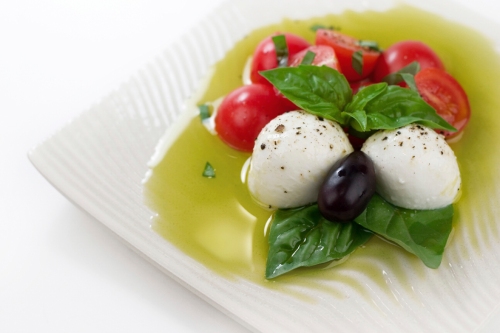
Naturally low-carb Caprese salad: mozzarella cheese, tomatoes, basil, extra virgin olive oil

Another anti-aging trick is a low-carb diet, defined as under 130 grams/day, or under 20% of total calories. It may work via insulin signaling and weight control.

Glutathione within our cells is a tripeptide antioxidant critical for clearing harmful reactive oxygen species (free radicals). We need adequate glutathione to prevent or slow aging. Cysteine is the peptide that tends to limit our body’s production of glutathione. We increase our cysteine supply either through autophagy (which recycles protein peptides) or diet. Dietary sources of cysteine are proteins, especially from animal sources. Whey protein supplements and over-the-counter n-acetyl cysteine are other sources. Fasting is another trick that increases cysteine availability via autophagic recyling.

I don’t recall the author ever mentioning it, but if you hope to maximize longevity, don’t smoke. Even if it has hormetic effects. Maybe that goes without saying in 2015.

When I read a book like this, I always run across tidbits of information that I want to remember. Here are some:

  • those of us in the top third of muscular strength have a 40% lower risk of cancer (NB: you increase your strength through resistance training not aerobics)
  • exercise helps prevent cognitive decline and dementia, at least partially via enhanced autophagy
  • exercise increases brain volume (in preparing to do this review I learned that our brains after age 65 lose 7 cubic centimeters of volume yearly)
  • optimal BMI may be 20 or 21, not the 18.5-25 you’ll see elsewhere (higher BMI due to muscle mass rather than fat should not be a problem)
  • Scientist Cynthia Kenyon: “Sugar is the new tobacco.” (in terms of aging)
  • phytochemicals (from plants, by definition) activate AMPK, a cellular energy sensor that improves stress defense mechanisms and increases metabolic efficiency
  • curcumin (from the spice turmeric) activates AMPK
  • coffee promotes autophagy
  • he does not favor HGH supplementation
  • in the author’s style of intermittent fasting, you’re not reducing overall calorie intake, just bunching your calories together over a shorter time frame (e.g., all 2,500 calories over 6-8 hours instead of spread over 24)
  • mouse studies suggest that intermittent fasting could reduce risk of Alzheimer’s disease and Parkinsons disease
  • consider phytochemical supplements: curcumin, resveratrol, green tea extract
  • calorie-restriction mimetics include resveratrol, curcumin, nicotinamide, EGCG, and hydroxycitrate
  • supplemental resveratrol at 150 mg/day improved memory and cognition in humans

The author provides very specific anti-aging recommendations that could be followed by just about anyone. Read the book for details. Scientists are working feverishly to develop more effective anti-aging techniques. I look forward to a second edition of this book in three to five years.

Steve Parker, M.D.

PS: People with certain medical conditions, such as diabetics taking drugs that can cause hypoglycemia, should not do intermittent fasting without the blessing of their personal physician. If you have any question about your ability to fast safely, check with your doctor.

PPS: If you need to lose weight on a low-carb diet, consider my Advanced Mediterranean Diet or Ketogenic Mediterranean Diet.

Recipe: Bacon Bit Brussels Sprouts

Bacon Bit Brussels Sprouts

Bacon Bit Brussels Sprouts

You can incorporate this meal into the Advanced Mediterranean Diet, Ketogenic Mediterranean Diet, or Low-Carb Mediterranean Diet since I provide the nutritional analysis below.

A while back I posted a meal recipe for Bacon Brussels Sprouts to accompany Brian Burgers. To make it a little more convenient, I’ve substituted off-the-shelf real bacon bits instead of frying my own bacon. I traded olive oil for the bacon grease. The two versions taste very similar.

diabetic diet, paleobetic diet, low-carb diet

It took 10 minutes of chopping to shred the sprouts

Ingredients:

1 lb (454 g) Brussels sprouts, raw, shredded (slice off and discard the bases first)

4 tbsp (60 ml) extra virgin olive oil

5 tbsp (75 ml or 35 g real bacon bits or crumbles (e.g., by Hormel or Oscar Mayer)

2 garlic cloves, minced (optional)

1/8 (0.6 ml) tsp salt

1/4 tsp (1.2 ml) ground black pepper

3 tbsp (45 ml) water

Instructions:

diabetic diet, paleobetic diet, low-carb diet

Steaming in progress

You’ll be steaming this in a pan with a lid. Put the garlic and olive oil in a pan and cook over medium-high heat for a few minutes to release the flavor of the garlic. Add the water to the pan and let it warm up for a half a minute or so on medium-high heat. Then add the shredded sprouts and cover with the lid. After a minute on this medium-high heat, turn it down to medium. The sprouts will have to cook for only 4–6 minutes. Every minute, shake the pan to keep contents from sticking. You might need to remove the lid and stir with a spoon once, but that lets ourtyour steam and may prolong cooking time. The sprouts are soft when done. Then remove from heat, add the bacon bits, salt, and pepper, then mix thoroughly.

When time allows, I’d like to experiment with this by leaving out the bacon and using various spices instead. Do you know what goes well with Brussels sprouts?

Number of Servings: 3 (1 cup or 240 ml each)

Nutritional Analysis per Serving:

Advanced Mediterranean Diet boxes: 2 veggie, 1.5 fat

71% fat

19% carbohydrate

10% protein

270 calories

14 g carbohydrate

6 g fiber

8 g digestible carbohydrate

328 mg sodium

646 mg potassium

Prominent feature: High in vitamin C (over 10o% of your RDA)

diabetic diet, low-carb diet, paleobetic diet

Brian burger and bacon Brussels sprouts

QOTD: David Montgomery on Mass Surveillance

The end-game of mass surveillance is self-imposed subjugation. Threats and cages are no longer required because people believe resistance is hopeless. When we know we’re being monitored by those who have the power to beat, cage, and kill us, we imprison ourselves in our own fear.

—”David Montgomery


Dietary Cholesterol Unrelated to Cardiovascular Disease!

…according to this article at American Journal of Clinical Nutrition.

Heart attack on a plate? Think again

Heart attack on a plate? Think again

This is quite contrary to the  party line spread by public health authorities for the last 40 years.

Enjoy your eggs! (If you can afford them.)

Sugar-Sweetened Beverages May Cause 9% of Type 2 Diabetes Cases in U.S.

…according to a meta-analysis published in the British Medical Journal.

At this point, it’s more accurate to say the two are associated than to say the drinks cause diabetes.

Is This How The Robots Take Over?

Thinking about it...

Exercise your brain

I saw a patient at the hospital a couple years ago who had been brought in by ambulance after suffering some trauma (not to his brain). He couldn’t call any friends or relatives to let them know what was going on because he didn’t have his cellphone. His phone had all his contact numbers so he had no reason to memorize any. Would you be in the same boat?

DailyMail has an interesting article on whether our use of technology is making us dumber. If we turn over mental tasks like navigation and math to computers, do our brains waste away? Is this how the robots take over? Will we be seeing more and earlier cases of age-related dementia? E-mentia?

This is worth keeping an eye on.

Steve Parker, M.D.

PS: The five other members of my household all have cellphones. The only number I’ve memorized is my wife’s.

Yet Another Potential Cause of Type 2 Diabetes: Fructose

Lumps of Diabetes

Cubes of Diabetes?

A Pharm.D (Dr of Pharmacology) and a pair of MD’s surveyed much of the available scientific literature—both animal and human studies—and concluded that fructose is a major culprit in the rise of type 2 diabetes and prediabetes. Fructose does its damage by increasing insulin resistance. ScienceDaily has the details.

Be aware that their conclusion is certainly not universally accepted. I just read “Pathogenesis of type 2 diabetes mellitus” at UpToDate.com and saw no mention of fructose. Under dietary factors, they mainly talked about obesity and how that increases insulin resistance, leading to elevated blood sugars, while the reverse happens with weight loss. I haven’t looked at all the research so I have no definite opinion yet on the fructose-diabetes theory; I’m skeptical.

Fructose is a type of simple sugar. Common dietary sources of fructose are fruits, table sugar (aka sucrose, a 50:50 combination of glucose and fructose molecules), and high-fructose corn syrup (which is usually 42 or 55% fructose).

Damaging effects, if any, of fructose in these fruits may be mitigated by the fiber

Damaging effects, if any, of fructose in these fruits may be mitigated by the fiber

A few quotes from ScienceDaily:

“At current levels, added-sugar consumption, and added-fructose consumption in particular, are fueling a worsening epidemic of type 2 diabetes,” said lead author James J. DiNicolantonio, PharmD, a cardiovascular research scientist at Saint Luke’s Mid America Heart Institute, Kansas City, MO. “Approximately 40% of U.S. adults already have some degree of insulin resistance with projections that nearly the same percentage will eventually develop frank diabetes.”

*   *   *

While fructose is found naturally in some whole foods like fruits and vegetables, consuming these foods poses no problem for human health. Indeed, consuming fruits and vegetables is likely protective against diabetes and broader cardiometabolic dysfunction, explained DiNicolantonio and colleagues. The authors propose that dietary guidelines should be modified to encourage individuals to replace processed foods, laden with added sugars and fructose, with whole foods like fruits and vegetables. “Most existing guidelines fall short of this mark at the potential cost of worsening rates of diabetes and related cardiovascular and other consequences,” they wrote.

If you’re eating a typical Western or American diet, you’ll reduce your fructose consumption by moving to the Mediterranean diet, the Advanced Mediterranean Diet, Low-Carb Mediterranean Diet, or the Paleobetic Diet.

RTWT.

Steve Parker, M.D.

QOTD: Captain John Parker on the American Revolution

Stand your ground. Don’t fire unless fired upon, but if they mean to have a war, let it begin here.

Captain John Parker at Lexington Green, 1775

ATMC: Misfortune or Good Fortune? We’ll See…

Java

Java

ATMC = Advice to my children (a series)

The Parable of the Farmer, His Horse, and His Son 

Hundreds of years ago in a poor Chinese village there lived a wise farmer and his son. The farmer’s only significant possessions were his patch of land, his shack, and a sturdy horse that helped him work the land.

One day the horse ran away into the wilderness. His neighbor said, “I’m so sorry. This is such bad news. You must be so upset.” The farmer just said, “We’ll see.”

A week later the horse returned to its corral, with three wild horses following it back. His neighbor said, “Instead of one horse, now you have four. Congratulations on your good fortune! You must be so happy!” The farmer just said, “We’ll see.”

A month later the farmer’s son decided to break in one of the new horses. But the animal bucked wildly and threw the young man off. The son’s leg broke when he landed. This could cripple him for life.

His neighbor said, “I’m so sorry. What bad luck. You must be so upset.” The farmer just said, “We’ll see.”

A few weeks later, barbarians from the north invaded the province. Every able-bodied young man was drafted to fight. The war was terrible and killed nine out of every 10 warriors, but the farmer’s son was spared since his broken leg prevented him from being drafted. His neighbor said, “Congratulations! What good luck. You must be so happy!”

The farmer just said, “We’ll see.”

*  *  *

The moral of the story is that we don’t really know if an event is “good” or “bad” until passage of some time. Secondarily, it’s a reminder that things always change. So don’t go off the deep end emotionally right away, especially when something doesn’t go your way. It may seem like the end of the world when that cute girl you’ve had a crush on turns down your request for a date, when you make a C or a D in a class instead of an A, when your boyfriend breaks your heart, when you don’t get into vet school, when you get arrested for drunk driving, when you get divorced, or when you lose an eye to cancer. It may seem like the end of the world, but it’s not. Wait.

The parable above is from the East; it’s claimed by both Taoists and Buddhists. It reminded me of my first day of medical school, during which an East Asian professor told us, “Every day not sunny day.” His lecture was on Sir William Osler’s essay, Aequanimitas. Equanimity is a word you don’t hear much. It means mental calmness, composure, and evenness of temper, especially in a difficult situation. Cultivate it.

—Dad

Romeo

Romeo

Karl Denninger’s Solution to the U.S. Healthcare Mess AND Federal Deficit Spending

Steve Parker MD

One of two bridges over the Colorado river in the Grand Canyon near Phantom Ranch

Karl says that U.S. healthcare and health insurance are way too expensive because of:

  • monopolistic practices
  • collusion among the major players (e.g., insurers, labs, Big Pharma, politicians, doctors)
  • ignored violations of the Sherman, Clayton, and Robinson-Patman Acts (15 USC)
  • ignored violations of state consumer protection laws
  • absence of market forces
  • price-fixing

Eliminate those problems, and you’d cut the cost of healthcare by 80%, the point at which you would need only catastrophic health insurance coverage, if at all. We’d have enough money left over to stop our federal deficit spending and eventually retire the entire federal debt. According to Karl.

What are examples of an absence of market forces?

  • Have you ever seen health insurance companies or hospitals compete on the basis of cost? Doctors rarely do it, either (and only when insurance isn’t involved).
  • Have you ever tried to get a firm estimate on the total cost of a proposed procedure before you have it done? Good luck with that.
  • The consumer of healthcare services usually isn’t the one paying for it. Your insurance company or the government (e.g., Medicare) is paying. You’ll get no thanks for your time spent shopping around for the best deal.
  • Scorpion antivenom costs $100 in Mexico, but if you get it in an emergency department in the U.S., you’ll be billed $40,000 for it. And don’t think you can go to Mexico and stock up then sell it to emergency departments for $150—that’s illegal.

Karl sings the praises of the Surgical Center of Oklahoma. They post their prices up front, work on a mostly cash basis, and eliminate the bill-padding and wasteful bureaucracy of other facilities. Their prices are a fifth of what others charge.

One possible fly in Karl’s ointment is that insurers are exempt from federal antitrust laws per 1945’s McCarran-Ferguson Act. Only a handful of industries are exempt. Karl doesn’t mention that. Nor does he talk about the cost of medical malpractice insurance and defensive medicine, wherein doctors order excessive testing to protect themselves from lawsuits.

I appreciate Karls’ efforts. He’s a smart guy with many good ideas.

RTWT.

Steve Parker, M.D.