Forty Years of Dietary Advice Was Wrong

Dr. Axel Sigurdsson is a cardiologist who focuses his blogging on cardiovascular disease and lipid disorders. I bet he agrees with me that dietary saturated fat is not the malevolent force we were taught in medical school.

From his blog:

“The [PURE study] suggests that placing carbohydrates at the bottom of the food pyramid based on their effect on blood cholesterol was a mistake. In fact, the data show that replacing dietary carbohydrates with different types of fat may improve lipid profile.

In an interview on Medscape, Dr. Mahshid Dehghan, the principal author of the abstract said: “To summarize our findings, the most adverse effect on blood lipids is from carbohydrates; the most benefit is from consumption of monounsaturated fatty acids; and the effect of saturated and polyunsaturated fatty acids are mixed. I believe this is a big message that we can give because we are confusing people with a low-fat diet and all the complications of total fat consumption, and WHO and AHA all suggest 55% to 60% of energy from carbohydrates.”

Today, most experts agree that diets high in saturated fatty acids or refined carbohydrates are not be recommended for the prevention of heart disease. However, it appears that carbohydrates are likely to cause a greater metabolic damage than saturated fatty acids in the rapidly growing population of people with metabolic abnormalities associated with obesity and insulin resistance.”

Source: High Carbohydrate Intake Worse than High Fat for Blood Lipids

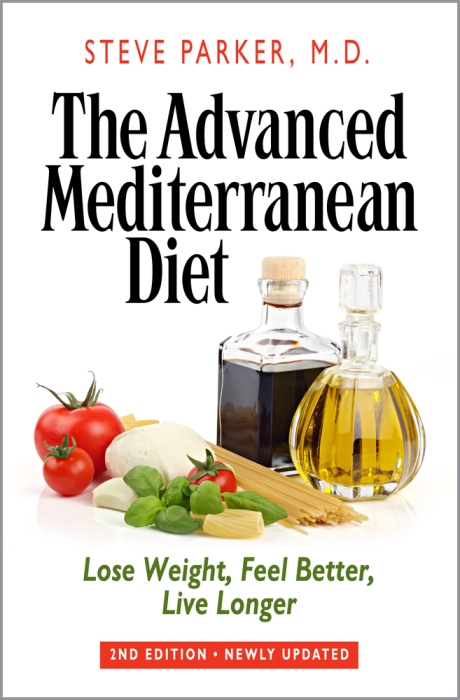
PS: A diet naturally high in monounsaturated fat is one you may have heard of: the Mediterranean diet. The Advanced Mediterranean Diet (2nd Ed.) contains both a low-carb Mediterranean diet and a portion-controlled traditional Mediterranean diet.

Steve Parker MD, Advanced Mediterranean Diet

Two diet books in one

Drinking Coffee Tied to Lower Risk of Suicide 

“Drinking several cups of coffee daily appears to reduce the risk of suicide in men and women by about 50 percent, according to a new study by researchers at the Harvard School of Public Health (HSPH). The study was published online July 2 in The World Journal of Biological Psychiatry.

“Unlike previous investigations, we were able to assess association of consumption of caffeinated and non-caffeinated beverages, and we identify caffeine as the most likely candidate of any putative protective effect of coffee,” said lead researcher Michel Lucas, research fellow in the Department of Nutrition at HSPH.

The authors reviewed data from three large U.S. studies and found that the risk of suicide for adults who drank two to four cups of caffeinated coffee per day was about half that of those who drank decaffeinated coffee or very little or no coffee.”

Source: Coffee drinking tied to lower risk of suicide | Harvard Gazette

Does Dietary Fat Influence Older Brain Function?

MRI scan of brain

MRI scan of brain

The Mediterranean diet has long been linked to lower rates of dementia. Olive oil, a staple of the traditional Mediterranean diet, is rich in monounsaturated fatty acid (oleic acid, specifically). The Mediterranean diet is also relatively low in saturated fatty acid.

From a 2012 study done by Harvard researchers:

“In conclusion, these data suggest that elevated saturated fatty acid intake is related to worse late-life cognitive trajectory, and increased monounsaturated fatty acid intake is related to better cognitive aging. Thus, decreasing saturated fatty acid and increasing monounsaturated fatty acid merit further consideration in promoting healthy cognitive aging, and dietary patterns that incorporate higher intake of “good” fats (e.g., Mediterranean) should be further addressed in cognitive aging research.”

Source: Dietary fat types and 4-year cognitive change in community-dwelling older women

PS: The study at hand involved women, so results may not apply to older men.

Steve Parker MD, Advanced Mediterranean Diet

Two diet books in one

Mark Rippetoe: “Once Again, Terrible Exercise Science Gets Praised by Mainstream Media”

“An important new science article has been making the rounds, with apparently every newspaper and internet news aggregator in the world repeating the message: You don’t have to lift heavy weights to get stronger.I know you read it. Here’s the first place I saw it, and here’s the actual paper.

It’s important because it both seems to confirm what everybody wants to believe, and because it’s actually a pretty good technical study. But it is wrong, because it studies the wrong questions. Nonetheless, you now think that you don’t have to lift heavier weights to get stronger.”

Source: Once Again, Terrible Exercise Science Gets Praised by Mainstream Media | PJ Media

Medicare Announces New Star Ranking System for Hospitals

The hospital where I work ranked four stars, for what it’s worth. The scale runs from one to five stars. The nearby Mayo Clinic Hospital scored five. Although Kaiser says the system is new, I was looking up star rankings last January when I was looking for a job. Look up your favorite hospital here.

From Kaiser Health News:

“The [U.S.] federal government released its first overall hospital quality rating on Wednesday, slapping average or below average scores on many of the nation’s best-known hospitals while awarding top scores to dozens of unheralded ones.

The Centers for Medicare & Medicaid Services rated 3,617 hospitals on a one- to five-star scale, angering the hospital industry, which has been pressing the Obama administration and Congress to block the ratings. Hospitals argue the ratings will make places that treat the toughest cases look bad, but Medicare has held firm, saying that consumers need a simple way to objectively gauge quality. Medicare does factor in the health of patients when comparing hospitals, though not as much as some hospitals would like.

Just 102 hospitals received the top rating of five stars, and few are those considered as the nation’s best by private ratings sources such as U.S. News & World Report or viewed as the most elite within the medical profession.”

Source: Many Well-Known Hospitals Fail To Score 5 Stars In Medicare’s New Ratings | Kaiser Health News

Bix Reports: Tea And Apples Are Good For The Heart 

Green tea

Green tea

The healthful component of tea and apples seems to be epicatechins. Bix, the Fanatic Cook, writes:

“Other good sources of epicatechins, besides apples and tea, include blackberries, broad beans, cherries, black grapes, pears, raspberries, and chocolate. Red wine also contains epicatechins….”

Source: New Study: Tea And Apples Are Good For The Heart | Fanatic Cook

Bix worries about the alcohol in wine causing cancer. Keep your consumption low to moderate and cancer shouldn’t be a problem.

TeaGuardian.com says green and white teas have the most catechins (same as epicatechins, I assume for now).

The study at hand involved Dutch men, so we don’t know if results apply to women. It’s an observational study. The men with the highest epicatechin consumption had a 38% lower risk of death from coronary heart disease compared to the lowest consumers. Perhaps because it was a relatively small study involving only Dutch men, the researcher write that “More studies are needed before conclusions can be drawn.

Steve Parker, M.D.

PS: Have you heard that the Mediterranean diet is also good for your heart?

Federal Prosecutor Says Florida Network Defrauded Medicare and Medicaid of Over $1 Billion

The New York Times reports the details. Here’s a sample:

“Prosecutors, however, described [Philip Esformes] as the “mastermind” of a conspiracy that cycled some 14,000 elderly people in and out of nursing homes and assisted-living facilities, whether they needed medical care or not.

With the help of doctors, pharmacists, health care consultants and other medical personnel who got kickbacks for their roles, the facilities billed Medicare and Medicaid for high-priced drugs, medical procedures and health equipment that the patients either did not need or never received, prosecutors said.

In some cases, they charged, Mr. Esformes’s operation “preyed upon” the elderly patients by giving them narcotics so that they would have to remain longer in the care facilities to treat their addictions and “the cycle of fraud could continue.”

Source: U.S. Says Florida Network Defrauded Medicare and Medicaid of Over $1 Billion – The New York Times

Follow my advice and you’ll be much less likely to even need Medicare’s coverage.

Sugar (and Fructose) Restriction May Be the Key to Eliminating Metabolic Syndrome and Reducing Heart Disease

Dr. Axel Sigurdsson is a cardiologist and blogger who writes about heart disease. A recent post of his considered the role of sugar, including fructose, in metabolic syndrome and coronary artery disease. He does a great job translating scientific research for consumption by the general public. For example:

“Lustig studied 43 obese children (ages 8-19) with metabolic abnormalities typical of the metabolic syndrome. All were high consumers of added sugar in their diets (e.g. soft drinks, juices, pastries, breakfast cereals, salad dressings, etc.).

The children were fed the same calories and percent of each macronutrient as their home diet; but within the carbohydrate fraction, the added sugar was removed, and replaced with starch. For example, pastries were taken out, and bagels put in; yogurt was taken out, baked potato chips were put in; chicken teriyaki was taken out, turkey hot dogs were put in. Whole fruit was allowed.After ten days, diastolic blood pressure fell, insulin resistance decreased, liver tests improved, and triglycerides, LDL cholesterol, and HDL cholesterol all improved.”

Source: Medical Practice

PS: All of my diets combat metabolic syndrome.

Steve Parker MD, Advanced Mediterranean Diet

Two diet books in one

Ketogenic Diets Poised for a Resurgence


Front cover

Front cover

Men’s Fitness has an article praising ketogenic diets, with a focus on effects on athletic performance. Inexplicably, the piece doesn’t mention my Ketogenic Mediterranean Diet. The KMD is also presented as an option in The Advanced Mediterranean Diet (2nd ed.). A quote:

“Timothy Noakes, M.D., is an emeritus professor in the Division of Exercise Science and Sports Medicine at the University of Cape Town. While his name may not ring a bell here in the U.S., he’s a full-blown celebrity in his native South Africa and one of the most accomplished exercise physiologists on the planet. You can’t walk by a restaurant in Cape Town that doesn’t offer a “Noakes option”—say, an avocado stuffed with breakfast sausage and eggs, or a double cheeseburger with lettuce sans bun—and evidence of his teachings seems to be everywhere, mostly in the form of the nation’s best-known athletes, including ageless golfing legend Gary Player and eight-time Ironman World Champion Paula Newby-Fraser. In fact, Noakes’ celebrity these days is such that he’s even been pulled into South African presidential politics: To echo the country’s papers of record, “Is President Jacob Zuma’s and his wife’s dramatic weight loss a result of the Noakes Diet?” No one is sure about the president, but his wife, definitely: She’s lost 66 pounds following the Noakes plan.

Source: The Truth Behind the World’s Most Cutting-Edge Fat-Burning Performance Meal Plan: The Keto Diet

Steve Parker MD, Advanced Mediterranean Diet

Two diet books in one

David Howard Says Insurers Can Reduce Drug Prices, If Policymakers Let Them

“Whilst decrying rapid increases in drug spending and prices, elected officials have actually made it increasingly difficult for insurers to do anything about it. As payers, insurers are the only parties in the health care system who have both the means and the incentive to counter drug firms’ pricing power. For example, insurers have aggressively steered patients from branded to generic drugs, saving billions in the process. However, much of the growth in drug spending is attributable to new drugs that do not yet face generic competition.

In normal markets, monopolies face constraints on their pricing power. The higher they set the price, the less they sell. Insurers want to present drug companies with the same trade off, but as I describe here, numerous policies enacted in the name of facilitating patient access limit insurers’ ability to do so.”

Source: Insurers Can Reduce Drug Prices, If Policymakers Let Them