Sofia Norton Debunks 21 Weight-Loss Myths

Click the link below for her article at Kiss My Keto. The preamble:

Before we dive into the weight loss myths, it’s important to state the truth about weight loss.It’s not as simple as eating healthy and following an exercise program.

Of course, those can make a big difference, however, it doesn’t work that way for everyone.

There are so many factors that come into play when it comes to weight loss. Some of those factors include genetics, endocrine disorders, medications, insomnia, and cultural reasons.

This is why women with the polycystic ovarian syndrome may find it harder to lose weight than those who don’t have it.

So the next time you come across a trending weight loss tip, pause for a moment, and research about it to see if it’s even true. Secondly, analyze your current situation to see if this particular weight loss strategy will work for you.

Source: 21 Popular Weight Loss Myths Debunked! – Kiss My Keto

Steve Parker MD, Advanced Mediterranean Diet

Click the pic to purchase at Amazon.com in the U.S.

I Know Why You’re Not Losing Weight

Old-school preparation for exercise. Stretching actually doesn’t do any good for the average person

You’ll see the term “diet resistant” in the scientific abstract below. It refers to folks who are on a reduced-calorie diet who aren’t losing the weight they should, base on total calorie consumption. Long story short, they’re eating much more than the think and exercising less than they think.

BACKGROUND AND METHODS

Some obese subjects repeatedly fail to lose weight even though they report restricting their caloric intake to less than 1200 kcal per day. We studied two explanations for this apparent resistance to diet — low total energy expenditure and underreporting of caloric intake — in 224 consecutive obese subjects presenting for treatment. Group 1 consisted of nine women and one man with a history of diet resistance in whom we evaluated total energy expenditure and its main thermogenic components and actual energy intake for 14 days by indirect calorimetry and analysis of body composition. Group 2, subgroups of which served as controls in the various evaluations, consisted of 67 women and 13 men with no history of diet resistance.

RESULTS

Total energy expenditure and resting metabolic rate in the subjects with diet resistance (group 1) were within 5 percent of the predicted values for body composition, and there was no significant difference between groups 1 and 2 in the thermic effects of food and exercise. Low energy expenditure was thus excluded as a mechanism of self-reported diet resistance. In contrast, the subjects in group 1 underreported their actual food intake by an average (±SD) of 47±16 percent and overreported their physical activity by 51±75 percent. Although the subjects in group 1 had no distinct psychopathologic characteristics, they perceived a genetic cause for their obesity, used thyroid medication at a high frequency, and described their eating behavior as relatively normal (all P<0.05 as compared with group 2).

CONCLUSIONS

The failure of some obese subjects to lose weight while eating a diet they report as low in calories is due to an energy intake substantially higher than reported and an overestimation of physical activity, not to an abnormality in thermogenesis. (N Engl J Med 1992; 327:1893–8.)

Source: Discrepancy between Self-Reported and Actual Caloric Intake and Exercise in Obese Subjects | NEJM

Steve Parker MD, Advanced Mediterranean Diet

Click the pic to purchase at Amazon.com in the U.S.

QOTD: Steve Martin on Success

“Be so good they can’t ignore you.”

That was what Steve Martin said when he was being interviewed by Charlie Rose and Rose asked what advice Martin would give to a young people.

Martin continued, “ . . . it’s not the answer they want to hear.”

according to Wilder, Wealthy, and Wise.

Steve Parker MD, Advanced Mediterranean Diet

Click the pic to purchase at Amazon.com in the U.S.
Another Physician Discovers the Ketogenic Mediterranean Diet

Colin Champ, M.D., published an article on his version of a Ketogenic Mediterranean Diet.

“The Study Participants – The Mediterannean Ketogenic Lifestyle

Regardless, the study was a massive success, as it allowed 40 overweight individuals with an average BMI of 37 to switch from their diabetes-provoking diet containing over 50% carbohydrates for 12 weeks. Ketosis was apparently confirmed via ketone strips in the morning. This concerns me, because if they were urine strips, after 2-3 weeks they would have been inaccurate. Once again, we must question whether it was a ketogenic diet or simply a very low-carbohydrate diet. Yet, the proof is it the pudding as the Spanish Ketogenic dieters experienced an average reduction in bodyweight from 240 to 208 lbs. Most importantly, there was a clear loss of fat over muscle. Blood pressure dropped, blood lipids improved, triglycerides divebombed as they were cut in half, blood sugar dropped by almost 20 mg/dl, and HDL cholesterol – a difficult number to budge – rose significantly. Take note, as expected, the largest reduction overall was the massive drop in triglycerides, which is especially important as elevated triglycerides are strongly associated with an increased risk of stroke, heart disease, and cancer.

Globally, all of these changes are desired. The question I pose, is can we take this a step further to encourage a full-blown Mediterranean Ketogenic Diet? I have been following what I consider a Mediterranean Ketogenic Diet for years by combining the cultural and social aspects of my Southern Italian heritage along with the scientific approach of the ketogenic diet. Sounds complicated? It’s not. In fact, it is so simple, that I have distilled it down to seven steps that are so simple, your great-grandfather likely followed most of them (mine certainly did).”

Source: The Mediterranean Ketogenic Lifestyle – Colin Champ

Compare with my version.

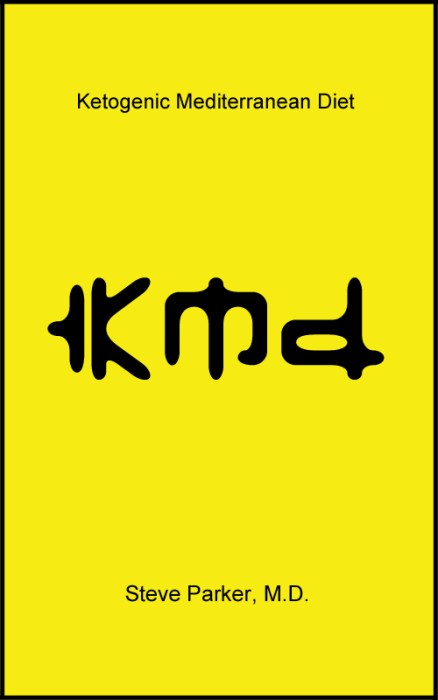
Odd cover, huh?

Steve Parker MD, Advanced Mediterranean Diet

The KMD is also here

At Five Years Out, Gastric Bypass is as Effective in Adolescents as in Adults 

From The New England Journal of Medicine:

Adolescents and adults who underwent gastric bypass had marked weight loss that was similar in magnitude 5 years after surgery. Adolescents had remission of diabetes and hypertension more often than adults.

Note, however,

Three adolescents (1.9%) and seven adults (1.8%) died in the 5 years after surgery. The rate of abdominal reoperations was significantly higher among adolescents than among adults (19 vs. 10 reoperations per 500 person-years, P=0.003).

Source: Five-Year Outcomes of Gastric Bypass in Adolescents as Compared with Adults | NEJM

Steve Parker MD, Advanced Mediterranean Diet

Not linked to any deaths as far as I know


Low-Carb Mediterranean Diet Beats Low-Fat Diet for Reducing Liver Fat

From the study abstract:

Methods

In an 18-month weight-loss trial, 278 participants with abdominal obesity/dyslipidemia were randomized to low-fat (LF) or Mediterranean/low-carbohydrate (MED/LC+28g walnuts/day) diets with/without moderate physical activity (PA). HFC and abdominal fat-depots were measured using magnetic-resonance-imaging at baseline, after 6 (sub-study, n=158) and 18-months.

Results

Of 278 participants [age=48yr;88% men; body-mass-index=30.8kg/m2; mean HFC =10.2%,(range:0.01%-50.4%)], retention rate was 86.3%. %HFC substantially decreased after 6 [-6.6% absolute-units (-41% relatively)] and 18-months [-4.0% absolute-units (-29% relatively);p<0.001 vs. baseline]. Reduction of HFC associated with decreases in VAT beyond weight loss. After controlling for VAT loss, decreased %HFC remained independently associated with reductions in serum gamma-glutamyl-transferase and alanine-aminotransferase, circulating chemerin, and HbA1c (p<0.05). While reduction of HFC was similar between PA groups, compared to LF diet, MED/LC induced a greater %HFC decrease (p=0.036) and greater improvements in cardiometabolic risk parameters (p<0.05), even after controlling for VAT changes. Yet, the greater decreases induced by MED/LC compared to LF diets in triglycerides, TG/HDL ratio and cardiovascular risk score were all markedly attenuated when controlling for HFC changes.

Source: The Beneficial effects of Mediterranean diet over low-fat diet may be mediated by decreasing hepatic fat content – Journal of Hepatology

h/t DietDoctor

Here’s a low-carb Mediterranean diet:

Steve Parker MD, Advanced Mediterranean Diet

Two diet books in one

Sitting is the new smoking? No, it’s worse than that: Not exercising worse is for your longevity than smoking, diabetes AND heart disease

exercise for weight loss and management, dumbbells

At least he’s trying…

I’ve long advocated that life-and health-insurance companies base their premiums on results of individual treadmill exercise tests or similar. Here’s why.

From CNN:

We’ve all heard exercise helps you live longer. But a new study goes one step further, finding that a sedentary lifestyle is worse for your health than smoking, diabetes and heart disease.

Dr. Wael Jaber, a cardiologist at the Cleveland Clinic and senior author of the study, called the results “extremely surprising.”

“Being unfit on a treadmill or in an exercise stress test has a worse prognosis, as far as death, than being hypertensive, being diabetic or being a current smoker,” Jaber told CNN. “We’ve never seen something as pronounced as this and as objective as this.”

Source: Not exercising worse for your health than smoking, diabetes and heart disease – CNN

Most folks can improve their fitness by exercising regularly. But what about nonresponders?

Steve Parker, M.D.

PS: All of my weight-loss books recommend and teach you how to improve your level of fitness.

Steve Parker MD, Advanced Mediterranean Diet

Two diet books in one

High cholesterol doesn’t cause heart disease. Say what?

Plaque unrelated to cholesterol

From The Irish Times:

There is no evidence that high levels of total cholesterol or of “bad” cholesterol cause heart disease, according to a new paper by 17 international physicians based on a review of patient data of almost 1.3 million people.

The authors also say their review shows the use of statins – cholesterol lowering drugs – is “of doubtful benefit” when used as primary prevention of cardiovascular disease.

The authors include Galway-based Prof Sherif Sultan, professor of the International Society for Vascular Surgery; Scottish-based Dr Malcolm Kendrick, author of The Great Cholesterol Con; and Dr David M Diamond, a US-based neuroscientist and cardiovascular disease researcher.

Prof Sultan said millions of people all over the world, including many with no history of heart disease, are taking statins “despite unproven benefits and serious side effects”.

Source: ‘No evidence’ high cholesterol causes heart disease, say doctors

Another Sacred Cow Slaughtered: Omega-3 Fatty Acids Have No Effect on Cardiovascular Disease or Longevity

Salmon, a cold-water fatty fish, is a rich source of omega-3 fatty acids

That headline is the conclusion of a Cochrane systematic review of the evidence. As you read the summary below, be aware that the main omega-3 fatty acids are alpha-lenolinic acid (ALA), docosahexaenoic acid (DHA), and eicosapentaenoic acid (EPA).

From Cochrane Library:

Increasing EPA and DHA has little or no effect on all‐cause deaths and cardiovascular events (high‐quality evidence) and probably makes little or no difference to cardiovascular death, coronary deaths or events, stroke, or heart irregularities (moderate‐quality evidence, coronary events are illnesses of the arteries which supply the heart). EPA and DHA slightly reduce serum triglycerides and raise HDL (high‐quality evidence).

Eating more ALA (for example, by increasing walnuts or enriched margarine) probably makes little or no difference to all‐cause or cardiovascular deaths or coronary events but probably slightly reduce cardiovascular events, coronary mortality and heart irregularities (moderate/low‐quality evidence). Effects of ALA on stroke are unclear as the evidence was of very low quality.

There is evidence that taking omega‐3 capsules does not reduce heart disease, stroke or death. There is little evidence of effects of eating fish. Although EPA and DHA reduce triglycerides, supplementary omega‐3 fats are probably not useful for preventing or treating heart and circulatory diseases. However, increasing plant‐based ALA may be slightly protective for some heart and circulatory diseases.

Source: Omega‐3 fatty acids for the primary and secondary prevention of cardiovascular disease – Abdelhamid, AS – 2018 | Cochrane Library

The Uncertainty Of Nutrient Absorption


IMG_2935From Bix, the Fanatic Cook…

It is just about impossible to anticipate how much, say, calcium we will absorb from a meal or a pill. It depends upon a number of variables which themselves can be difficult to measure, including but not limited to: our calcium status, how much calcium is in the meal or pill, what the calcium is bound to, how acidic the internal environment is, what our vitamin D status is, how much of the calcium binding protein is in place, how much of and what type of fiber is present, the presence of other divalent cations like zinc or magnesium, the condition of the intestinal brush border.

The amount of calcium (or any nutrient, I’m using calcium as an example) consumed and the amount absorbed is not a linear relationship. That is, eating 100 mg of calcium does not mean 100 mg gets absorbed. One thing that is known – the more calcium we eat, the less we absorb; and the less we eat, the more we absorb.

***

Compounding the uncertainty, nutrient content varies within food – the same type of food. In this study:

Calcium and Magnesium Concentration of Inbred and Hybrid Broccoli Heads, Journal of the American Society for Horticultural Science, 2000

Farnham et al. found significant variability among broccoli varieties for calcium and magnesium. Broccoli purchased at random across the US varied by as much as 2-fold for these elements.

Here’s a study that shows almost a three-fold difference in calcium content among several varieties of kale and collards. It also shows significant year-to-year variability for the same variety:

Variability In Elemental Accumulations Among Leafy Brassica Oleracea Cultivars And Selections, Journal of Plant Nutrition, 2005

And yet, data bases and nutrient tables give calcium content in a cup of cooked kale to 2 decimal places!

Source: The Uncertainty Of Nutrient Absorption | Fanatic Cook