The wrath of God is being revealed from heaven against all the godlessness and wickedness of men who suppress the truth by their wickedness, since what may be known about God is plain to them, because God has made it plain to them. For since the creation of the world God’s invisible qualities – his eternal power and divine nature – have been clearly seen, being understood from what has been made, so that men are without excuse.
For although they knew God, they neither glorified him as God, nor gave thanks to him, but their thinking became futile and their foolish hearts were darkened.
Although they claimed to be wise, they became fools and exchanged the glory of the immortal God for images made to look like mortal man and birds and animals and reptiles.
A couple months ago I passed my one year anniversary of getting Pfizer’s COVID-19 vax. I’m starting to worry less about adverse effects, not that I ever lost much sleep over it. Fortunately, I’m hearing no chatter at my hospital about requiring the boosters. Yet I don’t hear any of the vax mandators saying “we were wrong.” A relative of mine is searching for a job now and reports that the great majority of posted jobs still require the vax. Unbelievable!
The patient is wise to look away. If you watch the needle go in, it’ll hurt more.
Many people assumed the vaccine kills you quickly (in the first two weeks) because that’s when people notice the association and report it to VAERS [Vaccine Adverse Event Reporting System in the U.S.]. This is still true; it does kill some people quickly: half of the deaths reported in VAERS are in the first few weeks.
But the key words are “reported in VAERS.” It turns out that if we don’t have that restriction but are just wondering when most of the deaths after COVID vaccination happen, the answer is different.
Thanks to a helper [whistleblower] who works at HHS [Health and Human Services in the U.S.], we can now clearly see that most of the deaths from the vaccine are happening an average of 5 months from the last dose. That is for the second dose; it may be getting shorter the more shots you get but there are arguments both ways (since there can be survivor bias). Using data from the UK, we can see more clearly that the delay time is around 23 weeks (so a bit more than 5 weeks). We’ll dive into that shortly.
This delay explains why the life insurance companies got off-the-charts all-cause mortality peaks for people under 60 in Q3 and Q4 [3rd and 4th quarters of 2021] rather than right after the shots rolled out.
The five month delay is also consistent with death reports where people are developing new aggressive cancers that are killing them over a 4 to 6 month period.
The 5 month death delay was also confirmed using only European data. That analysis was posted Aug 11, but I learned about it after I wrote this post.
So when you hear of a death from stroke, cardiac arrest, heart attack, cancer, and suicide that is happening around 5 months after vaccination, it could very well be a vaccine-related death.
Kirsch concludes that:
The UK data shows statistical proof of causality of deaths (p<.001): the vaccine doses track with the excess deaths 23 weeks later. Dose dependency is key to showing causality. If no one can explain this, the precautionary principle of medicine requires any ethical society to halt the vaccines now.
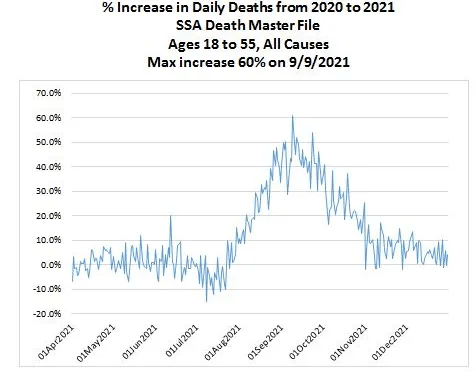
This graph, which is not publicly available, is from the US Social Security death master file. It compares deaths from 2021 to deaths in 2020. You simply cannot get such a rise in deaths like that unless something very deadly is affecting massive numbers of people. This explains why insurance companies all over the world were seeing massive death spikes in Q3 and Q4 of 2021. The vaccine was simply taking an average of 5 months from the most recent injection to kill people. The peak here is September 9, 2021.
In what is possibly related news, guess what’s the top killer in Alberta, Canada, at this time. “Ill-defined and unknown causes.” I’d expect that out of an undeveloped, third-world country, but not Canada. Are they trying to hide something?
It would have been fascinating to be a fly on the wall in the brainstorming sessions that led to this little treatise. The wording was chosen very carefully, not to say anything false outright, much less admit any errors of the past, but to imply that it was only possible to say these things now.
“As SARS-CoV-2, the virus that causes COVID-19, continues to circulate globally, high levels of vaccine- and infection-induced immunity and the availability of effective treatments and prevention tools have substantially reduced the risk for medically significant COVID-19 illness (severe acute illness and post–COVID-19 conditions) and associated hospitalization and death. These circumstances now allow public health efforts to minimize the individual and societal health impacts of COVID-19 by focusing on sustainable measures to further reduce medically significant illness as well as to minimize strain on the health care system, while reducing barriers to social, educational, and economic activity.“
In English: everyone can pretty much go back to normal. Focus on illness that is medically significant. Stop worrying about positive cases because nothing is going to stop them. Think about the bigger picture of overall social health. End the compulsion. Thank you. It’s only two and a half years late.
Alcohol is a two-edged sword. On the one hand it makes life fun and turns strangers into intimate friends in the course of an evening; on the other, it makes a person dysfunctional. Very dysfunctional. Productive time is lost, relationships are damaged, and health is harmed.
I cannot say that I’ve “struggled” with alcohol in the truest sense. I’ve never been arrested for drunk driving, and I’ve had no serious relationship trouble from drinking. All of my drinking has been in an appropriate time and place — but one drink inevitably would lead to another. I’d wind up accidently drunk when I really wanted a light buzz. I also found that when the time came up when I’d be free to drink, I looked a bit too much forward to it.
If you’re a tippler, this is the time of year to consider a “Dry January.” You may learn something about yourself. Be kind to your liver — you only have one.
Steve Parker, M.D.
PS: It’s also time to decide on your weight loss program for the new year.
We will forever believe that locking down the economy for COVID-19 was a massive mistake. There is virtually no evidence that death rates were lowered by government mandates and lockdowns.
Business activity in certain sectors would surely have slowed as individuals protected themselves from COVID: think hotels, cruises, restaurants & bars, amongst other services. But the government didn’t have to aggravate the problem by applying a version of medical central planning. Doctors, epidemiologists, and scientists can be very good at coming up with treatments, cures, and vaccines, but they’re not equipped to weigh trade-offs that involve costs outside the medical arena, like loss of income or basic freedoms.
There is clear evidence that closing schools caused a harmful loss of learning, which could affect the incomes of future workers for decades, while paying people not to work has warped the labor force.
Economically, the United States ran up about $5 trillion in additional debt and boosted the M2 measure of the money supply by more than 40% during the pandemic, which caused a 40-year high in inflation. In turn, this inflation led politicians to release hundreds of millions of barrels of oil from the strategic petroleum reserve in an attempt to temporarily reduce energy prices.
In other words, the US enters the decades ahead with more debt, less spending power, an undereducated population, and less petroleum put aside for national defense. The US has made the future riskier.
At the same time, no one can know exactly what the near-term future looks like. Right now, the conventional wisdom is that the US faces a recession. Normally, we would disagree with the conventional wisdom, but this time we agree. Unwinding COVID policies will be painful.
Posted onNovember 17, 2022|Comments Off on Wake Up, People! Watch This Video If You Believe Everything the Mainstream Media Spoon-Feeds You
Whitney Webb opines on Epstein, WEF, electric vehicles, international political corruption and more. I first saw this remarkable 33-year-old mother in one of the COVID-19 videos I linked to here.
My favorite line of hers from the video: “We have outsourced our needs to corporations that want to enslave us….”
I love Whitney Webb. I’ll be very sad when she’s assassinated. Watch the video before it’s banned.
Posted onNovember 16, 2022|Comments Off on Facts and Fiction Regarding Fad Diets
Frontiers In Nutrition in July, 2022, published “Fad Diets: Facts and Fiction.” Thank you, FIN, for making it available at no cost. The authors are based in Pakistan and Romania. They attempted to summarize the literature on popular fad diets. I am shocked that they included the Mediterranean diet as a fad diet. Read the article and 134 references then form your own opinion. Some snippets:
Regarding the Atkins Diet: “AD provides several benefits including weight reduction and cardio-metabolic health improvement, but limited evidence exists as compliance is the major barrier to this dietary regimen. Strict supervision by health professionals is advised as adverse metabolic sequelae can result from this type of diet.”
The Paleolithic Diet: “More randomized trials need to be done to highlight the consequences of such diets that eliminate one or more food groups. PD is powerful at advancing weight reduction for the time being but its efficacy in cardiovascular events is not well established as limited long-term data is available.”
Mediterranean Diet: “No evidence of adverse effects associated with MD is available in the literature. Rather, MD has preventive and therapeutic potential for many chronic diseases. It is highly suitable for the general public for the prevention of micronutrient deficiencies and specifically for those patients who are more health-conscious than just weight loss oriented.”
Vegetarian Diet: “No evidence of adverse effects associated with MD is available in the literature. Rather, MD has preventive and therapeutic potential for many chronic diseases. It is highly suitable for the general public for the prevention of micronutrient deficiencies and specifically for those patients who are more health-conscious than just weight loss oriented.”
Intermittent Fasting: “Despite the effectiveness of IF in weight loss as indicated by several studies, the current evidence is non-conclusive. The prime focus of available literature is weight loss but little is known about its sustainability and long-term health effects. More long-term trials should be conducted to draw a clear conclusion.”
Detox Diets: “Energy-restricted DDs are capable of short-term weight loss. But still, there is a high likelihood of health risks from detox products because of their nutritional inadequacy. As no convincing evidence exists in this domain so such diets and products need to be discouraged by health professionals and must be subjected to regulatory review and monitoring.”
Posted onNovember 10, 2022|Comments Off on Ultra-Processed Foods Associated With Impaired Cognition
Processed or ultra-processed?
An article earlier this year in the European Journal of Nutrition reported that high consumption of ultra-processed foods is linked to worse-than-average performance on one particular test of cognitive function in older U.S. adults (60+ years-old) who did not have chronic diseases such as diabetes or cardiovascular disease. The particular test was “Animal Fluency.” Never heard of it? Me either. Keep reading.
The study included 2,700 participants, average age 69. Participants were asked to recall what they ate in the prior 24 hours. Foods were “classified according to NOVA, a food classification based on the extent and purpose of industrial food processing, into four mutually exclusive groups: (1) unprocessed or minimally processed foods, (2) processed culinary ingredients, (3) processed foods, and (4) UPFs [ultra-processed foods].”
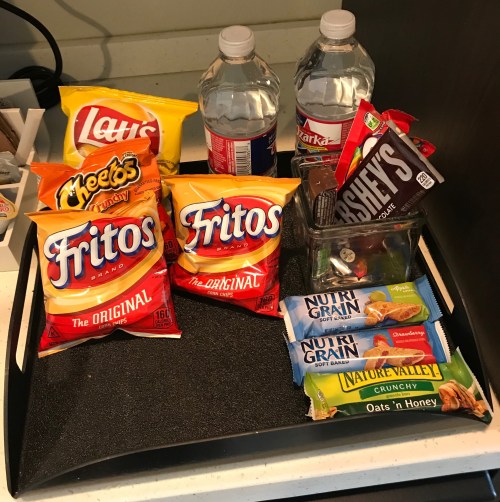
Ultra-processed foods? “…most foods described as “Frozen meals” or “Lunchables”, as well as some items described as consumed in “Restaurant fast food/pizza” or acquired at a “Vending machine” were classified as UPFs.” Furthermore, the authors write in the introduction that “UPFs, according to NOVA classification system, are industrial formulations of processed food substances (oils, fats, sugars, starch, and protein isolates) that contain little or no whole food and typically include flavourings, colourings, emulsifiers, and other cosmetic additives. UPFs are becoming dominant in diets globally and are replacing traditional diets based on unprocessed and minimally processed foods.
Of the entire study population at hand, UPFs were about half of all calories consumed but ranged from 30 to 70%.
“Cognitive performance was assessed using the Consortium to Establish a Registry for Alzheimer’s Disease (CERAD), Word Learning test, Animal Fluency test, and the Digit Symbol Substitution test (DSST).”
The Animal Fluency test “evaluates categorical verbal fluency (executive function).” “For the Animal Fluency test, the participant is requested to name as many animals as possible within a 60-s [60 seconds, I assume] time period. Each animal corresponds to 1 point and the result is presented as the total sum of points.”
Mr Ed, the fluent horse (You won’t get this if under 63)
The test subjects were given two other tests of cognitive function but the investigators found no differences in performance based on ultra-processed food consumption. Here are these other two tests:
The two parts of the CERAD Word Learning test consist of (1) three consecutive learning trials, where the participant is requested to recall a list of ten unrelated words immediately after their presentation. Each word corresponds to one point, and the result is presented as a total score across the three trials (range 0–30); and (2) a delayed word recall test, performed after the two other cognitive tests. The result ranges from 0 to 10. … For the DSST, the participant is presented a single sheet of paper where they are asked to match a list of nine symbols to numbers according to a key located on the top of the page. The task had 133 numbers and the participant had 2 min to complete it. The result is shown as the total number of correct matches. For all the tests, higher scores represent better cognitive function.
The authors conclude: “Consumption of UPF was associated with worse performance in Animal Fluency, a cognitive test that assesses language and executive function in older adults without pre-existing diseases such as CVD [cardiovascular disease] and diabetes, while no associations were observed for those with these conditions. While longitudinal studies are required to provide stronger evidence, these results suggest that decreasing UPF consumption may be a way to mitigate age-associated cognitive decline and reduce the risk of dementia.”
The study looked at 3,600 adolescents who reported their food intake over a 24-hour period. The results are pretty strong: the more ultra-processed food consumed, the greater the odds of overweight and obesity.
Ultra-processed foods make up ‘two-thirds of calories consumed by children and teens’ Experts from Tufts University in Massachusetts studied two decades of dietary data to 2018 and found that the amount of calories young people consumed from ultra-processed foods jumped from 61 per cent to 67 per cent.
I’m not paying for the JAND scientific report so I don’t know how they defined ultra-processed foods. The definition varies quite a bit over time, by researcher, and by research goals. From the U.S. National Library of Medicine:
The definitions [of ultra-processed foods] used in 2009, 2010, 2012, 2014, and 2016a represent the definitions used from publications devoted solely to that purpose and are heavily referenced in the literature on ultra-processed foods. The definitions used in years 2015, 2016b, and 2017 are from articles that focused on the relation between ultra-processed food intake and public health nutrition, in which definitions of ultra-processed foods are presented in detail in the article. The first definition alludes mainly to the use of both food additives and salt in food products (6). The second introduces the putative impact of ultra-processed foods on accessibility, convenience, and palatability of ultra-processed foods (8). Subsequently, the definitions become longer and include more elements. Thus, the third definition builds on previous definitions but introduces 2 new angles (9). One is the nonavailability of ingredients used in ultra-processed foods from retail outlets such as supermarkets, and the second introduces food additives as the most widely used ingredients, in numerical terms, in the manufacture of ultra-processed foods. The next definition now introduces the role of food fortification as a defining element of ultra-processed foods (4). Further definitions introduce new elements such as the importance of foods synthesized in a laboratory, based on organic materials such as oil- and coal-based additives and flavoring compounds (10), a specification for the minimal number of ingredients to be found in these foods (5), and then an emphasis on the inclusion of salt, sugars, oils, and fats as a starting point for defining ultra-processed foods. This definition gives details of specific categories of food additives and highlights how the intended use of these additives is to imitate sensory qualities of fresh or minimally processed foods (group 1) or to specifically disguise undesirable qualities of ultra-processed foods (11). The final definition from 2017 (12) is quite similar to that used in the 2016b publication (11).
If you want to dive deep, you can download a list of ultra-processed food examples from that NLM article. I didn’t. But I figure the way to avoid over-processed foods is to eat food closer to the way God made it rather than man-made.










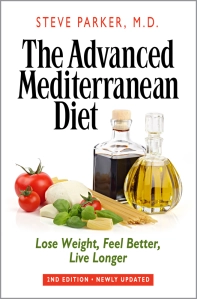
 Advanced Mediterranean Diet