Has anyone even bothered to ask why the tuna are eating mercury?
—Jim Gaffigan


Has anyone even bothered to ask why the tuna are eating mercury?
—Jim Gaffigan
Comments Off on Quote of the Day: Jim Gaffigan on Contaminated Fish
Posted in Quote of the Day
…according to an article at MedPageToday. Specific brands of extended-release niacin and fibrates are mentioned, among others. I particularly like this quote of Dr. James Stein:
“So at least $4.5 billion was spent on drugs with uncertain benefit and known risks,” Stein said. “I’d much rather these patients focus on exercising and eating a healthy, Mediterranean-based diet, which has been proved to reduce heart attacks and strokes, than spending money on these agents.”
It’s a good idea to talk to the prescribing physician before stopping any of your drugs.
Posted in Uncategorized

Don’t wait to take action until it’s too late
High blood insulin levels and insulin resistance promote age-related degeneration of the brain, leading to memory loss and dementia according to Robert Krikorian, Ph.D. He’s a professor in the Department of Psychiatry and Behavioral Neuroscience, University of Cincinnati Academic Health Center. He has an article in a recent issue of Current Psychiatry – Online.
Proper insulin signaling in the brain is important for healthy functioning of our brains’ memory centers. This signaling breaks down in the setting of insulin resistance and the associated high insulin levels. Dr. Krikorian makes much of the fact that high insulin levels and insulin resistance are closely tied to obesity. He writes that:
Waist circumference of ≥100 cm (39 inches) is a sensitive, specific, and independent predictor of hyperinsulinemia for men and women and a stronger predictor than body mass index, waist-to-hip ratio, and other measures of body fat.
Take-Home Points
Dr. Krikorian thinks that dietary approaches to the prevention of dementia are effective yet underutilized. He mentions reduction of insulin levels by restricting calories or a ketogenic diet: they’ve been linked with improved memory in middle-aged and older adults.
Dr. K suggests the following measures to prevent dementia and memory loss:
I must mention that many, perhaps most, dementia experts are not as confident as Dr. Krikorian that these dietary changes are effective. I think they are, to a degree.
The Mediterranean diet is high in fruits and vegetables and relatively low-glycemic. It’s usually mentioned by experts as the diet that may prevent dementia and slow its progression.
I’ve written before about how blood sugars in the upper normal range are linked to brain degeneration. Dr. Krikorian’s recommendations would tend to keep blood sugar levels in the lower end of the normal range.
PS: Speaking of dementia and ketogenic, have you ever heard of the Ketogenic Mediterranean Diet? (Free condensed version here.)
Comments Off on Does Diet Affect Age-Related Memory Loss and Dementia Risk?
Posted in Alzheimer Disease, Dementia, Glycemic Index, Ketogenic Mediterranean Diet, Overweight & Obesity, Uncategorized
Tagged berries, body mass index, dementia, diet, fruit, glycemic index, low carb, Mediterranean diet, memory loss, obesity, Robert Krikorian, vegetables
I don’t – never even tried. Darya Pino found a video showing how to do it with a fine mesh strainer.
Comments Off on Do You Know How To Perfectly Poach an Egg?
Posted in Uncategorized
Brief details are here. Peres is 89, BTW. He seems to prefer low-fat dairy when he eats dairy. Probably no particular need for that unless you’re watching your weight (calories).
Comments Off on Israeli President Shimon Peres Eats a Mediterranean Diet
Posted in Uncategorized
From his article at the Huffington Post:
My own personal opinion is you could design a dozen diet studies showing the superiority of a dozen different diets (from Atkins to Ornish to the Zone) as long as you compare each of them to the crap we’re eating now.
As for Dr. Bowden’s repeated claim that there’s no specific Mediterranean diet, here’s one! It’s as specific as any other mainstream named diet out there.
Comments Off on Jonny Bowden, Ph.D., Disputes That Mediterranean Diet is the Best
Posted in Uncategorized
Tagged Jonny Bowden, Mediterranean diet
…in general. See his recent blog post. A snippet:
“…2 weekly training sessions produced significantly better gains in lean weight than one session a week (3lbs. vs. <1lbs.) and better losses in fat mass. Note that three strength sessions a week did not produce better gains in lean tissue. More exercise is not always better!”
I’m not very familiar with Fred’s exercise ideas, but they sound similar to what I’m doing personally.
Comments Off on Fred Hahn Says Two Weekly Seesions of Weight Training Are Optimal
Posted in Uncategorized
…according to an article at ScienceDaily. Excerpt:
Dr. Michal Katz-Leurer of Tel Aviv University’s Stanley Steyer School of Health Professions at the Sackler Faculty of Medicine says that a simple aerobic walking program is as effective in alleviating lower back pain as muscle strengthening programs that require specialized equipment in rehabilitation clinics. The program includes walking two to three times a week for a period of 20 to 40 minutes.
Sounds too good to be true, doesn’t it? You know what they say about that. Since back pain tends to flare and regress spontaneously, I wonder if an untreated control group would have improved like the two active intervention groups.
Comments Off on For Low Back Pain, Walking Program May Be Just As Good As Clinic-Based Muscle Strengthening
Posted in Uncategorized
In the news once again is the poor ranking of the U.S. in terms of longevity compared to other developed countries. As always, this will spark discussion about what can be done to improve our ranking.
The New England Journal of Medicine in 2007 published an article looking at the determinants of premature death (and poor health, by implication). Here are some quotations from the article:
Parker here again.
Behavioral patterns cause 40% of poor health and premature death. Since healthcare determines only 10% of health status and premature death, let’s focus our health-promotion attention on the other 90%—behavioral patterns, social circumstances, genetics, and environmental exposure. Bigger bang for the buck.
Don’t we the people already know what to do to improve our health? Execution is the problem.
We’re smart enough to solve this problem. But are we too lazy and spineless?
Comments Off on Why Does the U.S. Rank Poorly In Longevity?
Posted in Healthcare Reform, Longevity
 Melanie Thomassian’s recent blog post on physical activity reminded me of a Ken Hutchins essay called “Exercise vs Recreation.”
One of the key take-away points of the essay for me is that exercise isn’t supposed to be fun. Ken wrote, “Do not try to make exercise enjoyable.” Getting your teeth cleaned isn’t supposed to be fun, either.
Once I got that through my thick skull, it made it easier for me to slog through my twice weekly workouts. Another excerpt:
We accept that both exercise and recreation are important in the overall scheme of fitness, and they overlap to a great degree. But to reap maximum benefits of both or either they must first be well-defined and then be segregated in practice.
Comments Off on Exercise Isn’t Supposed To Be Fun
Posted in Exercise
Tagged exercise, Ken Hutchins, Melanie Thomassian, physical activity, recreation
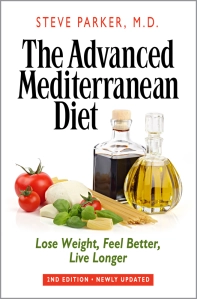
Click the pic to purchase at Amazon.com. E-book versions also available at Smashwords.com.

 Advanced Mediterranean Diet