Testing Your Fitness When You’re Hungover is a Bad Idea

"Good job, maggot!"

“You can do better, Parker!”

It’s been 23 months since I last tested my fitness level in February, 2013. So on New Years’ Day I re-tested. My standard is the Army Physical Fitness Test, which is required for U.S. Army soldiers to pass every six months. I’ve never served in the military. The other military branches probably have their own fitness standards, but my dad was in the Army, so that’s what I use.

Unlike 23 months ago, I didn’t pass this time. I don’t like to exercise but I’ve been pretty good about doing it for 60–70 minutes a week, a combination of weight training and HIIT on a stationary bicycle.

My performance:

  • 2-mile run: 21 mins, 16 secs (FAIL; need 19 mins, 54 secs to pass)
  • military sit-ups: 25 (FAIL: need 27 to pass)
  • push-ups: 31 PASS
  • chip-ups: 7 (not part of the Army test but something I monitor)

My run, if you can call it that, was pitiful. I know I gave it my best effort because my thighs were sore for 48 hours thereafter. At one point I wondered if I could “speed walk” just as fast as I was jogging.

Military sit-ups are done with hands behind your head or neck. Doing sit-ups with my arms folded over my chest, I can do 30.

Yes, I’m disappointed. Why did I fail? I’m almost two years older, probably six pounds (2.7 kg) heavier (at 176 lb or 80 kg), and missed too many workouts.

My remedial plan to pass: Miss fewer workouts and lose six pounds of fat, then re-test. I don’t know if it’ll work.

Steve Parker, M.D.

PS: Just kidding; I wasn’t hungover.

Spaghetti Squash Recipes

low-carb diet, spaghetti squash, paleobetic diet, diabetic diet

The yellow spaghetti squash is at the top. It’s related to pumpkins and zucchini.

Many weight-conscious folks are cutting down on carbohydrate consumption. One way to do that is to find lower-carb alternatives to carb-rich items.

An alternative to spaghetti pasta is spaghetti squash. A cup of cooked spaghetti squash has 10 g of carb; a cup of cooked spaghetti has 43 g. The fiber grams are about the same. Numbers are from FitDay.com.

Spaghetti squash is a classic low-carb vegetable. If you’ve never tried it, you should. As vegetables go, it’s one of the largest, heaviest, and most interesting to prepare. Easy, too. The spaghetti squash season is autumn and winter in the northern hemisphere. Purchasing in spring and summer may be iffy.

In my part of the world, supermarket spaghetti squashes weigh between two and five pounds. We cooked a three-pounder (1.4 kg) that yielded five cups; a five-pounder (2.3 kg) gave us 12 cups. A serving size is one, maybe two cups. What you don’t eat immediately stays fresh in the refrigerator for at least several days. Re-heat by microwaving or stir-frying.

Like pasta and potatoes, the squash by itself is bland. It’s a great substrate for sauces or seasonings.
low-carb diet, paleobetic diet, diabetic diet, spaghetti squash

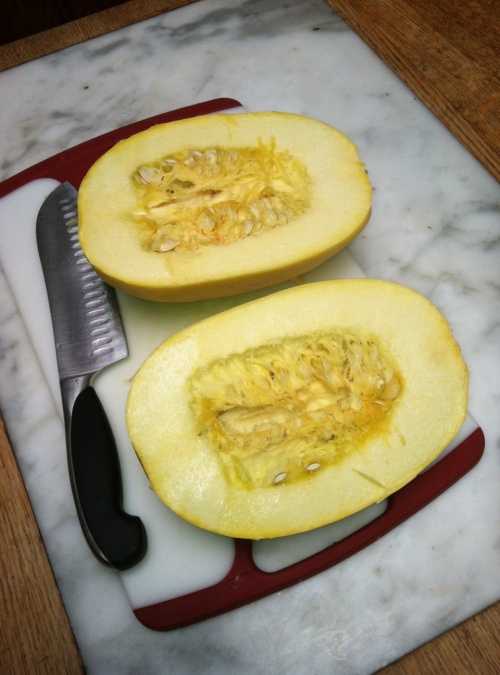
Raw squash cut in half lengthwise

Here’s how we cook it at the Parker Compound. Preheat the oven to 375º F 0r 190º C. Very carefully slice the squash in half lengthwise. Spoon out and discard the guts (seeds and membranes like a pumpkin; it even smells like a pumpkin). Put the halves flat-side down in a pan, then add a half inch (1.3 cm) of water to the pan. Cover with foil and bake until the outer shell (rind) is fairly easily pierced with a paring knife. This will be about 45 minutes for a two-pound squash (0.9 kg); 90 minutes for a four-plus pounder (2.3+ kg). Then turn them over, re-cover with foil, and cook 15 minutes more, until very tender. Remove from the oven and allow them to cool for a few minutes. Then use a fork to pull the strands away from the rind.

Other cooks simplify the process and just place the squash halves flat-side down on a baking sheet and cook for 30-60 minutes. Some leave the seeds in while cooking and spoon them out just before the stranding step.

Or you can save time and microwave it. We can’t tell the difference in the final product.

Now what?

You got options.

Our first experiment was with l0w-carb spaghetti sauce.

paleobetic diet, low-carb diet, diabetic diet, spaghetti squash

Low-carb spaghetti

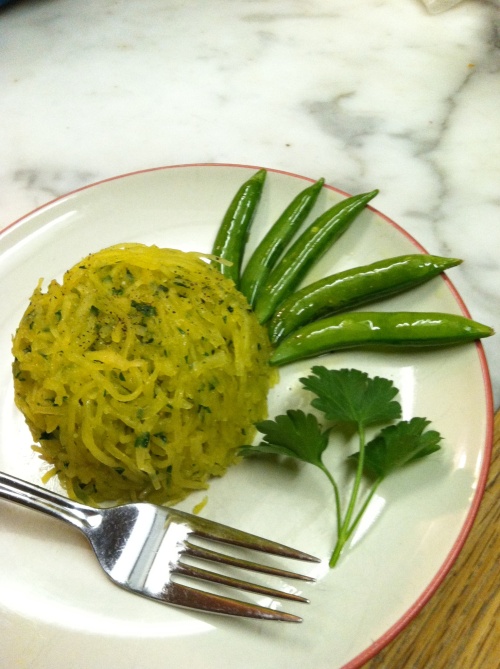
Next we took three cups squash (710 ml) and mixed in 2 tbsp (30 ml) extra virgin olive oil, 2.5 tbsp (37 ml) chopped parsley, 1/2 tsp (2.5 ml) minced fresh garlic, 1/2 tsp (2.5 ml) salt, and 1/8 tsp (0.6 ml) black pepper.
low-carb diet, diabetic diet, paleobetic diet

Seasoned with parsley, olive oil, garlic, salt, pepper

Finally, we took a cup (240 ml) of the squash and added minced celery (4 inches or 10 cm of stalk), 3 minced black olives, 5/8 oz (18 g) of minced sweet (bell) pepper, 1/2 clove of minced garlic, salt (a dash), and pepper to taste.
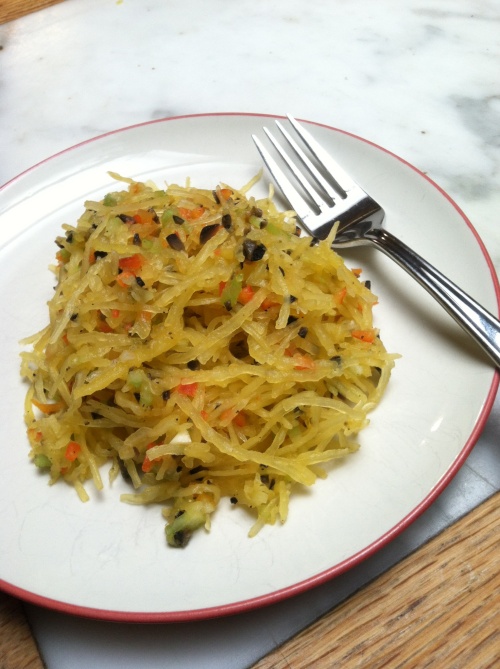
paleobetic diet, diabetic diet, low-carb diet, spaghetti squash

Seasoned with sweet peppers, black olives, garlic, celery, and salt

These last two options I consider side dishes. By the way, they taste good either cold or warm. They would go well with a number of entrees, such as steak or salmon.

I’ve read that this squash is good with pesto, or just with salt and butter.

Nutrition facts from FitDay.com:

One cup of cooked spaghetti squash has 75 calories (I’ve seen 42 elsewhere), 10 g of carbohydrate, 2 g of fiber, 8 g of digestible carb, 4 g of fat (predominantly MUFA), minimal protein, and a fair amount of vitamins A, niacin, B6, and C. Plus 8% of your RDA for manganese.

Steve Parker, M.D.

 

Just What We Needed, Right? Americans Have a New Weight-Loss Drug: Saxenda

Well, it’s not entirely new. It’s liraglutide, which has been available to treat diabetes for a several years, sold in the U.S. as Victoza. Click for my brief review of the drug class for diabetics.

Click for the CBS News report on Saxenda. A snippet:

One clinical trial that involved patients without diabetes found that patients taking Saxenda had an average weight loss of 4.5 percent after one year. Of the people treated with the drug, 62 percent lost at least 5 percent of their body weight. Meanwhile, only 34 percent of those given an inactive placebo had the same result.

Another clinical trial that included patients with type 2 diabetes found that patients had an average weight loss of almost 4 percent after one year. Of those given Saxenda, 49 percent lost at least 5 percent of their body weight, compared to 16 percent of those who were given a placebo treatment.

Click for the FDA’s press release.

Oh, by the way. You have to inject it daily under the skin (subcutaneous). And if you were hoping for a shortcut to weight loss, this isn’t it. You’re still supposed to follow a reduced-calorie diet and exercise regularly.

I’d try The Advanced Mediterranean Diet first.

Steve Parker, M.D.

PS: Full prescribing information.

Merry Christmas!

Stained glass window created by F. Zettler (1878-1911) at the German Church (St. Gertrude's church) in Gamla Stan in Stockholm, depicting a Nativity Scene. This window was created more than 100 years ago, no property release is required.christmas

Stained glass window created by F. Zettler (1878-1911) at the German Church (St. Gertrude’s church) in Gamla Stan in Stockholm, depicting a Nativity Scene. 

How to Prevent Macular Degeneration

Remember...peanuts aren't nuts, they're legumes

Remember…peanuts aren’t nuts, they’re legumes

I saw an optometrist recently for a new eyeglass prescription and mentioned that age-related macular degeneration (ARMD or AMD) runs in my family. ARMD is the leading cause of adult blindness in the West. Thank God, I don’t have it….yet.

The optometrist suggested I start taking eye vitamins to help prevent ARMD. Popular eye vitamin preparations around here are Ocuvite and I-Caps. He said a multivitamin like Centrum might be just as effective.

UpToDate.com, a source I trust, says that supplements for prevention probably don’t work and are not recommended. Which means Centrum would be just as effective: i.e., none of them work.

Instead, UpToDate recommends regular exercise, not smoking, and relatively high consumption of leafy green vegetables, fruits, fish and nuts. Although they didn’t mention it by name, the traditional Mediterranean diet provides all of those.

On the other hand, if you already have macular degeneration (wet or dry), UpToDate recommends these supplements (probably based on the AREDS-2 study):

  • vitamin C 500 mg/day
  • vitamin E 400 mg/day
  • lutein 10 mg/day
  • zeaxanthin 1 mg/day
  • zinc 80 mg/day (as zinc oxide)
  • copper 2 mg/day (as cupric oxide)

An reasonable alternative for non-smokers and never-smokers is the standard AREDS formula. It’s the same as above except it substitutes beta carotene for lutein or zeaxanthin. You can buy both formulations over-the-counter in the U.S. pre-mixed so you don’t have to swallow a handful of pills, just one.

I was in a supermarket yesterday checking out eye vitamins and noted that Bausch and Lomb’s AREDS-2 formula costs about $10/month.

I haven’t decided yet whether I’ll take the optometrist’s supplement advice. Probably not. But I’ll go the diet, exercise, and non-smoking route.

Steve Parker, M.D.

Fruit Smoothie #1: Grapes, Mandarin Orange, Banana, Pear, Chia Seeds, Kale


A 12 fl oz serving

A 12 fl oz serving

My wife has started to experiment with smoothies. Most Americans should eat more fruits; smoothies are one way to do that. Here’s one she made today. Note the trendy chia seeds and kale. You can easily include today’s recipe in your Advanced Mediterranean Diet. Smoothies are a great substitute for junk food desserts.

We’re using a Vitamix mixer. Other devices may be able to get the job done. The mixing speeds our device range from one to 10. (Tip for a competitor: make one that goes to 11.) We love our Vitamix and have no regrets about the purchase. It is hard to hear anything else when it’s running at top speed.

One potential advantage of blending these fruits is that one fruit may provide nutrients that the others lack

One potential advantage of blending these fruits is that one fruit may provide nutrients that the others lack

Ingredients

1 cup (240 ml) grapes, green seedless

1 mandarin orange, peeled, halved

1 banana (7 inches or 18 cm), peeled, cut into 3–4 pieces

1 pear, medium-size, cored, quartered (ok to leave peel on)

1/2 tbsp (7 g) chia seeds

1 cup (50 g) raw kale

1/2 cup (120 ml) water

2 cups (480 ml) ice cubes

Instructions

First put the water in the Vitamix, then grapes, pear, orange, banana, chia seeds, kale, and finally ice. Ice is always last. Then blend on variable speed 1 and gradually go up to high level (10). Total spin time is about 45 seconds.

Full speed ahead!

Full speed ahead!

Number of Servings: 2.5 consisting of 12 fl oz (350 ml) each.

Advanced Mediterranean Diet boxes: 2 fruits

Nutritional Analysis per Serving:

7% fat

88% carbohydrate

5% protein

160 calories

38 g carbohydrate

6 g fiber

32 g digestible carbohydrate

15 mg sodium

520 mg potassium

Prominent features: Good source of vitamin C, fair amount of fiber, miniscule sodium.

Steve Parker, M.D.


Ashes to Ashes, Dust to Dust…

Here’s a beautiful rendition of an Anglican hymn I’d never heard before, “Abide With Me.”

Visit YouTube and you can see the printed lyrics. Written in 1847, the author reportedly died of tuberculosis three weeks later.

h/t John Derbyshire

Do Low-Carb Diets Cause Death?

Adult life is a battle against gravity. Eventually we all lose.

Adult life is a battle against gravity. Eventually we all lose.

Japanese researchers say low-carb diets are causing premature death. I’m skeptical.

The potentially healthful side effects linked to low-carb eating include reduced weight, higher HDL cholesterol, and lower triglycerides and blood pressure. The Japanese investigators wondered if the improved cardiovascular risk factors seen with low-carb diets actually translate into less heart disease and death.

How Was the Study At Hand Done?

The best way to test long-term health effects of a low-carb diet (or any diet) is to do a randomized controlled trial. You take 20,000 healthy and very similar people—not rodents—and randomize half of them to follow a specific low-carb diet while the other half all eat a standard or control diet. Teach them how to eat, make damn sure they do it, and monitor their health for five, 10, or 20 years. This has never been, and never will be, done in humans. The Nazis may have done it, but it’s not published. In the old days, we could do this study on inmates of insane asylums or prisons.

What we have instead are observational studies in which people voluntarily choose what they’re eating, and we assume they keep eating that way for five or 10+ years. You also assume that folks who choose low-carb diets are very similar to other people at the outset. You depend on regular people to accurately report what and how much they’re eating. You can then estimate how much of their diet is derived from carbohydrate and other macronutrients (protein and fat), then compare health outcomes of those who were in the top 10% of carb eaters with those in the bottom 10%. (We’ve made a lot of assumptions, perhaps too many.)

Of the observational studies the authors reviewed, the majority of the study participants were from the U.S. or Sweden. So any true conclusions may not apply to you if you’re not in those countries. In looking for articles, they found no randomized controlled trials.

The observational studies estimated carb consumption at the outset, but few ever re-checked to see if participants changed their diets. That alone is a problem. I don’t know about you, but I’ve had significant changes in my diet depending on when I was in college and med school, when I was a bachelor versus married, when my income was higher or lower, and when I had young children versus teenagers. But maybe that’s just me.

The researchers looked at all-cause mortality, deaths from cardiovascular disease, and incidence of cardiovascular disease. They don’t bother to define cardiovascular disease. I assume heart attack, strokes, and peripheral vascular disease. (But aren’t aneurysms, deep vein thrombosis, and pulmonary embolism vascular diseases, too?) Wouldn’t you think they’d carefully define their end-points? I would. Since they were going to all this trouble, why not look at cancer deaths, too?

What Did the Investigators Conclude?

Very low-carbohydrate dieters had a 30% higher risk of death from any cause (aka all-cause mortality) compared to very high-carb eaters. The risk of cardiovascular disease incidence or death were not linked with low-carb diets. Nor did they find protection against cardiovascular disease.

Finally, “Given the facts that low-carbohydrate diets are likely unsafe and that calorie restriction has been demonstrated to be effective in weight loss regardless of nutritional composition, it would be prudent not to recommend low-carbohydrate diets for the time being.”

If Low-Carb Dieters Die Prematurely, What Are They Dying From?

The top four causes of death in the U.S. in 2011, in order, were:

  1. heart attacks
  2. cancer
  3. chronic lower respiratory tract disease
  4. stroke

You’ll note that two of those are cardiovascular disease: heart attacks and stroke. So if low-carb diets promote premature death, it’s from cancer, chronic lung disease, or myriad other possibilities. Seventy-five percent of Americans die from one of the top 10 causes. Causes five through 10 are:

  • accidents
  • Alzheimer disease
  • diabetes
  • flu and pneumonia
  • kidney disease
  • suicide

Problem is, no one has ever linked low-carb diets to higher risk of death from any specific disease, whether or not in the top ten. Our researchers don’t mention that. That’s one reason I’m very skeptical about their conclusion. If you’re telling me low-carb diets cause premature death, tell me the cause of death.

Another frustration of mine with this report is that they never specify how many carbohydrates are in this lethal low-carb diet. Is it 20 grams, 100, 150? The typical American eats 250-300 grams of carb a day. If you’re going to sound the alarm against low-carb diets, you need to specify the lowest safe daily carb intake.

For most of my career—like most physicians—I’ve been wary of low-carb diets causing cardiovascular disease. That’s because they can be relatively high in total fat and saturated fat. In 2009, however, I did my own review of the scientific literature and found little evidence of fats causing cardiovascular disease.

If you’re looking for a reason to avoid low-carb diets, you can cite this study and its finding of premature death. I’m not convinced. I’ll turn it around on you and note this study found no evidence that low-carb diets cause cardiovascular disease. The risk of cardiovascular disease had been the traditional reason for physicians to recommend against low-carb diets.

Steve Parker, M.D.

Reference: Noto, Hiroshi et al. Low-Carbohydrate diets and all-cause mortality: A systematic review and meta-analysis of observational studies. PLoS One, 2013; 8(1): e55050

Ibuprofen and Acetaminophen Enhance Exercise-Induced Muscle Strength and Size in Older Adults

The study involved 12 weeks of resistance training in 36 adults who were in their 60s. Subjects were randomly assigned to take acetaminophen, ibuprofen, or placebo for the duration of the study. The acetaminophen dose (e.g., Tylenol) was 4000 mg/day and the ibuprofen dose (e.g., Advil) was 1200 mg/day. The total daily amount was divided into three doses.

Compared to placebo, the drug-takers saw a 25-50% increase in muscle mass and strength. The authors attribute the benefit to inhibition of cyclooxygenase (COX).

In case you’re tempted to try this hack on yourself, you might want to run it by your doctor first. For instance, I wouldn’t take the acetaminophen if I had chronic liver disease. I’d eschew the ibuprofen if I had kidney impairment, were prone to bleeding, had stomach ulcers or gastritis, or were taking a strong blood thinner.

Update December 20, 2014: Ibuprofen seems to increase lifespan in several species. Humans, too?

Steve Parker, M.D.
h/t P.D. Mangan

Do Salt Substitutes Help Lower Blood Pressure?

Yes, according to a meta-analysis in a recent AJCN. They drop systolic pressure about 5 units and diastolic only about 1.5 units (mmHg). Although modest, that may be enough to help reduce the need for blood pressure medications.

Steve Parker, M.D.