“I wish we could have read PD Mangan’s book thirty years ago!”
I read P.D. Mangan’s 2015 book, Stop the Clock: The Optimal Anti-Aging Strategy. I give it five stars in Amazon’s rating system. High recommended.
♦ ♦ ♦
I approached this book with trepidation. I like PD Mangan even though I’ve never met him. We’ve interacted on Twitter and at our blogs. You can tell from his blogging that he’s very intelligent. I don’t know his educational background but wouldn’t be surprised if he has a doctorate degree. My apprehension about the book is that I was concerned it would be brimming with malarkey and scams. Fortunately, that’s not the case at all.
Twin studies have established that 25% of longevity is genetic. That leaves a lot of lifestyle factors for us to manipulate.
I’m not familiar with the anti-aging scientific literature and don’t expect it will ever be something I’ll spend much time on. But it’s an important topic. I’ll listen to what other smart analysts—like Mr. Mangan—have to say about it.
It’s quite difficult to do rigorous testing of anti-aging strategies on free-living humans. So the best studies we have were done with worms, rodents, and monkeys; the findings may or may not apply to us. For example, long-term calorie restriction—about 30% below expected energy needs—is known to prolong life span in certain worms and rodents, with mixed results in rhesus monkeys. It’s the rare person who would follow such a low-calorie diet for years as an experiment. I doubt I would do it even if proven to give me an extra five years of life. I like to eat.
There are several prominent theories of how and why animals age. The author thinks the major factors are:
- oxidative stress
- inflammation
- a decline in autophagy (perhaps most important)
An effective anti-aging program should address these issues.
In the anti-aging chapter of his book, The South Asian Health Solution, internist Ronesh Sinha says that “Lifestyle practices that reduce excess inflammation in the body will help delay the aging process.” Dr. Sinha is a huge exercise advocate and low-carb diet proponent.
Mr. Mangan makes a convincing argument that a good way to forestall aging is to apply hormetic stress. Hormesis is a phenomenon whereby a beneficial effect (e.g., improved health, stress tolerance, growth, or longevity) results from exposure to low doses of an agent or activity that is otherwise toxic or lethal when given at higher doses.

Needs a bit more hormetic stress
In case you’re not familiar with hormesis, here’s a major example. Lack of regular exercise leads is linked to premature death from heart disease and cancer. Starting and maintaining an exercise program leads to greater resistance to injury and disease and longer life span. On the other hand, too much exercise is harmful to health and longevity. We see that in professional athletes and excessive marathon runners. Something about exercise—in the right amount—enhances the body’s intrinsic repair mechanisms. That’s the hormetic effect of exercise; one mechanism is by turning on autophagy.
Autophagy is the body’s natural process for breaking down and removing or recycling worn-out cellular structures. This wearing-out occurs daily and at all ages.
If you’re thinking Mr. Mangan recommends exercise as an anti-aging strategy, you’re exactly right. Especially resistance training and high intensity training. His specific recommendations are perfectly in line with what I tell my patients.
Calorie restriction is another form of hormesis; the body reacts by up-regulating stress defense mechanisms. As a substitute for calorie restriction, the author recommends intermittent fasting. Intermittent fasting increases insulin sensitivity, which leads to enhanced autophagy. Fasting seems perfectly reasonable if you think about it, which very few do. Many of us eat every three or four hours while awake, whether a meal or a snack. If you think about it, that’s not a pattern that would be supported by evolution. In the Paleolithic era, we often must have gone 12–16 hours or even several days without food. Hominins without the resiliency to do that would have died off and not passed their genes down to us.
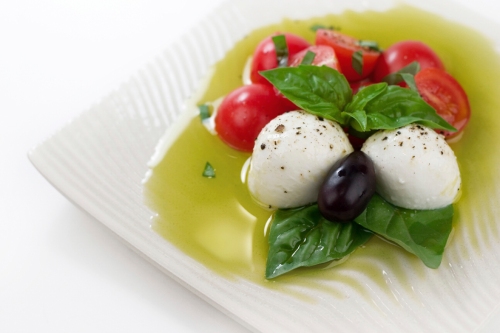
Naturally low-carb Caprese salad: mozzarella cheese, tomatoes, basil, extra virgin olive oil
Another anti-aging trick is a low-carb diet, defined as under 130 grams/day, or under 20% of total calories. It may work via insulin signaling and weight control.
Glutathione within our cells is a tripeptide antioxidant critical for clearing harmful reactive oxygen species (free radicals). We need adequate glutathione to prevent or slow aging. Cysteine is the peptide that tends to limit our body’s production of glutathione. We increase our cysteine supply either through autophagy (which recycles protein peptides) or diet. Dietary sources of cysteine are proteins, especially from animal sources. Whey protein supplements and over-the-counter n-acetyl cysteine are other sources. Fasting is another trick that increases cysteine availability via autophagic recyling.
I don’t recall the author ever mentioning it, but if you hope to maximize longevity, don’t smoke. Even if it has hormetic effects. Maybe that goes without saying in 2015.
When I read a book like this, I always run across tidbits of information that I want to remember. Here are some:
- those of us in the top third of muscular strength have a 40% lower risk of cancer (NB: you increase your strength through resistance training not aerobics)
- exercise helps prevent cognitive decline and dementia, at least partially via enhanced autophagy
- exercise increases brain volume (in preparing to do this review I learned that our brains after age 65 lose 7 cubic centimeters of volume yearly)
- optimal BMI may be 20 or 21, not the 18.5-25 you’ll see elsewhere (higher BMI due to muscle mass rather than fat should not be a problem)
- Scientist Cynthia Kenyon: “Sugar is the new tobacco.” (in terms of aging)
- phytochemicals (from plants, by definition) activate AMPK, a cellular energy sensor that improves stress defense mechanisms and increases metabolic efficiency
- curcumin (from the spice turmeric) activates AMPK
- coffee promotes autophagy
- he does not favor HGH supplementation
- in the author’s style of intermittent fasting, you’re not reducing overall calorie intake, just bunching your calories together over a shorter time frame (e.g., all 2,500 calories over 6-8 hours instead of spread over 24)
- mouse studies suggest that intermittent fasting could reduce risk of Alzheimer’s disease and Parkinsons disease
- consider phytochemical supplements: curcumin, resveratrol, green tea extract
- calorie-restriction mimetics include resveratrol, curcumin, nicotinamide, EGCG, and hydroxycitrate
- supplemental resveratrol at 150 mg/day improved memory and cognition in humans
The author provides very specific anti-aging recommendations that could be followed by just about anyone. Read the book for details. Scientists are working feverishly to develop more effective anti-aging techniques. I look forward to a second edition of this book in three to five years.
Steve Parker, M.D.
PS: People with certain medical conditions, such as diabetics taking drugs that can cause hypoglycemia, should not do intermittent fasting without the blessing of their personal physician. If you have any question about your ability to fast safely, check with your doctor.
PPS: If you need to lose weight on a low-carb diet, consider my Advanced Mediterranean Diet or Ketogenic Mediterranean Diet.