Category Archives: Weight Loss

Overweight Women Lose More Weight While Dieting If Main Meal Is Lunch Instead of Dinner

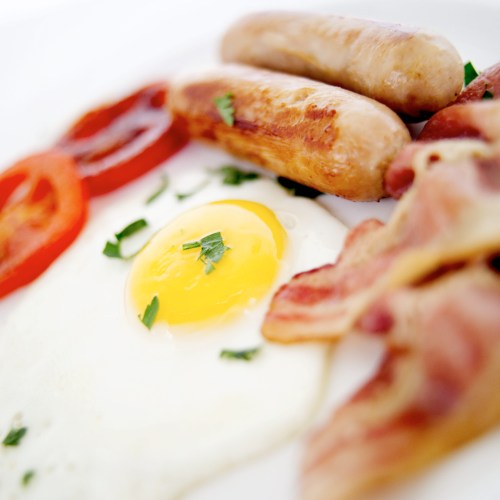
Breakfast of kings?

Breakfast of kings?

They say that to lose excess weight, you should eat breakfast like a king, lunch like a prince, and dinner like a pauper.

A recent study tested whether weight loss in dieting women was more effective by making lunch rather than dinner (evening meal) the main meal of the day. Over the course of 12 weeks, dieters making lunch their main meal lost 4 lb (2 kg) more than the other group.

From the abstract:

“Background: The association between the time of nutrient intake and health has been described in a few studies. To our knowledge, no study has evaluated the relation between high energy intakes at lunch compared with at dinner on weight loss in overweight and obese subjects.

Objective: We compared the effect of high energy intake at lunch with that at dinner on weight loss and cardiometabolic risk factors in women during a weight-loss program.Design: Overweight and obese women [n = 80; body mass index (BMI; in kg/m2): 27–35; age: 18–45 y] were asked to eat either a main meal at lunch (LM) or a main meal at dinner (DM) for 12 wk while in a weight-loss program.

Conclusions: The consumption of higher energy intake at lunch compared with at dinner may result in favorable changes in weight loss in overweight and obese women after a weight-loss program of 12 wk. The consumption may also offer clinical benefits to improve insulin resistance.”

Source: Beneficial effect of high energy intake at lunch rather than dinner on weight loss in healthy obese women in a weight-loss program: a randomized clinical trial

I don’t have the full text of the research report, so I don’t know what kind of diet the women were on. The researchers seem to be based in both Iran and Great Britain. I don’t know the nationality of the women participating. The metabolism of Iranians may be different from Brits.

Steve Parker, M.D.


“Low Sugar Diet,” Whatever That Is, Is the Most Popular in U.K. This Year

…according to an article at TLE. The second most popular diet plan is carbohydrate restriction (low-carb diet). Of course, sugars are carbohydrates.

The most frustrating sentence I read was that “…less than 10% of respondents stated that they intend to make long term changes to their eating habits.”

People, if you go back to your old way of eating, you’re going to gain the weight back. Duh!

That’s why there’s an endless array of new diets.

Source: Low Sugar Diet Is Most Popular For 2016 – The London Economic

Obese and Have Psoriasis? Weight Loss Reduces Severity

Sure, it’s a small research study and I only have the abstract.

Anyway, a reduced-calorie diet led to loss of 15 kg (33 lb) over 16 weeks. Over the next 48 weeks, dieters only regained 5 kg (11 lb). (But, hey. Diets don’t work, right?)

It’s possible the specific diet itself lead to the psoriasis improvement, but the researchers don’t make that claim in the abstract. They credit the long-term weight loss:

“Long-term weight loss in patients with psoriasis has long-lasting positive effects on the severity of psoriasis.”

Source: Long-term effects of weight reduction on the severity of psoriasis in a cohort derived from a randomized trial: a prospective observational follow-up study

Bariatric Gastric Bypass Linked to Higher Risk of Suicide Attempt

according to an article at MedPageToday.

Steve Parker MD, bariatric surgery

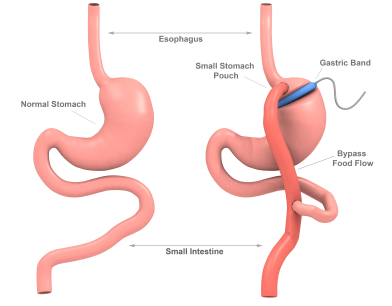
Band Gastric Bypass Surgery

Self-harm emergencies rose by 50% after gastric bypass surgery in the Canadians in this study.

Folks on my diets lose weight without an increase in suicide risk, as far as I know. Click on my name for the diets.

Steve Parker, M.D.

Are Diet Beverages OK When You’re Trying to Lose Weight?

Overweight and obese women who habitually drank diet beverages lost more weight if they substituted water for the diet beverage. Over the course of 24 weeks on a reduced calorie diet, the water drinkers lost an extra 1.2 kg (2.6 lb) compared to those who continued their diet beverage habit.

Furthermore, the researchers found that the water drinkers had healthier values on insulin levels, HOMA-IR (a measure of insulin resistance), and after-meal blood sugar levels.

It was a small study with only about 30 in each experimental group. Whether similar results would be seen in men is unknown to me.

In the past, I’ve advised dieters it’s OK to drink diet drinks in moderation while trying to weight. I may have to revise my recommendations. On the other hand, if diet drinks help keep you happy and on a successful weight-loss journey, they may be helpful. The diet beverage consumers still lost 7.6 kg (16.7 lb) compared with 8.8 kg (19.4 lb) in the abstainers. But diets don’t work, right?

Steve Parker, M.D.

PS: I haven’t read the full text of the article; just the abstract.

PPS: Steven Novella at Science-Based Medicine blog concludes that low energy sweeteners probably help with weight control.

What Really Was William Banting’s Diet?

Banting thought salmon was too fatty

Banting eschewed salmon (too fatty?)

I’ve been reading about Banting’s diet for at least five years. Thanks to Tim Noakes in South Africa, it’s seeing a mini-surge in popularity. William Banting published his Letter on Corpulence in 1863. Eating like him to lose weight is sometimes referred to as “Banting.” It’s one form of a low-carb diet and considered a precursor to the Atkins diet.

Form your own opinion of what William Banting may have eaten by reading these:

In terms of macronutrient calories, here’s my rough back-of-the-envelope synthesis of Banting’s diet:

  • 20–25% carbohydrate
  • 25% protein
  • 20–25% fat
  • 25% alcohol
  • 1800–2000 total calories

For the 200 lb (91 kg) man that Banting was, 2000 calories would almost certainly have been a calorie-restricted diet. Leigh estimated he was eating at least 2800 cals/day at baseline before losing weight. I don’t doubt that.

In summary, Banting drank a lot of alcohol (even more than on the Ketogenic Mediterranean Diet), and ate fairly low-fat, moderately carb-restricted, and relatively high protein. In other words: low cal, low carb, low fat, high protein, high alcohol.

His weight loss, assuming it wasn’t a hoax, came from calorie restriction. Something about that combination of macronutrients apparently allowed him to stick with the program and maintain a 50-lb weight loss. Protein is particularly satiating. Your mileage may vary.

I’m concerned that 25% of calories from alcohol would displace more healthful micronutrients.

Steve Parker, M.D.

PS: William Banting was a distant relative of Frederick Banting, the co-discoverer of insulin in 1921.

How Many Years Does Obesity Cut From Lifespan?

Are you tired of this stock photo yet?

Are you tired of this stock photo yet?

MedPageToday has the details. A quote:

In a computer modeling study, very obese men lost just over 8 years of life compared with normal-weight men, and very obese women lost as many as 6 years, Steven Grover, PhD, of McGill University, and colleagues reported online in the Lancet Diabetes and Endocrinology.

They also found that very obese men and women (defined as a body mass index [BMI] of 35 and higher) lost about 19 years of healthy life, defined as living free of chronic disease such as diabetes and cardiovascular disease.

Note that “very obese” in this context has a specific definition: body mass index 35 or higher. Calculate yours.

The number of life years lost to obesity and disease were highest for those who were very obese in young adulthood and presumably stayed obese for years. In other words, becoming very obese at age 60 is not as dangerous as at 25.

I first got interested in weight loss in the 1990s when I had an office-based primary care medical practice. It was obvious that many of the medical problems I was treating were related to years of obesity. Believe me, you’re much better off preventing those problems via diet and exercise.

In the 1990’s, both Dr. Dean Ornish’s vegetarian diet and Dr. Robert Atkins low-carb diet were very popular, and you couldn’t find any two diets that were more polar opposites. And do you remember Susan Powter and her “Stop the Insanity” diet? My desire to lead my patients onto the right path resulted in the first edition of my Advanced Mediterranean Diet.

Click for The Lancet study abstract.

Steve Parker, M.D.

Just What We Needed, Right? Americans Have a New Weight-Loss Drug: Saxenda

Well, it’s not entirely new. It’s liraglutide, which has been available to treat diabetes for a several years, sold in the U.S. as Victoza. Click for my brief review of the drug class for diabetics.

Click for the CBS News report on Saxenda. A snippet:

One clinical trial that involved patients without diabetes found that patients taking Saxenda had an average weight loss of 4.5 percent after one year. Of the people treated with the drug, 62 percent lost at least 5 percent of their body weight. Meanwhile, only 34 percent of those given an inactive placebo had the same result.

Another clinical trial that included patients with type 2 diabetes found that patients had an average weight loss of almost 4 percent after one year. Of those given Saxenda, 49 percent lost at least 5 percent of their body weight, compared to 16 percent of those who were given a placebo treatment.

Click for the FDA’s press release.

Oh, by the way. You have to inject it daily under the skin (subcutaneous). And if you were hoping for a shortcut to weight loss, this isn’t it. You’re still supposed to follow a reduced-calorie diet and exercise regularly.

I’d try The Advanced Mediterranean Diet first.

Steve Parker, M.D.

PS: Full prescribing information.

Laparoscopic Bariatric Surgery: Gastric Bypass Yields Greater Weight Loss But Higher Complications Compared to Banding

Click for details. Try the Advanced Mediterranean Diet first!

New Weight Loss Drug, Contrave, May Work But Also Cause Suicidal Thoughts

"These are flying off the shelves!"

“This’ll fix you right up!”

The FDA recently approved a new weight-loss drug for the U.S. market. It’s marketed as Contrave, a combination of naltrexone and bupropion.

Neither of the components is new. Naltrexone’s been used to treat alcohol and narcotic addiction. Bupropion, e.g., Wellbutrin, is for depression and smoking cessation.

Contrave joins two other recent drugs for weight loss. Belviq and Qsymia were approved in 2012. I still haven’t run across anyone using those.

To qualify for the new formulation, you need a body mass index over 30, or over 27 plus one or more weight-related medical condition such as type 2 diabetes or high blood pressure.

If you haven’t lost over 5% of your initial body weight in the first 12 weeks of use, the FDA recommends stopping the drug.

Potential adverse effects include suicidal thoughts and seizures. More commonly, users may experience headache, nausea, constipation, diarrhea, dizziness, insomnia, and dry mouth. Constipation and diarrhea?!

Even with the drug, you still have to be on a reduced-calorie diet and exercise program.

Why not try the Advanced Mediterranean Diet or Ketogenic Mediterranean Diet first?

Steve Parker, M.D.