The snippet below is only a sliver of the story. RTWT.
I heard on local radio a few days ago that 82% of the meat in the U.S. food system is processed by only four companies, two of which are Brazilian-owned.
From Wired.com:
So what is it about these places that makes them such dangerous incubators for the novel coronavirus? It’s a question that urgently needs answers, especially now that concerns over food shortages and an order given on April 28 by President Donald Trump classifying meat processors as critical infrastructure are already forcing workers back to the production line. Like most aspects of the pandemic, this one, too, is complicated by a dearth of data. Figuring out how exactly the disease is spreading between workers and which slaughterhouse practices are to blame is going to take time and lots of epidemiological legwork. But there are some clues.
According to the CDC’s latest report, the chief risks to meatpackers come from being in prolonged close proximity to other workers. A thousand people might work a single eight-hour shift, standing shoulder to shoulder as carcasses whiz by on hooks or conveyor belts. Often, workers get only a second or two to complete their task before the next hunk of meat arrives. The frenzied pace and grueling physical demands of breaking down so many dead animals can make people breathe hard and have difficulty keeping masks properly positioned on their faces. To allow for social distancing, the agency recommended that meat processors slow down production lines to require fewer workers, and that they stagger shifts to limit the number of employees in a facility at one time.
Posted onApril 28, 2020|Comments Off on Many Nursing Home Residents are Shedding and Spreading #Coronavirus Before They Get Sick #COVID19
Another call for widespread use of face masks when out in public
Nursing home staff also have a high incidence of COVID-19 infection. Undoubtedly, some staff get “infected” and carry the ‘rona home and to the grocery store, but how many of them are shedding virus to you and others?
An editorial at NEJM calls asymptomatic viral transmission the Achilles’ heel of current strategies to control the COVID-19 pandemic:
A new approach that expands Covid-19 testing to include asymptomatic persons residing or working in skilled nursing facilities needs to be implemented now. Despite “lockdowns” in these facilities, coronavirus outbreaks continue to spread, with 1 in 10 nursing homes in the United States (>1300 skilled nursing facilities) now reporting cases, with the likelihood of thousands of deaths. Mass testing of the residents in skilled nursing facilities will allow appropriate isolation of infected residents so that they can be cared for and quarantine of exposed residents to minimize the risk of spread. Mass testing in these facilities could also allow cohorting and some resumption of group activities in a nonoutbreak setting. Routine rRT-PCR testing in addition to symptomatic screening of new residents before entry, conservative guidelines for discontinuation of isolation, and periodic retesting of long-term residents, as well as both periodic rRT-PCR screening and surgical masking of all staff, are important concomitant measures.
There are approximately 1.3 million Americans currently residing in nursing homes. Although this recommendation for mass testing in skilled nursing facilities could be initially rolled out in geographic areas with high rates of community Covid-19 transmission, an argument can be made to extend this recommendation to all U.S.-based skilled nursing facilities now because case ascertainment is uneven and incomplete and because of the devastating consequences of outbreaks. Immediately enforceable alternatives to mass testing in skilled nursing facilities are few. The public health director of Los Angeles has recommended that families remove their loved ones from nursing homes, a measure that is not feasible for many families.Asymptomatic transmission of SARS-CoV-2 is the Achilles’ heel of Covid-19 pandemic control through the public health strategies we have currently deployed. Symptom-based screening has utility, but epidemiologic evaluations of Covid-19 outbreaks within skilled nursing facilities such as the one described by Arons et al. strongly demonstrate that our current approaches are inadequate. This recommendation for SARS-CoV-2 testing of asymptomatic persons in skilled nursing facilities should most likely be expanded to other congregate living situations, such as prisons and jails (where outbreaks in the United States, whose incarceration rate is much higher than rates in other countries, are increasing), enclosed mental health facilities, and homeless shelters, and to hospitalized inpatients. Current U.S. testing capability must increase immediately for this strategy to be implemented.
Ultimately, the rapid spread of Covid-19 across the United States and the globe, the clear evidence of SARS-CoV-2 transmission from asymptomatic persons, and the eventual need to relax current social distancing practices argue for broadened SARS-CoV-2 testing to include asymptomatic persons in prioritized settings. These factors also support the case for the general public to use face masks when in crowded outdoor or indoor spaces. This unprecedented pandemic calls for unprecedented measures to achieve its ultimate defeat.
Posted onApril 14, 2020|Comments Off on And Now for Something Completely Different: #OutOfShadows
…to take your mind off the coronavirus pandemic.
You might enjoy this documentary if you’re interested in propaganda, social control, conspiracy theories, child sex trafficking, unseen forces like the Deep State, and the mainstream media oligopoly.
When YouTube bans it, I hope you can still find it at OutOfShadows.org.
Posted onMarch 13, 2020|Comments Off on Which Dietary Patterns Lower Blood Pressure?
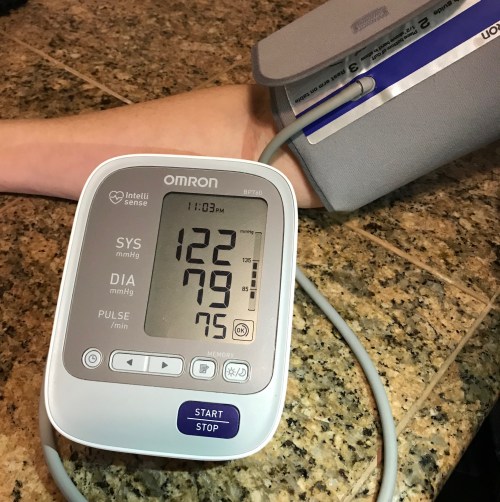
Not a bad monitor
Increasingly, I’m suspicious of results from meta-analyses. Anyway, here’s the abstract of one from American Journal of Clinical Nutrition in 2020. In case you’re not familiar with the LDL-lowering, vegetarian, “portfolio diet,” click for an infographic.
Background: Many systematic reviews and meta-analyses have assessed the efficacy of dietary patterns on blood pressure (BP) lowering but their findings are largely conflicting.
Objective: This umbrella review aims to provide an update on the available evidence for the efficacy of different dietary patterns on BP lowering.
Methods: PubMed and Scopus databases were searched to identify relevant studies through to June 2020. Systematic reviews with meta-analyses of randomized controlled trials (RCTs) were eligible if they measured the effect of dietary patterns on systolic (SBP) and/or diastolic blood pressure (DBP) levels. The methodological quality of included systematic reviews was assessed by A Measurement Tool to Assess Systematic Review version 2. The efficacy of each dietary pattern was summarized qualitatively. The confidence of the effect estimates for each dietary pattern was graded using the NutriGrade scoring system.
Results: Fifty systematic reviews and meta-analyses of RCTs were eligible for review. Twelve dietary patterns namely the Dietary Approaches to Stop Hypertension (DASH), Mediterranean, Nordic, vegetarian, low-salt, low-carbohydrate, low-fat, high-protein, low glycemic index, portfolio, pulse, and Paleolithic diets were included in this umbrella review. Among these dietary patterns, the DASH diet was associated with the greatest overall reduction in BP with unstandardized mean differences ranging from -3.20 to -7.62 mmHg for SBP and from -2.50 to -4.22 mmHg for DBP. Adherence to Nordic, portfolio, and low-salt diets also significantly decreased SBP and DBP levels. In contrast, evidence for the efficacy of BP lowering using the Mediterranean, vegetarian, Paleolithic, low-carbohydrate, low glycemic index, high-protein, and low-fat diets was inconsistent.
Conclusion: Adherence to the DASH, Nordic, and portfolio diets effectively reduced BP. Low-salt diets significantly decreased BP levels in normotensive Afro-Caribbean people and in hypertensive patients of all ethnic origins.
Posted onMarch 11, 2020|Comments Off on Low-Carb Diet May Help Your Knee Arthritis, Regardless of Weight Loss
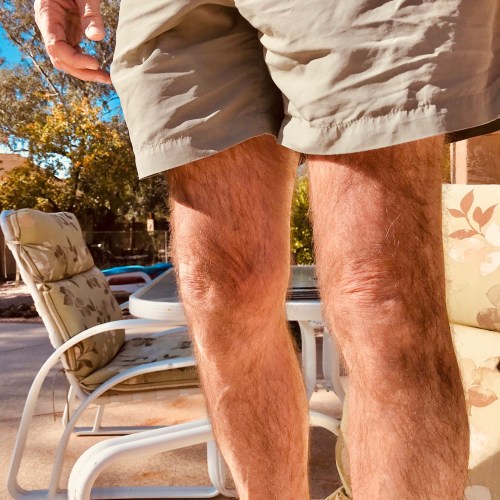
Photo credit: Steven Paul Parker II
Dr Ken Berry published at YouTube a 4-minute video on a diet he believes will lessen the effects and incidence of knee osteoarthritis. For men, the lifetime risk of developing knee osteoarthritis is 40%. For women, 47%. The effects of arthritis are pain and impaired functional status. The title of the video even mentions reversing arthritis. I suppose improved pain and functional ability would be at least a partial reversal.
In short, Dr Berry suggests a diet free of all sugar (no mention of fruits), all grains, and all vegetable oils.
The twenty-one study participants were folks with knee osteoarthritis between 65 and 75-years-old. Nine men, 12 women. Average baseline weight was 194 lb (88 kg). The 21 participants were randomly assigned to one of three diets they would follow for 12 weeks:
L0w-carb diet group (8 participants). Restricted daily total carbohydrates (not net carbs) to 20 grams or less for the first three weeks. Then could go up to 40 grams “if required” (not explained). No fat or protein or calorie restriction. Limited amount of vegetables were OK (e.g., 2 cups/day of leafy greens, 1 cup of non-starchy vegetables). Carb-free sweeteners (stevia, sucralose) were allowed but maltodextrin-containing sweeteners were limited (stevia, sucralose, aspartame, saccharin). This group had no drop-outs.
Low-fat diet group (6 participants). 800–1,200 calories/day. It looks like the men were put on reduced calorie diets—500 cals under estimated baseline or maintenance calories. Women’s calories were reduced by 250-300/day from baseline. Calories were reduced mainly through reduction of fats. They ate veggies, fruit, low-fat foods, whole grains, low-fat dairy, and limited cholesterol and saturated fats. Macronutrient distribution: 60% of calories from carb, 20% from protein, 20% from fat. (Yet Table 1 indicates 50–67 g of fat/day. Twenty percent of 1,200 of calories is only 27 g of fat. So misprint in table 1?) This group had one drop-out.
Control group (N=7), eating as per their usual routine although given documents on portion control. Two drop-outs.
The authors indicate that groups 1 and 2 ate about 100 g of protein/day.
All participants filled out surveys documenting knee pain levels and were put through periodic supervised tests like a timed walk and repeatedly arising from a chair with their hands placed on opposite shoulders.
Results
The low-carb diet group is the only one that demonstrated decreased pain intensity and unpleasantness in some functional pain tasks. In other words, improved quality of life.
The low-carb group lost an average of 20 lb (9 kg) compared to the low-fat weight loss of 14 lb (6.5 kg), not a statistically significant difference. Even the control group lost 4 lb (1.8 kg).
A blood test—thiobarbituric acid reactive substances or TBARS—indicated reduced oxidative stress in the low-carb dieters.
The authors hypothesize that the improvement in arthritis pain in the low-carb group was related to the reduction in oxidative stress, which reduces pain and inflammation.
Will these old knees make it up Humprheys Peak one more time?
Implications
With so few participants, you know this was a pilot study that ultimately may not be entirely valid or replicable. But it’s promising. Next, we need a study with 150 participants.
Dr Berry is getting a bit ahead the the science here. He gives a powerful personal testimony in his video. And perhaps he’s seen many of his patients improve their arthritis with a very low-carb diet.
The carb consumption of the low-carb dieters would be ketogenic in most folks. Yet I didn’t even see “ketogenic” in their report. Perhaps because they didn’t measure ketone levels?
The authors of the report mention other studies finding improvement of osteoarthritis pain and inflammation by the Mediterranean diet. The Mediterranean diet even helps rheumatoid arthritis.
How about combining a very low-carb and Mediterranean diet? As in my Ketogenic Mediterranean Diet. If you have the funds to run the study, I can probably get you a nice discount on books. Have your people contact my people.
Given the safety of very low-carb diets, I can’t argue against a 12-week trial if you have bothersome knee osteoarthritis. Get your doctor’s clearance first.
Steve Parker, M.D.
References:
Strath LJ, et al. The effect of low-carbohydrate and low-fat diets in individuals with knee osteoarthritis. Pain Medicine, 21(1), 2020, pp 150-160.
Oliviero, F, et al. How the Mediterranean diet and some of its components modulate inflammatory pathways in arthritis. Swiss Med Wkly, 2015; 145; w14190.
Veronese, N, et al. Adherence to the Mediterranean diet is associated with better quality of life: Data from the Osteoarthritis Initiative. American Journal of Clinical Nutrition 2016: 104(5): 1403-9.
McKellar, G. et al. A pilot study of a Mediterranean-like diet intervention in female patients with rheumatoid arthritis living in areas of social deprivation in Glasgow. Ann Rheum Dis 2007;66(9):1239-43.
Slöldstam, LB, et al. Weight reduction is not a major reason for improvement in rheumatoid arthritis from lacto-vegetarian, vegan or Mediterranean diets. Nutr J 2005;4(15).
Click pic to purchase book at Amazon.com. E-book versions are also at
Posted onJanuary 21, 2020|Comments Off on Dr Gorski on Dr Joseph Mercola: Not a Fan
“Would I lie to you if my income depended on it?”
I’m probably on the opposite end of the political spectrum from Dr Gorski, but from a science-based medical perspective I almost always agree with him.
From Dr G at Science-Based Medicine:
One of the most frequent ad hominem attacks leveled against those of us who try to educate the public about medical quackery, antivaccine pseudoscience, and the infiltration of pseudoscience and quackery into medicine in the form of “complementary and alternative medicine” (CAM) or “integrative medicine” is that we’re shills for big pharma. It’s such a common attack that I even coined a phrase to describe it. (Well, I think I coined the phrase; I could be wrong.) It’s known as the “pharma shill gambit.” The idea is as obvious as it is trite: to cast doubt on what defenders of science say about medical quackery by portraying them as in the pocket of big pharma. My frequent retort goes along the lines of, “Dammit, where is all filthy lucre I’m supposed to be getting doing this? Where is my mansion? Where is my Maserati?” Of course, I have none of these things. Don’t get me wrong. As an academic surgeon I make considerably more than the average person, but I’m just well off, not wealthy, and I don’t even make that much compared to the average surgeon in private practice with my level of experience. (Hell, I don’t even make as much as the radiologists at my hospital.) The point is, no one gets wealthy opposing pseudoscience. They do, however, become wealthy selling pseudoscience, as a recent Washington Post story about Dr. Joseph Mercola demonstrates.
Posted onJanuary 13, 2020|Comments Off on Like Last Year, Flu Vaccine Not as Effective as Wished
From LiveScience:
“There’s more bad news about the flu: The main strain of flu that’s circulating right now doesn’t exactly match what’s in this year’s flu shot, according to a new report.
However, the strain in the vaccine may still be close enough to offer some protection, officials said.”
Posted onDecember 30, 2019|Comments Off on Recipe: Bangladeshi Curried Carp
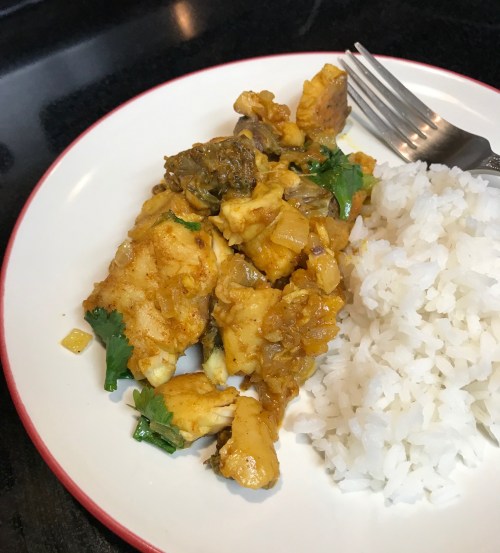
Bangladeshi Curried Carp with rice
Carp have been eaten in various cultures around the world for millennia. In the U.S., not so much. Here, most people consider it a “trash fish,” if not worse.
My inspiration for this recipe was a YouTube video by Luke Nichols at his Catfish and Carp channel. His friend Jay cooked Luke’s very first eaten carp for him. So it’s Jay’s recipe.
Before I forget, I must tell you that you will find some bones in most carp filets. No easy way around it. So you have to be careful when you eat it, and I would not give it to children or scatter-brained adults. The fish we cooked was small and therefore had small bones. They were very thin and flexible and I think I swallowed a few without concern, rather than fish them out of my mouth. When eating fish like this, look at your food well and eat small bites. The bones are one reason carp aren’t eaten widely in the U.S.
Don’t gobble fish off the bone. Rather, put a small piece in your mouth, and work it around a bit to be sure you have all flesh. If a bone sneaks in, you’ll notice right away. Simply remove it with your fingers or napkin and place it on the side of the plate.
Ingredients
carp filets, cut into chunks ~1 x 2 inches (we had 12 oz total uncooked, and the ingredient amounts below are for 12 oz of fish)
Tony Chachere’s Original Creole Seasoning or Old Bay Seasoning to taste (this latter is Jay’s recommendation but my local supermarket didn’t have it)
cooking oil (we used olive oil, about 5–6 Tbsp)
salt to taste
medium onion, diced or chunked
curry powder, 1/2 tsp
coriander powder, 1/2 tsp
turmeric powder, 1/2 tsp
garam masala powder, 1/2 tsp
cumin, 1/2 tsp
paprika, 1/2 tsp
garlic powder, 1/2 tsp
water, 1 or 1.5 cups
Instructions
Sprinkle the carp with Creole or Old Bay Seasoning and set aside for 10–20 minutes.
Sauté the onion chunks in the cooking oil over medium heat until slightly brown. Add some salt while cooking if desired (we didn’t). Then remove half the onions and set those aside.
Add the fish to the frying pan with the remaining onions and cook over medium heat for perhaps 2-3 minutes. Add a little more cooking oil now if desired. I think the idea is to sear the fish rather than cook through and through, so don’t flip or toss the fish too much. It will finish cooking later.
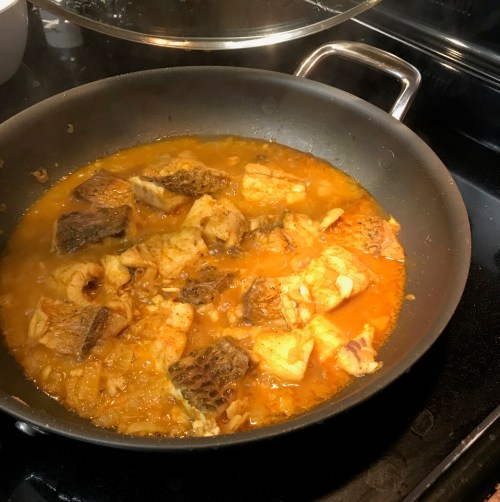
Turn the heat down to low and add 1 or 1.5 cups of water to the frying pan with the fish. Then add all the non-salt spices to the pan and gently stir and flip the fish until spices are evenly dispersed.
Time to cover the pan
Keep heat on low, cover the pan, and simmer for 15 minutes (or a little less if your filets are thin?).
Finally add the remaining set-aside onions and some cilantro to the pan, stir briefly, remove from heat and enjoy!
Servings: Two. Often served with rice in Bangladesh.
My son and I had a great time catching this carp, cooking it, and eating it. Thanks, Paul!
Posted onDecember 29, 2019|Comments Off on Carp Fishing at Bartlett Lake, Arizona
Fishing pier at Rattlesnake Cove, Bartlett Lake
The leading edge of a cold front had finished coming through, dumping about 1/2 inch of rain on the area and dropping daytime highs to 50° F and lows to 40°. December 28, 2019.
Our first view of Bartlett Lake, uphill from the marina
Paul and I had our lines in the water at 2PM, from the fishing pier at Rattlesnake Cove Day Use Area. The rain and sleet had just stopped but the pier had a covered area if needed. We offered the fish two kinds of bait. The first was what I used last about 45 years ago and I’ll call Oklahoma: a dough made from simmering water, flour, cornmeal, strawberry jello (3 oz), vanilla flavoring, and sugar. The second bait I’ll call Captain Carp’s: Panco, sweet corn from a can, and strawberry jello (6 0z).
Captain Carp is actually Luke Nichols, a criminal defense lawyer. At the start of his videos he often gives his website, CatsAndCarps.com. I watch most videos at 1.25 times normal speed, so Cats and Carps sounds like Captain Carp.
One of Paul’s first ever carp
I got definite nibbles on Oklahoma in about 10 feet of water, but no great bites or landed fish. On Captain Carp’s bait in ~ 20 feet water, we caught four carp ranging from 2 to 4.5 lb. The linked video above explains how to use Captain Carp’s “pack bait” method. A “slip sinker” rig is also probably important. CC explains his rigs in much more detail in other YouTube videos.
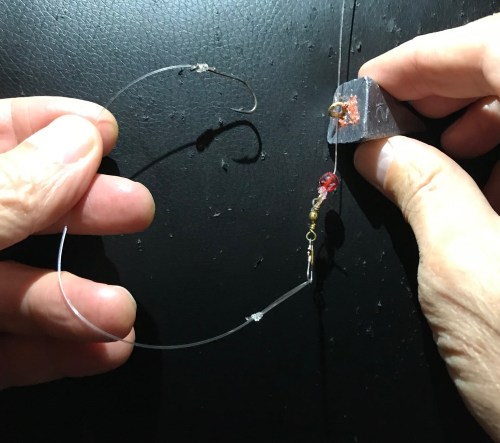
This was our basic rig. 2- or 1-ounce pyramid sliding sinker. Before casting, sinker is coated with pack bait, ending up about the size of a lime or lemon. And the hook is embedded in the pack bait ball. We should probably also get some plastic line protectors that spread the pressure of the sinker over 2 cm; you connect the sinker to the plastic instead of directly to the line. Captain Carp also is a huge proponent of the “hair rig,” which we should probably adopt.
I only caught one compared to Paul’ three
Five total hours of fishing, and nearly all the landed fish were from the same spot over 30 minutes, about 45-60 minutes before sunset at 5:30 PM. It was around 37° F when we quit at 7 PM. Fortunately there wasn’t much wind. We’re not used to that cold.
From that same recreation area you can easily walk along the shore northwards for perhaps half a mile, casting lures for bass and other fish. Not sure if walk would be that easy when lake level is higher. I’m guessing it’s about 15 feet below max now. There are man-made fish habitats along that route. One of these days….
Our honey hole was off this end of the pier, casting toward the center of the lake
Another half-mile north of that is Bartlett Flats, where the Verde River’s flood plain is indeed flatter and wider, and often under water depending on lake level. Perhaps best to have a pick-up truck or sturdy car to explore here. Lot’s of room to walk along the bank casting lures, or stay in one spot.
Pro Tip: Hold your fish in front of your body with outstretched arms to make it look bigger!
The next lake on the Verde River not much further north is Horseshoe Lake. When full, it’s a large lake. But its primary purpose seems to be holding excess river water until it’s needed further downstream. I guess for Phoenix metro area residents or agriculture. So it’s not managed as a fisheries habitat. It’s often drained close to dry during summer. Probably not a great place to fish.
I filleted the largest fish right there on the banks of lake and we’ll cook it up tomorrow. The smaller ones we released and we’ll come back and catch them in Spring when they’re bigger!
Steve Parker, M.D.
PS: Carp are not one of the Mediterranean diet cold-water fatty fish loaded with healthy omega-3 fatty acids.
Click the pic to purchase at Amazon.com. E-book versions also available at Smashwords. com.
Posted onDecember 26, 2019|Comments Off on Healthcare Lessons from Dr. Keith Smith
Russ Roberts interviewed Dr Keith Smith who has revolutionary thoughts about healthcare reform. From Medium:
The Surgery Center of Oklahoma provides a wide range of surgical procedures. All their prices are transparent, all-inclusive, and can be viewed online. They take no insurance. Their prices are considerably lower, often by many multiples, than the prices charged by hospitals. Smith claims they have not changed their base prices for 20 years. This is in a world where health care costs have risen relentlessly everywhere else. Patients of the Center seem to be very enthusiastic about their treatment.
There were two aspects of the conversation. The first was how the surgery center worked — the incentives it faces, the ability to offer a cash price that enough people can still afford to pay, how the surgeons are monitored for quality, how the surgeons reach out to patients and work with them, how surprises on the operating table are handled and so on. The second thing we talked about was how the rest of the health care system works — the fake prices, the incentives to inflate these fake prices, the bizarre interactions of hospitals and insurance companies, the lack of transparency and so on.













 Advanced Mediterranean Diet