Category Archives: Longevity

U.S. Lifespans Decreasing :(

“The latest, best guesses for U.S. lifespans come from a study (PDF) released this month by the Society of Actuaries: The average 65-year-old American man should die a few months short of his 86th birthday, while the average 65-year-old woman gets an additional two years, barely missing age 88.

This new data turns out to be a disappointment. Over the past several years, the health of Americans has deteriorated—particularly that of middle-aged non-Hispanic whites. Among the culprits are drug overdoses, suicide, alcohol poisoning, and liver disease, according to a Princeton University study issued in December.

Partly as a result, the life expectancy for 65-year-olds is now six months shorter than in last year’s actuarial study. Longevity for younger Americans was also affected: A 25-year-old woman last year had a 50/50 chance of reaching age 90. This year, she is projected to fall about six months short. (The average 25-year-old man is expected to live to 86 years and 11 months, down from 87 years and 8 months in last year’s estimates.) Baby boomers, Generation X, and yes, millennials, are all doing worse.”

Source: Americans Are Dying Faster. Millennials, Too – Bloomberg

Your Level of Fitness May Be More Important Than the Number of Hours You Exercise

She can increase intensity by increasing the weight of those dumbbells

She can increase intensity by increasing the weight of those dumbbells

You’ve heard that “sitting is the new smoking,” right?

Regular physical activity prevents disease and prolongs life. But if you nevertheless still spend to much time sitting around either at work or home, the sitting tends to counteract the benefits of your exercise.

A new study says that your fitness level is more important for long-term health than the number of hours you exercise. Fitness level in this context was cardiorespiratory fitness, probably measured by a maximal-effort treadmill or bicycle test.

Some of your fitness level is inherited, but you can also improve your fitness with the proper intensity or duration of exercise. Rather than exercise longer, I prefer more intensity. Just strolling around the mall at 2 mph for two hours isn’t going to improve fitness in most folks.

From MNT:

“The team conducted a cross-sectional study of 495 women and 379 men from Norway aged between 70-77 years. Sedentary time and physical activity were assessed by accelerometers, while cardiorespiratory fitness was determined by peak oxygen uptake (VO2 peak) – the measurement of the volume of oxygen that the body can utilize during physical exertion.

Researchers compared different levels of activity with fitness levels and cardiovascular risk factor clusters. A cardiovascular risk factor cluster was defined as the presence of three to five risk factors for heart disease.

These risk factors included: elevated waist circumference, elevated blood triglycerides or reduced “good” cholesterol levels, high blood pressure or treatment for hypertension, and elevated fasting blood sugar levels – combined symptoms commonly referred to as metabolic syndrome.

High cardiorespiratory fitness reduced risk of heart diseaseFindings – published in Mayo Clinic Proceedings – showed that when compared with women and men who were the least sedentary, women and men from the most sedentary group were 83 percent and 63 percent more likely to have cardiovascular risk factors from extended time sitting, respectively.

However, when the team took participants’ level of fitness into consideration – measured by having high age-specific cardiorespiratory fitness – they found that the fittest 40 percent had a decreased likelihood of cardiovascular risk factors from prolonged sitting.This finding held true even though the fittest participants spent between 12-13 hours per day sedentary and did not meet current moderate to vigorous physical activity guidelines.”

Source: Fitness, not physical activity, mitigates negative effects of prolonged sitting – Medical News Today

PS: If you’re new to exercise, I teach you how to get started in my books.

What happens after you die?

Blogger Claire Wolfe posted an interesting story that may change your perspective on the worries of the day:

“As many know by now – I died on October 6 – a Thursday.

I suffered the whole flat-line CPR + defibrillation for four minutes. Only the incredibly professional Grafton VOLUNTEER Ambulance Service (and good neighbors and good luck ) saved my butt.

I was asked several questions after this experience – did I feel the shocks, what do I remember, etc.. One question was – “What was your last thought before losing consciousness?

”Well, actually, I remember the last TWO thoughts before dying –

“Oh shit, it’s Thursday.

”Followed by

“I should have a more uplifting last thought than THAT!”

Source: What happens after you die – Living Freedom

RTWT.

Mediterranean diet could prevent 20,000 deaths in Britain each year 


Italian seaside tangentially related to this post

Italian seaside tangentially related to this post

The Telegraph has the details:

“Some 20,000 lives could be saved each year if Britons switched to a Mediterranean diet, according to a new study.

The Medical Research Council (MRC) and Cambridge University followed nearly 24,000 people in the UK for up to 17 years to see how their diet affected the health of their heart.

They discovered that people who followed a diet high in fruits, vegetables, whole grains, nuts, fish and olive oil lowered their risk of cardiovascular disease by up to 16 per cent. The researchers estimate that 12.5 per cent of cardiovascular deaths, such as heart attacks and strokes,  could be prevented if everyone switched to the Mediterranean diet. There are around 160,000 heart deaths each year so 20,000 deaths could be avoided just by eating more healthy foods.”

Source: Mediterranean diet could prevent 20,000 deaths in Britain each year 

Brain Shrinkage Linked to Loss of Youthful Thinking Ability

MNT has a headline pregnant with possibility:

‘Super agers’ avoid brain shrinkage, retain youthful thinking abilities

The problem is, we don’t know how to prevent brain shrinkage. The “super agers” may simply have won the genetic lottery. Other factors that might help prevent brain shrinkage include 1) not smoking, 2) the Mediterranean diet, 3) keep your brain actively engaged as you age, 4) exercise, 5) avoid obesity, 6) don’t drink too much alcohol, and 7) consume cold-water fatty fish.

From MNT:

“Touroutoglou and colleagues conducted imaging studies on the brains of the super agers that revealed that the prefrontal cortex and hippocampus (that typically shrink with age) were similar in size to those of young adults.

“We looked at a set of brain areas known as the default mode network, which has been associated with the ability to learn and remember new information, and found that those areas, particularly the hippocampus and medial prefrontal cortex, were thicker in super agers than in other older adults. In some cases, there was no difference in thickness between super agers and young adults,” Touroutoglou says.

Barrett points out that the team also examined a group of regions in the brain known as the salience network – involved in identifying information that is important and that needs attention for specific situations – and found that several areas had preserved thickness among super-agers, including the anterior insula and orbitofrontal cortex.”

Source: ‘Super agers’ avoid brain shrinkage, retain youthful thinking abilities – Medical News Today

At 145, ‘Longest living human’ is ready for death

I’m skeptical about his age, but suppose it’s possible. Click the link below to find out what he credits for his longevity.

“An Indonesian man who claims to be the longest living human in recorded history has described how he “just wants to die”.

Mbah Gotho, from Sragen in central Java, was born on December 31, 1870, according to the date of birth on his identity card.

Now officials at the local record office say they have finally been able to confirm that remarkable date as genuine.

If independently confirmed, the findings would make Mr Gotho a staggering 145 years old – and the longest lived human in recorded history.”

Source: ‘Longest living human’ says he is ready for death at 145

FTC Says Eukanuba Won’t Prolong Fido’s Life

From CBSNews.com:

“Mars Petcare, one of the country’s largest makers of dry pet food, ran a 2015 ad campaign for Eukanuba on TV, online and in print publications citing a 10-year scientific study that purportedly showed the product could extend dogs’ lifespan by 30 percent or more. The ads also pointed to a number of dogs, including three Labrador retrievers named “Iowa,” “Utah” and “Bunny,” that the company said were thriving well beyond the breed’s average 12-year lifespan.

“What we observed was astonishing,” the company said in its ads, according to the FTC.

FTC said that, in fact, the study showed that dogs that were fed Eukanuba lived no longer than dogs of the same breed typically do.”

Source: The arf-ful truth: That pricey dog food won’t extend Fido’s life – CBS News

The Vampires Are Right: Blood Transfusions from Young People Slow Aging

That’s the claim anyway.

From MIT Technology Review:

“The latest advancement in anti-aging therapies hardly sounds like modern medicine at all. Ambrosia, a startup based in Monterey, California, is launching a clinical trial to inject the blood of young people into just about anyone aged 35 and up—if they’re willing to pay $8,000.

Young-to-old blood transfusions hit the limelight in 2014 when Harvard Stem Cell Institute researcher Amy Wagers discovered that the blood of young mice improved muscle, heart, and brain function in older mice.”

Source: The Next Health Fad? Blood Transfusions from Young People

If this pans out, I bet it can be done for much less than $8,000.

Hope: A Huge Cost Driver in Medicine 

mountains above the clouds

As a hospitalist, I often end up taking care of patients who are clearly near the end of their lives. Usually I don’t know them well. I don’t know what they’ve been through. I wonder what their regular doctors have been telling them, if anything, about their chances of survival. Too often, I’m the one discussing end of life issues that should have been addressed three months ago.

After reading the article linked below, I have a bit more understanding of the situation. A sample:

“Cancers vary in prognosis. Cancers vary in their response to treatment. This begs the question: In the absence of perfect information, what should the oncologist tell the patient? Should the oncologist reveal the median survival only? If so, why? What normative ethics say only the central tendencies of a distribution be disclosed? Should the oncologist give a whiff of hope that the patient could be an outlier? Should the oncologist mention the short left and not long right tail and stress the imminence of death so that the patient can die gracefully? What is the truth? Is it the median, the long tail of optimism or the short tail of pessimism? If all three are truths which truth should be mentioned first and which truth should be mentioned last?”

Source: Hope: A Huge Cost Driver in Medicine | Medpage Today

Finally Some Good News: Major Diseases Are in Decline 

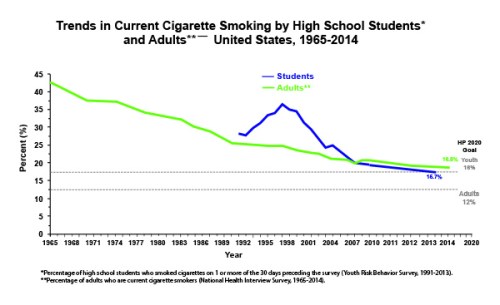
I wonder if it’s related to lower smoking rates.

U.S Smoking Rate Over Time

U.S Smoking Rate Over Time

(graph from Centers for Disease Control)

For details and further conjecture, read the New York Times article:

“Something strange is going on in medicine. Major diseases, like colon cancer, dementia and heart disease, are waning in wealthy countries, and improved diagnosis and treatment cannot fully explain it.

Scientists marvel at this good news, a medical mystery of the best sort and one that is often overlooked as advocacy groups emphasize the toll of diseases and the need for more funds. Still, many are puzzled.”

Source: A Medical Mystery of the Best Kind: Major Diseases Are in Decline – The New York Times