Category Archives: Longevity

What happens after you die?

Blogger Claire Wolfe posted an interesting story that may change your perspective on the worries of the day:

“As many know by now – I died on October 6 – a Thursday.

I suffered the whole flat-line CPR + defibrillation for four minutes. Only the incredibly professional Grafton VOLUNTEER Ambulance Service (and good neighbors and good luck ) saved my butt.

I was asked several questions after this experience – did I feel the shocks, what do I remember, etc.. One question was – “What was your last thought before losing consciousness?

”Well, actually, I remember the last TWO thoughts before dying –

“Oh shit, it’s Thursday.

”Followed by

“I should have a more uplifting last thought than THAT!”

Source: What happens after you die – Living Freedom

RTWT.

Mediterranean diet could prevent 20,000 deaths in Britain each year 


Italian seaside tangentially related to this post

Italian seaside tangentially related to this post

The Telegraph has the details:

“Some 20,000 lives could be saved each year if Britons switched to a Mediterranean diet, according to a new study.

The Medical Research Council (MRC) and Cambridge University followed nearly 24,000 people in the UK for up to 17 years to see how their diet affected the health of their heart.

They discovered that people who followed a diet high in fruits, vegetables, whole grains, nuts, fish and olive oil lowered their risk of cardiovascular disease by up to 16 per cent. The researchers estimate that 12.5 per cent of cardiovascular deaths, such as heart attacks and strokes,  could be prevented if everyone switched to the Mediterranean diet. There are around 160,000 heart deaths each year so 20,000 deaths could be avoided just by eating more healthy foods.”

Source: Mediterranean diet could prevent 20,000 deaths in Britain each year 

Brain Shrinkage Linked to Loss of Youthful Thinking Ability

MNT has a headline pregnant with possibility:

‘Super agers’ avoid brain shrinkage, retain youthful thinking abilities

The problem is, we don’t know how to prevent brain shrinkage. The “super agers” may simply have won the genetic lottery. Other factors that might help prevent brain shrinkage include 1) not smoking, 2) the Mediterranean diet, 3) keep your brain actively engaged as you age, 4) exercise, 5) avoid obesity, 6) don’t drink too much alcohol, and 7) consume cold-water fatty fish.

From MNT:

“Touroutoglou and colleagues conducted imaging studies on the brains of the super agers that revealed that the prefrontal cortex and hippocampus (that typically shrink with age) were similar in size to those of young adults.

“We looked at a set of brain areas known as the default mode network, which has been associated with the ability to learn and remember new information, and found that those areas, particularly the hippocampus and medial prefrontal cortex, were thicker in super agers than in other older adults. In some cases, there was no difference in thickness between super agers and young adults,” Touroutoglou says.

Barrett points out that the team also examined a group of regions in the brain known as the salience network – involved in identifying information that is important and that needs attention for specific situations – and found that several areas had preserved thickness among super-agers, including the anterior insula and orbitofrontal cortex.”

Source: ‘Super agers’ avoid brain shrinkage, retain youthful thinking abilities – Medical News Today


At 145, ‘Longest living human’ is ready for death

I’m skeptical about his age, but suppose it’s possible. Click the link below to find out what he credits for his longevity.

“An Indonesian man who claims to be the longest living human in recorded history has described how he “just wants to die”.

Mbah Gotho, from Sragen in central Java, was born on December 31, 1870, according to the date of birth on his identity card.

Now officials at the local record office say they have finally been able to confirm that remarkable date as genuine.

If independently confirmed, the findings would make Mr Gotho a staggering 145 years old – and the longest lived human in recorded history.”

Source: ‘Longest living human’ says he is ready for death at 145

FTC Says Eukanuba Won’t Prolong Fido’s Life

From CBSNews.com:

“Mars Petcare, one of the country’s largest makers of dry pet food, ran a 2015 ad campaign for Eukanuba on TV, online and in print publications citing a 10-year scientific study that purportedly showed the product could extend dogs’ lifespan by 30 percent or more. The ads also pointed to a number of dogs, including three Labrador retrievers named “Iowa,” “Utah” and “Bunny,” that the company said were thriving well beyond the breed’s average 12-year lifespan.

“What we observed was astonishing,” the company said in its ads, according to the FTC.

FTC said that, in fact, the study showed that dogs that were fed Eukanuba lived no longer than dogs of the same breed typically do.”

Source: The arf-ful truth: That pricey dog food won’t extend Fido’s life – CBS News

The Vampires Are Right: Blood Transfusions from Young People Slow Aging

That’s the claim anyway.

From MIT Technology Review:

“The latest advancement in anti-aging therapies hardly sounds like modern medicine at all. Ambrosia, a startup based in Monterey, California, is launching a clinical trial to inject the blood of young people into just about anyone aged 35 and up—if they’re willing to pay $8,000.

Young-to-old blood transfusions hit the limelight in 2014 when Harvard Stem Cell Institute researcher Amy Wagers discovered that the blood of young mice improved muscle, heart, and brain function in older mice.”

Source: The Next Health Fad? Blood Transfusions from Young People

If this pans out, I bet it can be done for much less than $8,000.

Hope: A Huge Cost Driver in Medicine 

mountains above the clouds

As a hospitalist, I often end up taking care of patients who are clearly near the end of their lives. Usually I don’t know them well. I don’t know what they’ve been through. I wonder what their regular doctors have been telling them, if anything, about their chances of survival. Too often, I’m the one discussing end of life issues that should have been addressed three months ago.

After reading the article linked below, I have a bit more understanding of the situation. A sample:

“Cancers vary in prognosis. Cancers vary in their response to treatment. This begs the question: In the absence of perfect information, what should the oncologist tell the patient? Should the oncologist reveal the median survival only? If so, why? What normative ethics say only the central tendencies of a distribution be disclosed? Should the oncologist give a whiff of hope that the patient could be an outlier? Should the oncologist mention the short left and not long right tail and stress the imminence of death so that the patient can die gracefully? What is the truth? Is it the median, the long tail of optimism or the short tail of pessimism? If all three are truths which truth should be mentioned first and which truth should be mentioned last?”

Source: Hope: A Huge Cost Driver in Medicine | Medpage Today

Finally Some Good News: Major Diseases Are in Decline 

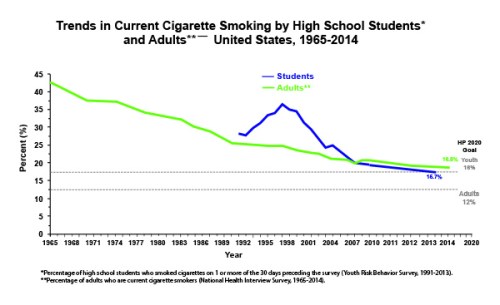
I wonder if it’s related to lower smoking rates.

U.S Smoking Rate Over Time

U.S Smoking Rate Over Time

(graph from Centers for Disease Control)

For details and further conjecture, read the New York Times article:

“Something strange is going on in medicine. Major diseases, like colon cancer, dementia and heart disease, are waning in wealthy countries, and improved diagnosis and treatment cannot fully explain it.

Scientists marvel at this good news, a medical mystery of the best sort and one that is often overlooked as advocacy groups emphasize the toll of diseases and the need for more funds. Still, many are puzzled.”

Source: A Medical Mystery of the Best Kind: Major Diseases Are in Decline – The New York Times

Telomere length and the cancer-atherosclerosis trade-off 

Telomeres are a hot research area now. If you can keep your telomeres long, you may live longer. But that may be an oversimplification. Click the link below for details. A teaser:

“Telomeres are caps of tandem repeats of DNA that protect the ends of all chromosomes. They are implicated in ageing because, with successive bouts of cell division, they are gradually whittled away to expose chromosomes to damage and, eventually, an inability to replicate any further. Sarah Tishkoff, together with co-authors Rivka Stone and Abraham Aviv, from the New Jersey Med School, and several others, have been taking a hard look at the evolution of telomere length across species and human groups and argue that there is a direct relationship between telomere length and susceptibility to cancer and atherosclerosis (and other diseases of ageing). Specifically, they describe evidence for an evolutionary trade-off whereby shorter telomeres in some human groups protect against cancer but expose individuals to a greater risk of other diseases in later life.”

Source: Telomere length and the cancer – atherosclerosis trade-off – The Evolution and Medicine Review

Why Not Live to 100? Your extra years are mostly healthy ones

dementia, memory loss, Mediterranean diet, low-carb diet, glycemic index, dementia memory loss

“I don’t want to live that long if I’m disabled and a burden to others.”

“An exceptionally long lifespan does not necessarily mean living more years with disease and disability. It seems that centenarians tend to live their extra years in good health, with illness striking decades later in life compared with younger counterparts.The study finds that unlike counterparts decades younger, people who live exceptionally long lives have a much shorter period of illness that is compressed into just months or weeks at the end of their lifespan.

This was the conclusion researchers came to after examining the health status of 3,000 centenarians and near-centenarians taking part in two ongoing longevity studies.”

Source: Centenarians’ extra years are mostly healthy ones – Medical News Today