Category Archives: Exercise

Ibuprofen and Acetaminophen Enhance Exercise-Induced Muscle Strength and Size in Older Adults

The study involved 12 weeks of resistance training in 36 adults who were in their 60s. Subjects were randomly assigned to take acetaminophen, ibuprofen, or placebo for the duration of the study. The acetaminophen dose (e.g., Tylenol) was 4000 mg/day and the ibuprofen dose (e.g., Advil) was 1200 mg/day. The total daily amount was divided into three doses.

Compared to placebo, the drug-takers saw a 25-50% increase in muscle mass and strength. The authors attribute the benefit to inhibition of cyclooxygenase (COX).

In case you’re tempted to try this hack on yourself, you might want to run it by your doctor first. For instance, I wouldn’t take the acetaminophen if I had chronic liver disease. I’d eschew the ibuprofen if I had kidney impairment, were prone to bleeding, had stomach ulcers or gastritis, or were taking a strong blood thinner.

Update December 20, 2014: Ibuprofen seems to increase lifespan in several species. Humans, too?

Steve Parker, M.D.

h/t P.D. Mangan

Magnesium Supplementation May Enhance Effects of Exercise in Elderly Women

…according to this study published at American Journal of Clinical Nutrition.

Average age of study subjects was 71

Average age of study subjects was 71

Weekly mild exercise sessions were supplemented with 300 mg/day of magnesium. Those taking the supplement showed improved physical performance compared with control subjects. Whether effects are long-lasting is unknown; the study lasted only 12 weeks.

Steve Parker, M.D.

Magnesium Oxide Supplement Boosted Performance in Exercising Elderly Women

AJCN has the details. I’d like to see replication of these study results by other researchers. If you’re tempted to start a magnesium supplement, be aware the you could get toxic blood levels of the mineral if you have kidney impairment; check with your doctor.

QOTD: J. Stanton on Exercise and Weight Loss

Exercise is not important because it burns calories! Exercise without calorie restriction is a remarkably ineffective weight loss intervention, because it usually makes us hungry enough to replace the calories we burn. Exercise is important because it restores your ability to oxidize fat—both when fasting and after meals. And we can tie this in with mitochondrial dysfunction by noting that exercise is proven to increase mitochondrial volume.

J. Stanton

Muscle-Bound Action Heroes: Is it Mother Nature, CGI, Genetics, or Juice?

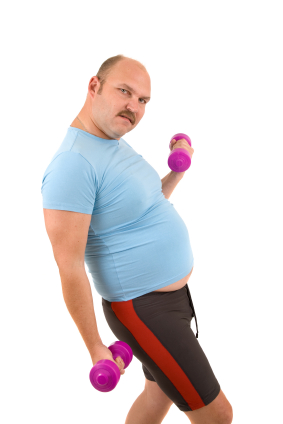
exercise for weight loss and management, dumbbells

This ain’t cuttin’ it, dude

Logan Hill has an interesting article in Men’s Journal on how actors get that muscled-up lean action hero body. He talks about how an impressive physique is almost a basic requirement to make it in Hollywood these days. It’s not like the good old days. Note the difference between the James Bond of Sean Connery and Daniel Craig (photo at the link). A quote:

Even the type of muscle has changed. “In the Eighties, it was the bigger, the better,” says director Tim Burton. “Think of that shot from Rambo of Sly holding the machine gun and the veins in his forearms bulging.” Actors rarely bulk up like that anymore; they’re all trying to be Tyler Durden.

Every trainer interviewed for this story cited Brad Pitt’s ripped physique in 1999’s Fight Club as an inspiration. Previously known for his lush, golden hair, the girls’ guy Pitt was reborn as Durden, a sinewy, predatory man’s man. “Brad Pitt in Fight Club is the reference for 300,” says Mark Twight, who trained the cast for 300. “Everyone thought he was huge, but he was, like, 155 pounds. If you strip away fat and get guys to 3, 4 percent body fat, they look huge without necessarily being huge.”

To get that hungry look, trainers stress calorie-conscious diets and exercises that pump up fat-burning metabolism. No actor can gain 10 pounds of muscle in a six-week period, but he can lean down to reveal the muscle underneath. Trainers talk about the “lean out” – the final, preshoot crash period when actors drop their BMI (body-mass index) to its bare minimum and unveil muscle definition.

You’ll read about insane commitment to exercise, high-protein diets, rapid weight loss and muscle definition, HGH, anabolic steroids, and even insulin. I imagine a $6 million paycheck is a good motivator.

Read the whole enchilada.

Steve Parker, M.D.

Update September 12, 2014: Mike at Danger and Play says the Logan Hill article is malarkey. You decide. When Mike refers to “gear,” think anabolic or androgenic steroids.

QOTD: Rippetoe on Squats

The below-parallel squat is the best exercise in the entire catalog for whole-body strength, power, balance, coordination, bone density, joint integrity, and mental toughness — good things to develop if you don’t have them.

—Mark Rippetoe

Obese Women Exercise Vigorously Just One Hour per Year

…and obese men in the U.S. don’t do much better at 3.6 hours/year. I exercise vigorously about 50 hours/year.

exercise for weight loss and management, dumbbells

If you’re not familiar with weight training, a personal trainer is an great idea

myfoxny.com has the story based on a recent article in Mayo Clinic Proceedings. A quote:

What kind of lives are the most inactive people living? “I think they’re living the typical life. They drive their children to school, they sit at a desk all day long, they may play some video games and they go to sleep,” Archer said.


Without a doubt, it’s hard to exercise if you’re markedly obese. Here’s how.

Read more: http://www.myfoxny.com/story/24774893/average-obese-woman-gets-just-1-hour-of-exercise-a-year-study#ixzz2u2MMctiW

Got Abdominal Obesity? Improve Your Health With Mediterranean Diet and High-Intensity Interval Training

…according to the Heart and Stroke Foundation. Some quotes:

The study found an average reduction in waist circumference of eight centimeters [3 inches], a reduction in systolic blood pressure of 6 mm Hg and an aerobic fitness improvement of 15 per cent over the first nine months of the study.

Improvements in waist circumference, blood pressure and fitness can lead to numerous other health benefits including a reduced risk of developing high blood pressure, as well as improving osteoarthritis symptoms, quality of life, physical functioning, and cognition.

The high-intensity interval training was done two or three times a week over 20-30 minutes each session. Click for an example of HIIT on a stationary bike. More basic info on HIIT.

The classic Mediterranean diet has too many carbohydrates for many diabetics, although it’s better for them than the Standard American Diet. That’s why I devised the Low-Carb Mediterranean Diet.

Steve Parker, M.D.

Another Reason for Regular Exercise…

…before you break your hip. From MedPageToday:

After a hip fracture or other serious fall-related injury, how much independence older adults regained depended to a large extent on how well they were doing beforehand, a study showed.

Functional trajectories were tightly linked, with rapid recovery observed only in those with no or mild disability before the fall,Thomas M. Gill, MD, of Yale University, and colleagues found.

Read the rest.

Need a fitness program? Consider this one.

Steve Parker, M.D.

Your Genes Determine Your Personal Response to Physical Training

Her response depends on genes, training program, nutrition, discipline, adequate sleep, adequate rest, etc.

Her response to depends on genes, training program, nutrition, discipline, adequate sleep, adequate rest, etc.

Here’s an excerpt from an interview with author David Epstein in Outside online. Epstein wrote The Sports Gene: Inside the Science Of Extraordinary Athletic Performance:

Interviewer: That’s one of the most fascinating and unexpected parts of the book, where you discuss the Heritage study’s findings on trainability. Explain its implications.

Epstein: That’s the most famous exercise-genetics study ever done. It’s the collaboration of five colleges in the U.S. and Canada. They took sedentary, two-generation families, which didn’t have a training history, and put them through stationary-bike exercise plans that were totally controlled. Families had to go into the lab and exercise over five months. The goal was to see how people would improve, and they were split into four different university centers to do the training and every center saw the exact same pattern. About 15% of people improved their aerobic capacity very little or not at all. And 15% improved 50% or more doing identical training. Families tended to stick together in the improvement curve, so about half of any person’s improvement was determined by their parents. I remember the editorial that ran in the journal of applied physiology “some people’s alphabet soup—meaning their DNA—didn’t spell ‘runner.’” One person training the exact same as another person can have completely different outcomes.

The exercise in this study was aerobic training. If I recall correctly, I’ve read similar reports regarding response to weight training, aka resistance training. Am I right?

Many folks don’t like to admit this genetic limitation, assuming it’s true. “Set your mind to it, work hard—10,000 hours—and you can do or be anything you want.” Have you ever been tortured by unrealistic expectations? The truth will set you free.

Read the rest.

Steve Parker, M.D.