Viagra (one brand name for generic sildenafil) is used to treat erectile dysfunction and pulmonary hypertension. I bet that usage for ED is far more common than for pulmonary hypertension.
…the team analyzed insurance claims data from more than 7 million Americans. They found that the people (mostly men) who took sildenafil were 69% less likely to develop AD [Alzheimer’s Disease] over 6 years than those who did not take the drug. This association between sildenafil and AD held after adjusting for sex, age, and other diseases and conditions.
To understand how sildenafil might affect AD, the researchers grew neurons from stem cells derived from AD patients. Exposing the cells to sildenafil led to increased growth of neurites, which connect neurons to each other, and decreased tau phosphorylation, an early biomarker of AD.
Taken together, these results show an association between sildenafil use and reduced AD risk. But the researchers emphasize that they haven’t shown that sildenafil prevents or reverses AD.
These things usually don’t pan out, but one can hope. How often were these guys taking viagra? Once a month? Twice a week? To treat erectile dysfunction, sildenafil is typically taken as needed one hour before sexual activity. Typical dose for pulmonary hypertension is 20 mg by mouth three times a day, every day. Would this drug affect dementia in women? As they say, further studies are needed.
Posted onJune 28, 2021|Comments Off on Ketogenic Diet Shows Promise in Alzheimer’s Disease
“Sweat Pea, it’s not too late to go keto.”
Here’s the abstract of an article in Advances in Nutrition:
Alzheimer disease (AD) is a global health concern with the majority of pharmacotherapy choices consisting of symptomatic treatment. Recently, ketogenic therapies have been tested in randomized controlled trials (RCTs), focusing on delaying disease progression and ameliorating cognitive function. The present systematic review aimed to aggregate the results of trials examining the effects of ketogenic therapy on patients with AD/mild cognitive impairment (MCI). A systematic search was conducted on PubMed, CENTRAL, clinicaltrials.gov, and gray literature for RCTs performed on adults, published in English until 1 April, 2019, assessing the effects of ketogenic therapy on MCI and/or AD compared against placebo, usual diet, or meals lacking ketogenic agents. Two researchers independently extracted data and assessed risk of bias with the Cochrane tool. A total of 10 RCTs were identified, fulfilling the inclusion criteria. Interventions were heterogeneous, acute or long term (45-180 d), including adherence to a ketogenic diet, intake of ready-to-consume drinks, medium-chain triglyceride (MCT) powder for drinks preparation, yoghurt enriched with MCTs, MCT capsules, and ketogenic formulas/meals. The use of ketoneurotherapeutics proved effective in improving general cognition using the Alzheimer’s Disease Assessment Scale-Cognitive, in interventions of either duration. In addition, long-term ketogenic therapy improved episodic and secondary memory. Psychological health, executive ability, and attention were not improved. Increases in blood ketone concentrations were unanimous and correlated to the neurocognitive battery based on various tests. Cerebral ketone uptake and utilization were improved, as indicated by the global brain cerebral metabolic rate for ketones and [11C] acetoacetate. Ketone concentrations and cognitive performance differed between APOE ε4(+) and APOE ε4(-) participants, indicating a delayed response among the former and an improved response among the latter. Although research on the subject is still in the early stages and highly heterogeneous in terms of study design, interventions, and outcome measures, ketogenic therapy appears promising in improving both acute and long-term cognition among patients with AD/MCI. This systematic review was registered at http://www.crd.york.ac.uk/prospero as CRD42019128311.
Posted onDecember 29, 2020|Comments Off on Blood Pressure Lowering Barely Lowered the Incidence of Dementia in New Meta-Analysis
“C’mon now! Let’s go Mediterranean before it’s too late.”
I haven’t read the entire article below and probably won’t ever. It will be used to promote treatment of mild to moderate hypertension in order to prevent dementia, despite cost and drug side effects. Results are distinctly unimpressive. Four years of drug therapy reduced the incidence of dementia and cognitive decline by less than 1%.
I was expecting and hoping for a much more significant reduction. Nevertheless, anti-hypertensive drug therapy is pretty well established as an effective preventative for cardiovascular disease, including stroke.
From JAMA Network:
Fourteen randomized clinical trials were eligible for inclusion (96 158 participants), of which 12 reported the incidence of dementia (or composite of dementia and cognitive impairment [3 trials]) on follow-up and were included in the primary meta-analysis, 8 reported cognitive decline, and 8 reported changes in cognitive test scores. The mean (SD) age of trial participants was 69 (5.4) years and 40 617 (42.2%) were women. The mean systolic baseline blood pressure was 154 (14.9) mm Hg and the mean diastolic blood pressure was 83.3 (9.9) mm Hg. The mean duration of follow-up was 49.2 months. Blood pressure lowering with antihypertensive agents compared with control was significantly associated with a reduced risk of dementia or cognitive impairment (12 trials; 92 135 participants) (7.0% vs 7.5% of patients over a mean trial follow-up of 4.1 years; odds ratio [OR], 0.93 [95% CI, 0.88-0.98]; absolute risk reduction, 0.39% [95% CI, 0.09%-0.68%]; I2 = 0.0%) and cognitive decline (8 trials) (20.2% vs 21.1% of participants over a mean trial follow-up of 4.1 years; OR, 0.93 [95% CI, 0.88-0.99]; absolute risk reduction, 0.71% [95% CI, 0.19%-1.2%]; I2 = 36.1%). Blood pressure lowering was not significantly associated with a change in cognitive test scores.
Conclusions and Relevance
In this meta-analysis of randomized clinical trials, blood pressure lowering with antihypertensive agents compared with control was significantly associated with a lower risk of incident dementia or cognitive impairment.
Posted onDecember 9, 2020|Comments Off on Will Your Proton Pump Inhibitor Cause Dementia?
I have nothing against Prilosec in particular. It can be very helpful.
We have two major classes of drugs that reduce acid production by the stomach. The first was H2 blockers, the granddaddy being Tagamet (cimetidine). Tagamet was the first PPI (proton pump inhibitor) on the market in the U.S., probably 25-30 years ago. Several H2 blockers are are available without a prescription. The second and later class of acid-reducing drugs is the PPI. These are more potent than H2 blockers. Because of H2 blockers and PPIs, and the discovery that H. pylori causes many ulcers, we have many fewer patients requiring surgery for upper gastrointestinal ulcers. Surgery like vagotomy and pyloroplasty. Once the ulcer heals, most folks don’t need to take a PPI for the rest of their lives.
There are reasons our stomachs produce acid. One is that the acid helps kill pathogens in our food before they make us sick. Another is to start the digestion of proteins we eat. You can imagine that drastically reducing stomach acid production has some potential adverse effects.
A German population study a few years ago linked PPI usage with higher risk of dementia.
A total of 73,679 participants 75 years of age or older and free of dementia at baseline were analyzed. The patients receiving regular PPI medication (n = 2950; mean [SD] age, 83.8 [5.4] years; 77.9% female) had a significantly increased risk of incident dementia compared with the patients not receiving PPI medication (n = 70,729; mean [SD] age, 83.0 [5.6] years; 73.6% female) (hazard ratio, 1.44 [95% CI, 1.36-1.52]; P < .001).
“Sweat Pea, why don’t you ask you doctor if it’s safe to stop that PPI you’ve been taking for the last six months?”
The avoidance of PPI medication may prevent the development of dementia. This finding is supported by recent pharmacoepidemiological analyses on primary data and is in line with mouse models in which the use of PPIs increased the levels of β-amyloid in the brains of mice. Randomized, prospective clinical trials are needed to examine this connection in more detail.
I don’t know about Germany, but there’s evidence that the incidence of dementia has been decreasing lately in the U.S. I’m guessing that the use of PPIs has been increasing over the last couple decades. So this doesn’t fit with the PPI-dementia theory.
Posted onOctober 27, 2020|Comments Off on Low-Carb Diet May Boost Brain Health
MRI of brain
From Stony Brook University News:
A diet low in carbohydrates could stave off, or even reverse, the effects of aging on the brain, Stony Brook-led research finds.
A study using neuroimaging led by Stony Brook University professor and lead author Lilianne R. Mujica-Parodi, PhD, and published in PNAS, reveals that neurobiological changes associated with aging can be seen at a much younger age than would be expected, in the late 40s. But the study also suggests that this process may be prevented or reversed based on dietary changes that involve minimizing the consumption of simple carbohydrates.
Even in younger adults, under age 50, dietary ketosis (whether achieved after one week of dietary change or 30 minutes after drinking ketones) increased overall brain activity and stabilized functional networks.
Posted onFebruary 13, 2020|Comments Off on Avoid Soybean Oil (if you’re a male mouse)
Soybean oil seems to be a real problem for male mice. We need more research in humans before declaring it a dangerous toxin to us. If you’re eating the Standard American Diet, you’ll find it hard if not impossible to avoid.
From EurekAlert:
New UC Riverside research shows soybean oil not only leads to obesity and diabetes, but could also affect neurological conditions like autism, Alzheimer’s disease, anxiety, and depression.
Used for fast food frying, added to packaged foods, and fed to livestock, soybean oil is by far the most widely produced and consumed edible oil in the U.S., according to the U.S. Department of Agriculture. In all likelihood, it is not healthy for humans.
Posted onFebruary 2, 2020|Comments Off on Can a Healthy Lifestyle Offset Your Genetic Risk for Dementia?
Yes, according to a study I found at JAMA Network.
The research was done in the UK and involved over 500,000 older adults of European ancestry, free of dementia and cognitive impairment at baseline.
So what are the healthy lifestyle characteristics linked to lower risk of dementia, whether you have genetic risk or not?
Physical activity
Not smoking
Healthy diet
Judicious alcohol consumption
Lifestyle details from the research report:
A healthy lifestyle score was constructed based on 4 well-established dementia risk factors (smoking status, physical activity, diet, and alcohol consumption) assessed at baseline using a touchscreen questionnaire. Participants scored 1 point for each of 4 healthy behaviors defined on the basis of national recommendations (full details in eTable 1 in Supplement 1). Smoking status was categorized as current or no current smoking. Regular physical activity was defined as meeting the American Heart Association recommendations of at least 150 minutes of moderate activity per week or 75 minutes of vigorous activity per week (or an equivalent combination) or engaging in moderate physical activity at least 5 days a week or vigorous activity once a week. Healthy diet was based on consumption of at least 4 of 7 commonly eaten food groups following recommendations on dietary priorities for cardiometabolic health, which are linked to better late-life cognition and reduced dementia risk. Previous studies of alcohol consumption and dementia risk support a U-shaped relationship, with moderate consumption associated with lower risk. Therefore, moderate consumption was defined as 0 to 14 g/d for women and 0 to 28 g/d for men, with the maximum limit reflecting US dietary guidelines.
What do they consider a healthy dementia-preventing diet? At least four of the following food groups and consumption levels:
Fruits: 3 or more servings a day
Veggies: 3 or more servings a day
Fish: 2 or more servings a week
Processed meats: no more than 1 serving a week
Unprocessed red meats: no more than 1.5 servings a week
Whole grains: 3 or more servings a day
Refined grains: no more than 1.5 servings a day
Regarding alcohol, the guideline is no more than one drink a day for women, and no more than two a day for men. Do a web search for standard drink sizes if needed. “One drink” is 14 grams of pure alcohol.
This stuff is good to know if dementia runs in your family.
Steve Parker, M.D.
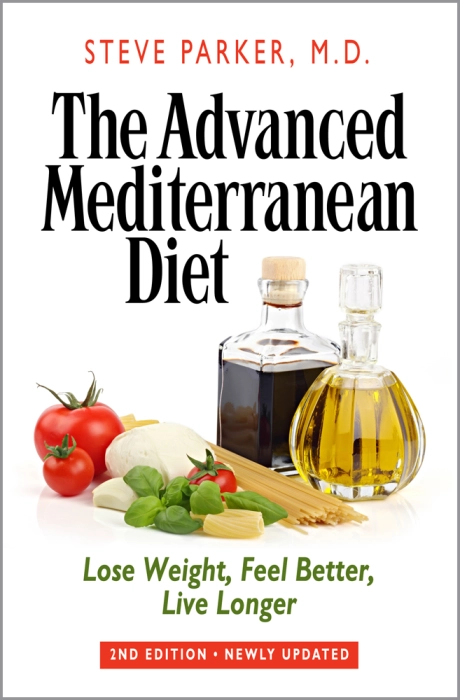
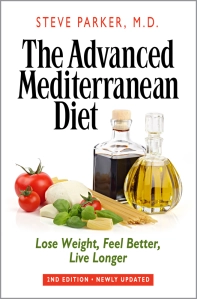
PS: Guess what else prevents dementia…the traditional Mediterranean diet.
Click the pic to purchase at Amazon.com. E-book versions also available at Smashwords. com.

Posted onJanuary 13, 2020|Comments Off on Moderate Wine Consumption May Prevent Dementia
…according to an article at Revue Neurologique:
The inverse relationship between moderate wine drinking and incident dementia was explained neither by known predictors of dementia nor by medical, psychological or socio-familial factors. Considering also the well documented negative associations between moderate wine consumption and cardiovascular morbidity and mortality in this age group, it seems that there is no medical rationale to advise people over 65 to quit drinking wine moderately, as this habit carries no specific risk and may even be of some benefit for their health. Advising all elderly people to drink wine regularly for prevention of dementia would be however premature at this stage.
But: alcohol is linked to higher risk of breast cancer
Posted onDecember 27, 2019|Comments Off on The Right Workout Routine Helps Fight Dementia
A slow leisurely pace won’t cut it
Dementia is a devastating and expensive development for an individual and his family. Most dementias are progressive and incurable. If it can be prevented, it should be. Exercise is one preventative. But how much and what kind of exercise?
Nine percent of U.S. adults over 65 have dementia. That’s 3.650,000 folks.
From The Globe and Mail:
In 2017, a team led by the lab’s director, Jennifer Heisz, published a five-year study of more than 1,600 adults older than 65 that concluded that genetics and exercise habits contribute roughly equally to the risk of eventually developing dementia. Only one of those two factors is under your control, so researchers around the world have been striving to pin down exactly what sort of workout routine will best nourish your neurons.
Heisz’s latest study, published last month in the journal Applied Physiology, Nutrition, and Metabolism, offers a tentative answer to this much-debated question. Older adults who sweated through 12 weeks of high-intensity interval training improved their performance on a memory test by 30 per cent compared with those who did a more moderate exercise routine.
This was a small study, only about 20 sedentary participants (all over 60 years old) subjected to one of three protocols for twelve weeks, exercising thrice weekly:
Four-minute bouts of vigorous treadmill walking at 90-95% of maximum heart rate, repeated four times, with three minutes easy walking between the high-intensity spells intervals (HIIT)
Walking at 70-75% of max heart rate for 47 minutes (burning the same number of calories as group #1
Thirty minutes of relaxed stretching
Alex Hutchinson’s full article is well worth a couple minutes of your time if you want to avoid dementia.
Posted onNovember 22, 2019|Comments Off on A practical guide to the Mediterranean diet – From Harvard
There are myriad reasons the traditional Mediterranean diet is considered one of the healthiest diets. From Harvard Medical Publishing, an article written by a Registered Dietitian:
The Mediterranean diet has received much attention as a healthy way to eat, and with good reason. The Mediterranean diet has been shown to reduce risk of heart disease, metabolic syndrome, diabetes, certain cancers, depression, and in older adults, a decreased risk of frailty, along with better mental and physical function. In January [2019], US News and World Report named it the “best diet overall” for the second year running.