Tag Archives: exercise

Starting Hillfit

Today I started Chris Highcock’s Hillfit exercise program.  It’s basically four exercises I can probably finish in 40 minutes a week, split into two sessions.

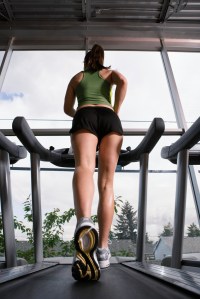
In addition I’ll be doing twice-weekly interval training on a treadmill:

  1. 3-minute warm-up at 5.3 mph, then
  2. 12 minutes of 1-minute fast runs (7-8 mph) alternating with 1-minute slow jogging (5.3 mph), then
  3. 3-minute cool-down by walking 2.5-3 mph

I’ll dial a 1% grade into the treadmill to simulate wind resistance I’d get if outdoors.

After six or eight weeks I’ll switch to another program, such as Jonathan Bailor’s Smarter Science of Slim, which also promises reasonable fitness with relatively little time and equipment investment.

If you hope to exercise regularly, you’ll need to be motivated.  I’ve recorded my motivations.  What’re yours? 

Steve Parker, M.D.

April is Fitness Month: My Motivation

My wife, Sunny, decrees April to be Fitness Month.  No joke.

But it’s more than just fitness.  It’s about eating right, plus exercise.  No dining out for the entire month.  No junk food.  Renewed commitment to physical activity.

In the spirit of Fitness Month, I’m restarting my exercise efforts, which have been on hold for the last month.  I’ve simply been lazy.

I’m trying a new program based on resistance exercise and high-intensity interval training.  All in less than an hour a week.  To help me judge effectiveness, I’ve measured and recorded my baseline fitness.  I’ll re-measure every couple weeks or so.  After six or eight weeks, I’ll switch to a different program.

Exercise isn’t fun.  You need good reasons to do it.  Here are mine:

  • it keeps you young (fountain of youth)
  • longevity
  • less low back aching
  • injury resistance
  • keep my supraspinatous tendonitis (rotator cuff) in remission
  • prevention dementia, heart disease, and cancer
  • I’m a sheepdog, not a sheep
  • weight management
  • emergency preparedness (e.g., carry out an injured Boy Scout from a wilderness area)
  • more energy to enjoy life (hiking, camping, horseback riding, horse stall mucking, horse grooming, hay bale wrangling, long walks with others, etc.)

If you hope to exercise regularly, you’ll need your own list of reasons.  You’ll have days, weeks, or months when you just don’t want to exercise.  Review your list then.

Steve Parker, M.D.

PS:  This is my first post done on my new MacBook Pro.  Woo hoo!  I haven’t given any thought to sources of royalty-free photos to accompany posts.  Any ideas?  I’m used to MS Clip Organizer, which isn’t on this machine.

Should Exercise Be Fun?

Exercise is not supposed to be fun. If it is, then you should suspect that something is wrong.

That quote is from an essay by Ken Hutchins posted at the Efficient Exercise website.

When I was a young man in my 30s, I was jogging 20 miles a week and ran a couple marathons (26.2 miles). I enjoyed it and didn’t do much else for exercise or overall fitness. I thought I was in pretty good shape. You can get away with that when you’re 35, but not when you’re 50. At 57 now, I can’t think of any single recreational activity that can help me maintain the overall strength, functionality, and injury resistance I want and need as I age.

I’ve come to view exercise as a chore, like flossing/brushing teeth, changing the oil in my car, and sleeping when I’d rather not. I’ve got my current exercise chore whittled down to an hour three times a week. OK, sometimes just twice a week.

Skyler Tanner takes a thoughtful and in-depth look at the exercise versus recreation dichotomy at his blog. If you have comments, more people will see them at his site than here.

Steve Parker, M.D.

My Fitness

A maximal exercise treadmill stress test is the standard way researchers measure fitness

This is boring.  You should quit reading now.

A few days ago I suggested some baseline measurements to help you keep track of your fitness level, especially if you’re starting or altering an exercise routine. 

I’m starting a new program soon.  Here are my numbers:

  • Weight: 168 lb (76.2 kg)
  • Height: 5 feet, 11.5 inches (181 cm)
  • Body mass index: 23.3
  • Resting heart rate: pending
  • Blood pressure: pending
  • Maximum consecutive push-ups: 30
  • Maximum consecutive pull-ups: 7
  • Maximum consecutive sit-ups (knees bent, forearms folded over chest): 30
  • 1-mile walk/run: 8 minutes, 45 seconds (jogging anywhere from 6 to 8 mph, average about 6.5 mph)
  • Vertical jump (highest point above ground I can jump to touch): 108 and 3/4 inches (276 cm)
  • Waist circumference: 92 cm (standing) or 87 cm (supine)  [big difference, huh?]
  • Biceps circumference: 33 cm (left) and 33.5 (right)
  • Calf circumference: 39.5 cm (left) and 39 cm (right)
  • Toe touch (stand and lock knees, bend over at waist to touch toes): 7.5 inches (19 cm) above ground

    Me around 2007-2008

I was in much better shape a year ago after I finished 15 weeks of Verstegen’s Core Performance.  The most surprising thing about that plan was that I recovered the ability to bend over and touch my toes; I hadn’t done that since my twenties.  I’m 57 now.  Clearly, I’ve regressed since slacking off from Verstegen’s program. 

I was in much worse shape two years ago, thanks to laziness and the resultant sedentary lifestyle. 

Just before the Verstegen program, I’d also developed some bothersome aching in my left shoulder, probably supraspinatous tendinitis.  I cured that with a couple months of rotator cuff strengthening exercises.

So at this point I’m at an average or moderate level of fitness for me.  If my numbers above seem wimpy, remember that I’m 57-years-old.  Hard to be sure, but I’m fairly confident I’m above the 50th percentile for my age group.

I’ll tell you about my new physical activity plan soon.

Steve Parker, M.D. 

Update April 4, 2012:  I added sit-ups today after finding out that the U.S. Army tests soldiers for sit-ups (among other things) twice yearly.

Baseline Measurements Before Starting a Fitness Progam

Impressive jump!

Before beginning or modifying a fitness program, it’s important to take some baseline physical measurements.  Re-measure periodically.  That way you’ll know whether you’re making progress, holding steady, or regressing.  Seeing improvement in the numbers also helps to maintain motivation.   

Not taking measurements would be like starting a weight loss plan without a baseline and subsequent weights.

Around this time last year, I finished a home-based, 15-week, six-days-a-week fitness program called Core Performance, designed by Mark Verstegen.  I was pleased with the results.  The only problem is that it’s very time-consuming.  Perhaps fitness just has to be that way.

I regret that I didn’t take any fitness measurements before and after starting Core Performance.

For much of the last year, I modified Core Performance to a thrice weekly, then twice weekly program, until a couple months ago when I pretty much abandoned it.  I miss the benefits now, but just didn’t want to put in the time to achieve them.  In other words, I lost my motivation.

Who needs this much flexibility?

Intellectually, I know that regular exercise is important.  I’m starting to get motivated again.  Not sure why.  Perhaps because I’ve read that you can be fairly fit with as little as 30 minutes of exercise a week.  I’m not convinced yet.  I’ll be test-driving some of these time-efficient programs soon.

This new style of fitness is promoted by the likes of Dr. Doug McGuff, Chris Highcock, Skyler Tanner, Nasim Taleb,  and Jonathan Bailor, among others.

What to Measure

  1. Weight
  2. Blood pressure
  3. Resting heart rate (first thing in the AM before getting out of bed)
  4. Waist circumference (upright and supine)
  5. Height
  6. Body mass index
  7. Mid-arm circumference, both arms, hanging relaxed at your sides
  8. Maximal calf circumference, both calves, while standing at ease
  9. Maximum number of consecutive pull-ups
  10. Maximum number of consecutive push-ups
  11. Maximum number of consecutive sit-ups
  12. Run/walk one mile as fast as you can
  13. Maximum vertical jump (stand by a tall wall then jump and reach up as high as you can with one arm, noting the highest point above ground your fingers can reach)
  14. Can you touch your toes?  Stand up straight, locking knees in extension, then bend over at your waist and touch your toes with your fingertips.  If you can touch toes, can you flatten your palms against the floor?  If you can’t reach your toes, measure the distance from your fingertips to the floor.
  15. Optional blood work for special situations: fasting blood sugar, hemoglobin A1c, triglycerides, cholesterols (total, HDL, LDL, sub-fractions)

The particular aspects of fitness these measure are strength and endurance in major muscle groups, cardiovascular and pulmonary endurance, a little flexibility, and a hint of body composition. 

You may appreciate an assistant to help you measure some of these.

Record your numbers.  Re-test some or all of these periodically.  If you’re in fairly poor condition at the outset, you’ll see some improved numbers after a couple or three weeks of a good exercise program.  It takes months to build significant muscle mass; you’ll see improved strength and endurance before mass. 

Am I missing anything?

Steve Parker, M.D. 

Update April 4, 2012:  I added the sit-ups today after finding out that’s one of the measurements the U.S. Army monitors in soldiers twice yearly.