QOTD: James LaFond on War

“The more one can place the person who demands violence outside of the field of violence the more violence they will demand. There was rarely a group of people more against their sons going to war than veterans of the U.S. Pacific War of the 1940s, who generally told the younger men of their families not to go to Vietnam, with some even offering to front money for a trip to Canada.”

Source: JL: ‘The Hand that Rocks the Cradle’

Do Wearable Activity-Trackers Help With Weight Loss?

“Wearable devices that monitor physical activity are not reliable tools for weight loss, says a new study from the University of Pittsburgh School of Education’s Department of Health and Physical Activity. The study specifically investigated whether regular use of commercially available activity trackers is effective for producing and sustaining weight loss.

At the conclusion of a 24-month trial, researchers observed that usage of a wearable device in combination with a behavioral weight loss program resulted in less weight loss when compared to those receiving only the behavioral weight loss program. In fact, participants without physical activity trackers showed nearly twice the weight loss benefits at the end of the 24 months. Participants who utilized wearable devices reported an average weight loss of 7.7 pounds, while those who partook only in health counseling reported an average loss of 13 pounds.”

Source: Activity trackers are ineffective at sustaining weight loss — ScienceDaily

Science News You Can Use: Are Anti-cellulite Creams Worth Your Money? 

I recently just happened to notice some cellulite on an attractive healthy 16-year-old.

From MedicalNewsToday:

“Do anticellulite creams work?

Skin creams and lotions are among the most commonly used methods to help reduce the appearance of cellulite. The presumed effect of these creams is through the active ingredients, which often include:

– Methylxanthines – the most common type of these chemicals used in cellulite creams are caffeine, aminophylline, and theophylline. Caffeine is thought to increase fat metabolism. Aminophylline and theophylline are muscle relaxants that may help promote smoother skin and break down fatty deposits

– Retinol – a vitamin A derivative that may improve blood flow to the skin and improve skin thickness and strength.

– Botanical derivatives – such as Gingko biloba, Centella asiatica, and horse chestnut. The potential aims of including these in cellulite creams are to slow the formation of fat, help to break down fat, and reduce inflammation.”

Source: Anticellulite Creams: Are They Worth Your Money? – Medical News Today

No, they don’t work.

Fanatic Cook Bix Makes the Case For Taking A B12 Supplement 

If you’re really interested in nutrition, you should be reading Bix regularly:

“Vitamin B12 follows a rather circuitous path to absorption. First, of course, you have to eat it. Then you have to free it from the proteins to which it’s bound, so you need a healthy amount of stomach acid. Stomach acid levels decline as we age. They’re also affected by drugs like antacids which are taken for gastric conditions that occur more frequently in the elderly. Once the vitamin is freed, it must bind to a specific protein called Intrinsic Factor (IF) which is secreted by cells that line the stomach. That’s a major stumbling block right there. Anything that damages those parietal cells will cause outright B12 deficiency. (Some people don’t secrete much IF to begin with.) Like? … Ulcers, tumors, scar tissue from ulcers & tumors, any kind of inflammation or gastritis, alcohol intake, and, naturally, the removal of these cells through weight loss or cancer surgery. Intrinsic Factor also doesn’t bind well in an acidic environment. Remember we needed an acidic environment, a low pH, to release B12 from its protein source? Well, now we need a higher pH, about 7, for binding. The pancreas releases buffers to raise the pH of gastric juice. Anything that interferes with pancreatic secretion (diabetes, cancer, cystic fibrosis, etc.) will interfere with B12 absorption. Right, now the IF-B12 complex travels to the small intestine where it’s absorbed. B12 needs to be freed from IF. The pancreas would have secreted enzymes to do that. No enzymes? Poor absorption. Finally it gets absorbed. Any damage to the lower part of the small intestine (celiac disease or other gluten-induced damage, cancer surgery, scar tissue, overrun by bacteria from the colon) will result in poor B12 absorption.”

Source: Repost: The Case For Taking A B12 Supplement | Fanatic Cook

BTW, Bix seems to be a vegetarian or vegan, but don’t hold that against him.

Night Shift Work Is Dangerous

Not very pertinent, but a cool picture

Not very pertinent, but a cool picture

Shift work can kill you.

I’ve seen studies associating night shift work with T diabetes in Japanese men, higher breast cancer rates, more metabolic syndrome, and higher heart disease risk in men.

Now we have evidence for higher diabetes rates in women who do shift work”

“Our results suggest that an extended period of rotating night shift work is associated with a modestly increased risk of type 2 diabetes in women, which appears to be partly mediated through body weight. Proper screening and intervention strategies in rotating night shift workers are needed for prevention of diabetes.”

Source: PLOS Medicine: Rotating Night Shift Work and Risk of Type 2 Diabetes: Two Prospective Cohort Studies in Women

Action Plan: P.D. Mangan has some ideas.

Also, reduce your risk of cancer, heart disease, and diabetes with the Mediterranean diet.

Steve Parker, M.D.

PS: If you get one of my books, stay safe and read it during the day.

Dr. Gorski on diet and exercise versus cancer: A science-based view 

You need to worry about cancer because you have a roughly four in 10 chance of coming down with invasive cancer. (Skin cancers like squamous cell and basal cell are quite common, but rarely invasive.)

Dr. David Gorski is a breast cancer surgeon. He’s looked at the scientific literature on the linkage between diet and exercises, and the risk of developing cancer.

Here’s his conclusion from his review at Science-Based Medicine:

“You can reduce your risk of cancer by staying active and exercising, eating a healthy diet with a lot of plant-based foods and minimizing intake of processed meats, limiting alcohol consumption (although I think the WCRF/AICR guidelines go a bit too far in saying that you shouldn’t drink at all if possible), and maintaining a healthy weight. (Of course, if you stay active and eat a healthy diet, maintaining a healthy weight will probably not be a problem.) Conceptually, it’s easy to do. In practice, as I’m discovering, it’s anything but easy.”

Source: Diet and exercise versus cancer: A science-based view « Science-Based Medicine

The Mediterranean diet seems to protect against cancer.

Steve Parker, M.D.

PS: One of the reasons I write diet books is that I want to keep you from getting cancer.

Skinny Women Are More Likely to Get That Service Sector Job

“Your worst fears have been confirmed, working ladies.

A study by researchers in the UK and Canada, published in the journal PLOS One, found that women who are on the heavier end of the “healthy” Body Mass Index, or BMI, range were subject to more weight-based prejudice than men who were solidly overweight.”

Source: Employers are more likely to hire skinny women | New York Post

I’m not too surprised about finding. And I’m not saying it’s right.

Easily calculate your BMI here.

Steve Parker MD, Advanced Mediterranean Diet

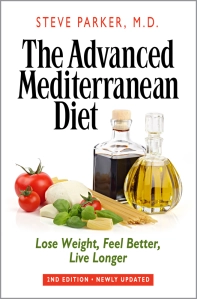
Two diet books in one

Chronic Daily Alcohol Consumption Linked to Atrial Fibrillation

Photo copyright: Steve Parker MD

Photo copyright: Steve Parker MD

Atrial Fibrillation is the most common serious heart rhythm disturbance in folks over 50. It can cause strokes, chest pain, trouble breathing, palpitations, dizziness, fainting, and other problems.

Many cases of atrial fibrillation are of unknown cause, but others are caused by blocked heart arteries, leaky or blocked heart valves, blood mineral disturbances, and overactive thyroid.

Another cause is alcohol consumption. Physicians typically think it takes relatively heavy alcohol consumption, even if just a short-term binge, to cause atrial fibrillation. A recent study suggests low doses could be problematic. From the American Heart Association Newsroom:

“Despite the common perception that moderate alcohol intake is good for the heart, new research suggests long-term alcohol consumption, even as little as one drink a day may enlarge the heart’s left upper chamber (atrium) and increase the risk of developing atrial fibrillation, according to new research in Journal of the American Heart Association, the Open Access Journal of the American Heart Association/American Stroke Association.

“Our study provides the first human evidence of why daily, long-term alcohol consumption may lead to the development of this very common heart rhythm disturbance,” said Gregory Marcus, M.D., senior study author and associate professor of medicine specializing in cardiac electrophysiology at the University of California at San Francisco. “We were somewhat surprised that a relatively small amount of alcohol was associated with a larger left atrium and subsequent atrial fibrillation.”

Source: Drinking alcohol daily may enlarge heart chamber; lead to atrial fibrillation | American Heart Association

Steve Parker, M.D.

PS: Although alcohol is an option with several of my diets, it’s not mandatory.

FDA Making Kratom Illegal

Like many folks, ItsTheWooo ain’t happy about it:

“Now, if you search my blog tags, you guys will know i’ve experimented, and very much benefit from kratom.  I’ve been using kratom for 2 years and counting, and i consider it really a healing substance, that transformed my life considerably. . Kratom has been a very valuable herb to me, which helps my mood and assists my sleep, helps my body regulate weight, and is generally a relaxing pleasant addition to my regimen.The first year i found it, the kratom was so effective it felt like a magical cure. There was greater happiness in my experience of life – it made me happier days after a dose, it kept fall depression completely at bay, and finding it in late august 2 years ago it was as if the summer did not end. It also stopped my brain, made the “noise” go away, let me sleep normally. Kratom seemed to normalize my body rhythm – i woke the same time every day, i slept the same every day. Upon finding kratom , my mood , sleep, everything got so much better; it even helped cure residual “eating problems” , eating became much easier and residual dieting/monitoring behaviors vanished.Work became much easier – the constant struggle with thoughts of people’s intents died down considerably. I could peacefully exist w/o this internal dialogue of suspicion. I performed vastly better at work as a result of kratom resolving these thought issues, as i could interact more normally with coworkers vs “coping” with my thoughts.”

Source: *The Scribble Pad*: Personal update + Kratom discussion (The unethical DEA tramples civil , human rights)

As a hospitalist, I see lots of accidental and intentional drug overdoses and adverse drug effects. But I’ve never seen a patient with an adverse effect from kratom. I’ve never even run across a patient who mentioned taking it.

Brain Shrinkage Linked to Loss of Youthful Thinking Ability

MNT has a headline pregnant with possibility:

‘Super agers’ avoid brain shrinkage, retain youthful thinking abilities

The problem is, we don’t know how to prevent brain shrinkage. The “super agers” may simply have won the genetic lottery. Other factors that might help prevent brain shrinkage include 1) not smoking, 2) the Mediterranean diet, 3) keep your brain actively engaged as you age, 4) exercise, 5) avoid obesity, 6) don’t drink too much alcohol, and 7) consume cold-water fatty fish.

From MNT:

“Touroutoglou and colleagues conducted imaging studies on the brains of the super agers that revealed that the prefrontal cortex and hippocampus (that typically shrink with age) were similar in size to those of young adults.

“We looked at a set of brain areas known as the default mode network, which has been associated with the ability to learn and remember new information, and found that those areas, particularly the hippocampus and medial prefrontal cortex, were thicker in super agers than in other older adults. In some cases, there was no difference in thickness between super agers and young adults,” Touroutoglou says.

Barrett points out that the team also examined a group of regions in the brain known as the salience network – involved in identifying information that is important and that needs attention for specific situations – and found that several areas had preserved thickness among super-agers, including the anterior insula and orbitofrontal cortex.”

Source: ‘Super agers’ avoid brain shrinkage, retain youthful thinking abilities – Medical News Today