Guess What Kind of Diet Can Treat Depression?


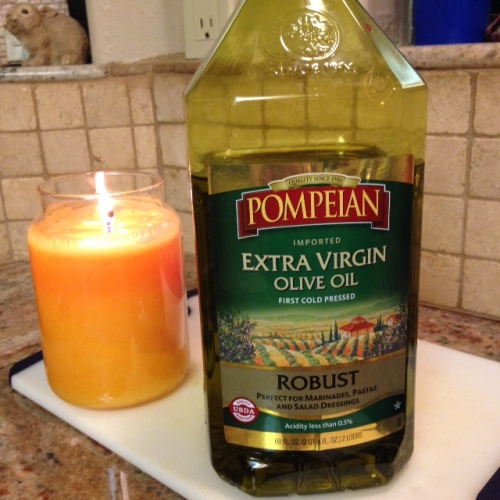
Olive oil is a prominent source of fat in the Mediterranean diet

From Dr. Emily Deans at Psychology Today:

“This year, finally, we have the SMILES trial, the very first dietary trial to look specifically at a dietary treatment in a depressed population in a mental health setting. Participants met criteria for depression and many were already being treated with standard therapy, meds, or both. The designers of this trial took the preponderance of observational and controlled data we already have for general and mental health and decided to train people using dietary advice, nutritional counseling, and motivational interviewing directed at eating a “modified Mediterranean diet” that combined the Australian Dietary Guidelines and the Dietary Guidelines for Adults in Greece. They recommended eating whole grains, vegetables, fruit, legumes, unsweetened dairy, raw nuts, fish, chicken, eggs, red meat (up to three servings per week), and olive oil. Everyone in the study met criteria for a depressive disorder.

The experimental arm of subjects were instructed to reduce the intake of sweets, refined cereals, fried food, fast food, processed meat, sugary drinks, and any alcohol beyond 1-2 glasses of wine with meals. There were seven hour long nutritional counseling sessions and a sample “food hamper” with some food and recipes. The control group had the same number of sessions in “social support,” which is a type of supportive therapy that is meant to mimic the time and interpersonal engagement of the experimental group without utilizing psychotherapeutic techniques.

*  *  *

Despite the small size, the results were still statistically significant and better than anticipated. The dietary group had bigger reductions in depression scores at the end of 12 weeks. Remission of depression symptoms occurred in 32.3 percent of the diet group as opposed to 8 percent of the control group.”

Source: A Dietary Treatment for Depression | Psychology Today

The Mediterranean diet: Is there anything it can’t do?

Does Alcohol Affect Body Weight?

Jamesons Irish Whiske.
Photo copyright: Steve Parker Parker

Jane Brody writes in NYT:

Prospective studies, which are generally considered to be more rigorous than cross-sectional studies and which follow groups of people over time, in this case from several months to 20 years, had varied results and produced “no clear picture” of the relationship between alcohol and weight. Several found either no relationship or a negative relationship, at least in women, while others found that men who drank tended to risk becoming obese, especially if they were beer drinkers.

The conclusion from the most recent such studies: While heavy drinkers risked gaining weight, “light to moderate alcohol intake is not associated with weight gain or changes in waist circumference.”

Parker here. “Light to moderate” drinking would be up to one drink a day for women or two a day for men, on average.

You can even lose excess body weight without deleting alcohol from your diet, as in the Ketogenic Mediterranean Diet.

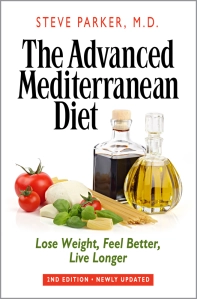
Front cover

Men, Are You Androgen Deficient?

Steve Parker MD, Advanced Mediterranean Diet, Ketogenic Mediterranean Diet

Testosterone is one reason men are better than women at push-ups

I’m running across more middle-aged and older men who are taking testosterone supplements. I don’t know if it’s a national trend or simply a Scottsdale, AZ, phenomenon.

The Endocrine Society in 2010 published guidelines regarding testosterone therapy for men who are androgen-deficient. Here are their recommendations on who should be tested for deficiency, and how:

1.1 Diagnosis and evaluation of patients with suspected androgen deficiency

We recommend making a diagnosis of androgen deficiency only in men with consistent symptoms and signs and unequivocally low serum testosterone levels.

We suggest that clinicians measure serum testosterone level in patients with clinical manifestations shown in Table 1A. We suggest that clinicians also consider measuring serum testosterone level when patients report the less specific symptoms and signs listed in Table 1B.

TABLE 1.
Symptoms and signs suggestive of androgen deficiency in men
A. More specific symptoms and signs
Incomplete or delayed sexual development, eunuchoidism
Reduced sexual desire (libido) and activity
Decreased spontaneous erections
Breast discomfort, gynecomastia
Loss of body (axillary and pubic) hair, reduced shaving
Very small (especially <5 ml) or shrinking testes
Inability to father children, low or zero sperm count
Height loss, low trauma fracture, low bone mineral density
Hot flushes, sweats
B. Other less specific symptoms and signs
Decreased energy, motivation, initiative, and self-confidence
Feeling sad or blue, depressed mood, dysthymia
Poor concentration and memory
Sleep disturbance, increased sleepiness
Mild anemia (normochromic, normocytic, in the female range)
Reduced muscle bulk and strength
Increased body fat, body mass index
Diminished physical or work performance
We suggest the measurement of morning total testosterone level by a reliable assay as the initial diagnostic test.

We recommend confirmation of the diagnosis by repeating measurement of total testosterone.

We suggest measurement of free or bioavailable testosterone level, using an accurate and reliable assay, in some men in whom total testosterone concentrations are near the lower limit of the normal range and in whom alterations of SHBG are suspected.

We suggest that an evaluation of androgen deficiency should not be made during an acute or subacute illness.

Harriet Hall thinks testosterone is being over-prescribed.

Less Writing, More Speech…

I need to reach more people. Last fall I tripled my blogging frequency and it did nothing to increase viewership. I plan to cut back on written blogging and Tweeting, but will be doing more videos. It’s an experiment.

I’ll try to keep all videos under six minutes out of respect for your time.

This video mentions the topics I’ll be covering. If they sound interesting, please subscribe to the pxHealth YouTube Channel.

QOTD: H.L. Mencken on Slitting Throats

Every normal man must be tempted at times to spit on his hands, hoist the black flag, and begin slitting throats.

– H.L. Mencken

Karl Denninger’s 5-Point Plan to Reform U.S. Healthcare

Imaginary view from my office

Healthcare costs represent almost 20% of the U.S. economy, a much higher percentage than seen in other first-world countries. And we’re not getting our money’s worth (judging from average lifespan, for instance).

The Republicans just rolled out a healthcare reform plan to replace Obamacare and address other issues. I haven’t read it. But I have zero confidence in those clowns being able to solve this problem.

Denninger has sussed out a plan that you may enjoy considering if you’re a policy geek. In brief:

  • If you sell “insurance” to anyone in a given state, you must accept all persons in that state on the same terms and at the same price. to open. For acute conditions where adverse selection becomes most important this restriction resolves the problem.
  • All “insurance” companies must offer a true insurance policy covering only unlikely-but-catastrophic events on the same terms as their “full service” policies.
  • All health providers must publish a price list and may not bill or accept payment at anything other than that price; doing so becomes a violation of Robinson-Patman and exposes the provider to civil suit for treble damages.
  • No event caused by the provision of your treatment may be billed to you. Period.
  • If you show up without insurance or ability to pay with a life-threatening condition, you will be treated, but the hospital cannot cost-shift the bill – it instead bills The Federal Government.

He concludes:

“Five points and a fully free-market solution that brings affordable health care coverage to all who can buy it, yet protects those who cannot, while, to the greatest possible extent, forces everyone to bear the cost of their own decisions.

If you choose not to be insured and pay cash you are free to make that choice. If you have a catastrophic illness or injury, insist on treatment but have no means to pay then you are subject to attachment of wages and assets by the IRS, a debt that is only discharged by your death.

Simple, fair, free-market and this path will dramatically control costs as free market competition will be forced to the forefront among health providers who will be compelled to make available their pricing schedules to everyone before they show up for treatment and are presented the bill.”

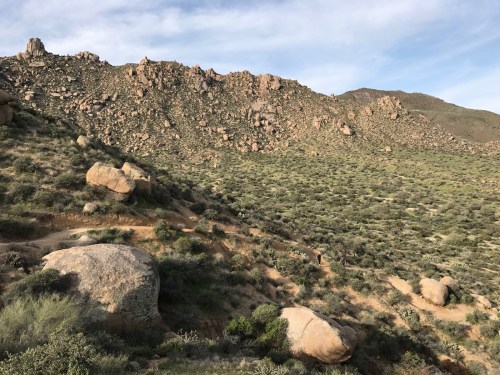
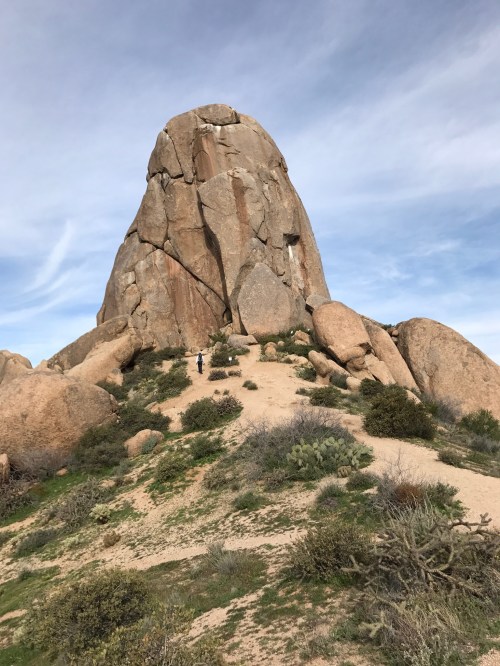
Tom’s Thumb Trail in the McDowell Sonoran Preserve


The thumb is sticking up on the horizon on the far left

The thumb is sticking up on the horizon on the far left

You might recall I hope to climb to the summit of Arizona’s highest mountain in June. So I’m in training.

First time I've seen a backhoe doing trail repair

First time I’ve seen a backhoe doing trail repair

I started this hike at the Tom’s Thumb Trailhead at the north end of the preserve. I made it to the base of the landmark then turned around and came back the same way. Total trip length is between 4 and 4.5 miles and I figure a 1000 feet of vertical elevation gain. The footing is mostly gravel/dirt. Lots of folks were hiking it with less sturdy shoes than mine. It took me 1 hour and 50 minutes round-trip.

At the base of Tom's Thumb, overlooking Scottsdale and the Valley of the Sun

At the base of Tom’s Thumb, overlooking Scottsdale and the Valley of the Sun far in the distance

On the way down I was wishing I’d brought my trekking poles to take some of the strain off my knees.

Click for trail details.

The thumb up close and personal

The thumb up close and personal

Mark Rippetoe Argues That Older Folks Need Strength Training

Of course, he’s right. Click the link below for his reasons.

“Strength – as well as a tolerance for childish nonsense – is the thing we all lose as we age. Squatting down, standing back up, putting things overhead, pulling things up the driveway, loading the groceries, wrestling with the grandkids, teaching the dog who’s boss, mowing the yard, putting the broken lawnmower in the truck again: simple physical tasks we took for granted years ago are often problems for older, weaker people, as well as a source of potential injury that can be expensive and debilitating.

For most of us, this happens because of inactivity. If you do not use your muscles to produce enough force to convince them to maintain their ability to do so, it shouldn’t be surprising that they become less capable of doing it. And walking, running, riding a bicycle – physical activities whose performance is not limited by strength for even moderately active people – cannot increase or even maintain strength.”

Source: Strength Training for People My Age | Mark Rippetoe

The View From Pinnacle Peak, Looking Southeast

Taken with my new iPhone-7 Plus

Taken with my new iPhone-7 Plus

This was only my third training hike (in prep for Humphreys Peak) and I was pleasantly surprised to feel a positive training effect already. Or maybe I was just high on the beautiful day and setting.

Steve Parker, M.D.

Latest Diet Craze: Lose 19 lb With the Venezuelan Diet!

“In a new sign that Venezuela’s financial crisis is morphing dangerously into a humanitarian one, a new nationwide survey shows that in the past year nearly 75 percent of the population lost an average of 19 pounds for lack of food.”

“Venezuela’s food crisis has gotten so bad that remains of everything from dogs and cats to donkeys and even giant anteaters have been found in garbage bags at city dumps around the country.”

Yum!

But caloric restriction doesn’t work, right?

Source: Study: Venezuelans lost 19 lbs. on average over past year due to lack of food | Fox News