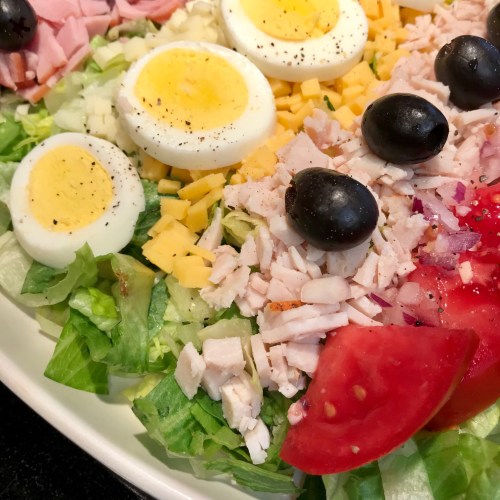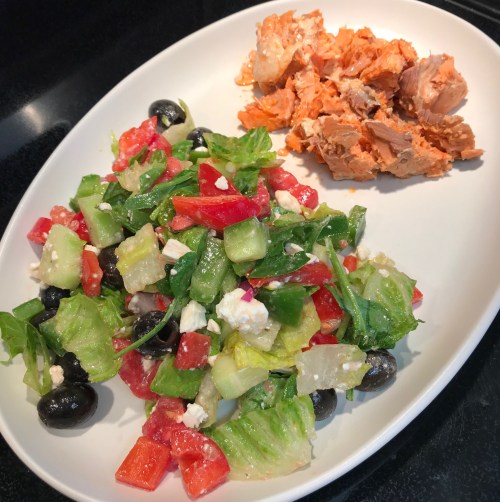
Recipe: Chef Salad

Not pictured: olive oil vinaigrette I dressed it with

Ingredients:

8 oz Romaine lettuce (4 cups chopped)

2 oz cooked ham (we like Boar’s Head Black Forest), strips or diced

2 oz cooked turkey (both our ham and turkey were deli-style, as for sandwiches), strips or diced

1 oz American cheese

1 oz mozzarella cheese

1/2 oz red onion, diced (optional)

4.5 oz tomato, diced, quartered, or chunked

8  (1 oz) black olives

1 hard-boiled egg, sliced or quartered

3 Tbsp salad dressing

I like a simple olive oil vinaigrette, either home-made or Newman’s Own. Nutrient analysis below assumes a traditional vinaigrette (3:1 ratio of olive oil to vinegar), which will typically have about 200 calories per two tablespoons, nearly all from the oil. Many commercial salad dressings have fewer calories due to water, which is sometimes listed as the first ingredient. For instance, Wishbone Balsamic Vinaigrette, which we like, has only 60 cals per two Tbsp; water is the first ingredient, vinegar next, then vegetable oil. The popular Hidden Valley Ranch Dressing has 140 cals per two Tbsp. Interestingly, Newman’s Own Olive Oil Vinaigrette does not require refrigeration after opening, unlike most other commercial dressings.

Salt and pepper to taste

Instructions:

Simple. Lay out your chopped lettuce on a large plate, then start topping with the other ingredients as artfully as you wish. Salad dressing is last.

Servings: 1

Nutrient Analysis (Fitday.com):

925 calories

Cals from fat: 67%

Cals from carbohydrate: 8%

Cals from protein: 25%

Protein grams: 55

Fiber: 7 g

Digestible carbs: 12 g

Alternatives: Instead of 8 oz Romaine lettuce, use only 4 oz Romaine plus 4 oz of either fresh spinach or kale. More micronutrients that way. Substitute your favorite cheeses ounce for ounce.

Steve Parker, M.D.


There’s Another Ketogenic Mediterranean Diet

I spoke today with a reporter with First for Women who’s working on a ketogenic Mediterranean diet article to be published later this year.

In preparing for my interview I ran across a book at Amazon.com called The Ketogenic Mediterranean Diet, written by a dietitian and published in Jan. 2017. Amazon also has a ketogenic Mediterranean diet cookbook. I haven’t read either book. But here’s an interview with the dietitian author.

A couple months ago I searched the U.S. Amazon.com site for the most popular diet and/or weight loss books. Three of the top five were ketogenic.

I’ve had a free Ketogenic Mediterranean Diet on the Internet since 2010, and published my first comprehensive KMD program with recipes, etc., in 2012.

Wake Forest University is doing a study on a modified ketogenic Mediterranean diet and its effect on Alzheimer’s Dementia. I hope to see results published in 2019.

Thus far, there are five ketogenic Mediterranean diets: mine, the dietitian’s, the Spanish researcher’s from 2008, the Italian researcher’s (Paoli et el) and Wake Forest’s (assuming it’s different than the others).

Steve Parker, M.D.

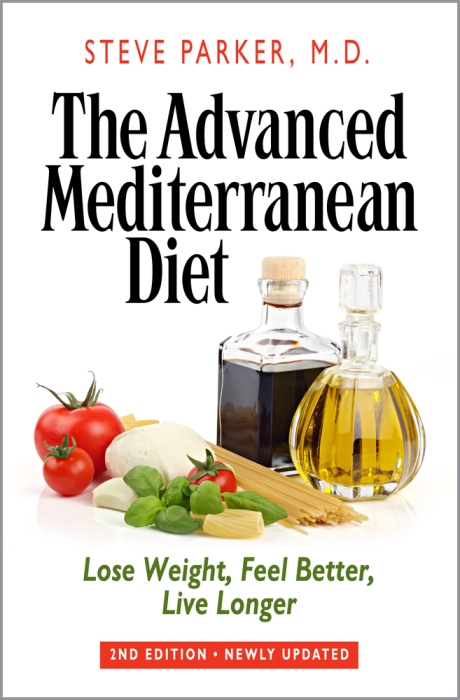
Front cover

Recipe: Brussels Sprouts Chicken Salad

…with 4 oz sous vide chicken breast

Ingredients:

10 0z Brussels sprouts, raw, shredded

1/3 cup sweet onion, diced

1/4 cup (1.5 oz)  almond slivers or slices, toasted

2 and 1/4 Tbsp bacon bits (or 2 slices of bacon, fried, diced)

1/4 cup dried cranberries

Salt and pepper to taste

8 oz cooked chicken breast (boneless, skinless), sliced

For the vinaigrette

4.5 Tbsp EVOO

1.5 Tbsp apple cider vinegar

1.5 tsp sugar

Instructions:

Toast the almonds in a frying pan over medium heat, stirring frequently, until fragrant and slightly browned. this only takes a few minutes.Remove from heat and set aside.

Brussels sprouts: Slice off a small portion of the base or stalk and discard that along with any nasty leaves. I then like to rinse or briefly soak the sprouts in cold water to remove dust and unwanted particles. Then shred the sprouts with a knife, food processor, or mandolin. I used a knife. After this most of the work is done.

In a large bowl, dump the sprouts onion, almonds, bacon bits, and cranberries.

Combine the EVOO, vinegar, and sugar in bowl and whisk thoroughly, or put then in a jar and shake well. Pour over the sprouts and mix well.  Salt  and pepper to taste (may not need any). This is four cups of salad.

Servings size: 2 cups salad plus 4 oz chicken breast

Number of servings: 2

Rough nutrient analysis of one serving (Fitday.com):

775 calories

Carb calories 17%

Fat calories 60%

Protein calories 23%

Protein grams: 43

9 g fiber

Digestible carbs 25 g

Alternatives:

Substitute 4 oz of steak for the chicken. Mix 1.5 oz of parmesan cheese into the salad. Substitute dried cherries or raisins for the cranberries ounce for ounce. Substitute toasted crumbled walnuts for the almonds. Experiment with other vinegars.


Ongoing Debate: Moderate Alcohol Consumption Isn’t Dangerous 

From Competitive Enterprise Institute:

“Joel Achenbach, a science and politics reporter, once asked why “many reasonable people doubt science.” He should look at his own reporting on alcohol research for the possible explanation. Despite decades of overwhelming evidence that moderate drinking confers health benefits, Achenbach’s August 3 Washington Post piece asserts that the evidence is “murky.” The basis for the assertion seems to come from a single study published in April in the journal The Lancet. Not only is a single study insufficient to challenge three decades of research, but Achenbach (along with reporters at other major news outlets) completely misunderstood the what this study found.”

Source: Science Reporters Get it Wrong: Moderate Alcohol Consumption Isn’t Dangerous | Competitive Enterprise Institute

George Monbiot Ponders Why Brits Have Gotten So Fat

…in an article at The Guardian. He thinks the trend start in 1976.

Why?

So what has happened? The light begins to dawn when you look at the nutrition figures in more detail. Yes, we ate more in 1976, but differently. Today, we buy half as much fresh milk per person, but five times more yoghurt, three times more ice cream and – wait for it – 39 times as many dairy desserts. We buy half as many eggs as in 1976, but a third more breakfast cereals and twice the cereal snacks; half the total potatoes, but three times the crisps. While our direct purchases of sugar have sharply declined, the sugar we consume in drinks and confectionery is likely to have rocketed (there are purchase numbers only from 1992, at which point they were rising rapidly. Perhaps, as we consumed just 9kcal a day in the form of drinks in 1976, no one thought the numbers were worth collecting.) In other words, the opportunities to load our food with sugar have boomed. As some experts have long proposed, this seems to be the issue.

Source: We’re in a new age of obesity. How did it happen? You’d be surprised | George Monbiot | Opinion | The Guardian

Contrary to the above, we in the U.S. have been eating significantly more calories over the last 50 years. I’m surprised George didn’t mention the dramatic increase in industrial seed oil consumption over same time frame.

The problem cannot be reduced to sugar consumption alone.

Steve Parker, M.D.

Mediterranean versus Vegetarian diet for weight loss? Both work equally well, study says

Raw Brussels sprouts salad

It’s refreshing to see a vegetarian diet study that specifies which type of vegetarian diet was used.

Followers of two different healthy diet patterns showed similar reductions in weight, body mass index and fat mass after 3 months, found researchers from the University of Florence, Italy in conjunction with Careggi University Hospital, Florence.

The lacto-ovo vegetarian diet was however more effective in reducing ‘bad’ low-density lipoprotein cholesterol whereas Mediterranean diet followers saw a greater reduction in triglycerides.

“After 3 months of dietary intervention, both lacto-ovo vegetarian and Mediterranean diets were effective in reducing body weight, body mass index, and fat mass, with no significant differences between them,” ​commented study first author Professor Francesco Sofi.

Source: Vegetarian or Mediterranean diet for weight loss? Both work equally well, says study

Mediterranean diet may slow psoriasis disease progression

From MedicalNewsToday:

A new study suggests that adhering to a Mediterranean diet may relieve the severity of psoriasis and slow its progression.

Psoriasis is a chronic inflammatory disease that affects about 6.7 million adults in the United States, according to recent estimates.

Some studies have shown that people with psoriasis are more prone to obesity and metabolic syndrome, and some have suggested that inflammation may be the reason behind this link.

Diet can play a key role in inflammatory conditions. Research has shown that pro-inflammatory compounds including saturated fats can worsen conditions such as inflammatory bowel disease and rheumatoid arthritis.

So, researchers led by Dr. Céline Phan — at the Hôpital Mondor in Créteil, France — set out to investigate whether conversely, an anti-inflammatory diet would have appeasing effects on symptoms of psoriasis.

The Mediterranean diet is considered anti-inflammatory because it has been associated with a lower incidence of chronic inflammatory illness.

Source: Psoriasis: Mediterranean diet may slow disease progression

Today’s Best-Selling Diet Books at Amazon

Front cover

As of 0130 hrs August 2, these are the top five diet and/or weight-loss books at Amazon.com. (If you’re not in the U.S., your country may have its own separate URL.) In order of top sellers first:

  • The Complete Ketogenic Diet for Beginners (#5 on best-seller list)
  • Instant Loss Cookbook (#8)
  • The Ketogenic Diet (#40)
  • The Plant Paradoz Cookbook (#42)
  • The Easy 5-Ingredient Ketogenic Diet Cookbook (#50-something)

I was fully aware ketogenic diets are popular now, but I didn’t realize just how popular! Both of my books on this page feature a doctor-designed ketogenic diet based on the healthy traditional Mediterranean diet.

Sadly, none of my books are best-sellers. I may have to start begging for donations from my blog readers. Poor, poor, pitiful me.

Steve Parker, M.D.

Steve Parker MD, Advanced Mediterranean Diet

Two diet books in one

Tighter blood pressure control may cut memory loss, even dementia

dementia, memory loss, Mediterranean diet, low-carb diet, glycemic index, dementia memory loss

“Systolic of 140 isn’t good enough anymore.”

Keep your eyes on this development, folks. Potential game-changer. And a boon to Big Pharma. From NBCnews.com…

Lowering blood pressure to recommended levels can prevent dementia and the memory and thinking problems that often show up first [mild cognitive impairment], researchers reported Wednesday.

People whose top blood pressure reading was taken down to 120 were 19 percent less likely to develop mild cognitive impairment, the loss of memory and brain processing power that usually precedes Alzheimer’s, the study found. And they were 15 percent less likely to eventually develop cognitive decline and dementia.

***

It may take a few more years before the study conclusively shows whether the risk of Alzheimer’s was actually reduced because of the lower blood pressure,the researchers said.

It’s the first intervention that has been clearly demonstrated to lower rates of mental decline.

***

The findings come from a large trial of blood pressure called the Systolic Blood Pressure Intervention Trial, or SPRINT.

It has already found that lowering systolic blood pressure — the top number in a blood pressure reading — to 120 or less can prevent stroke, heart attacks, kidney disease and other problems.

Source: Tight blood pressure control can cut memory loss, study finds

Guess what else helps prevent memory loss and dementia? The Mediterranean Diet.

Steve Parker MD, Advanced Mediterranean Diet

Two diet books in one

Is It Time to Abandon the Mediterranean Diet?

Bastian is also skeptical about the health benefits of judicious alcohol consumption. Fair enough.

Hilda Bastian at PLOS Blogs wrote about the recent retraction of a PREDIMED sub-study published in the New England Journal of Medicine in 2013. The suspect conclusion of that study was: “Among persons at high cardiovascular risk, a Mediterranean diet supplemented with extra-virgin olive oil or nuts reduced the incidence of major cardiovascular events.”

From Ms Bastian:

A very influential nutrition trial just tanked. It was retracted from the New England Journal of Medicine (NEJM) on 13 June, and re-published with new analyses and toned-down conclusions.Both Gina Kolata, writing in the New York Times, and Alison McCook, writing at NPR, imply, at least to some extent, that it might make no difference to the evidence. But I disagree.

Here’s what’s happened to the trial, and where I think it leaves the overall evidence.Called PREDIMED, it was a multi-center trial from Spain, with the NEJM final report published in 2013. Altogether, 7,447 people at risk of cardiovascular disease (CVD) – heart attack and stroke – were reported as randomized to one of 3 groups:

  • Mediterranean diet with free olive oil provided, along with individual and group training sessions at the start, and then quarterly;
  • Mediterranean diet with free nuts provided, along with individual and group training sessions at the start, and then quarterly;
  • Advice to reduce fat intake, with a leaflet – but after the first 3 years, people in this control group were also offered individual and group training sessions.

The primary endpoint for the trial was a composite one of major cardiovascular events: myocardial infarction, stroke, or CVD-related death. And the trial was stopped early. More people dropped out of the control group than the Mediterranean diet groups.There are several alarm bells here already, and we’ll come back to those.

Source: What Does the PREDIMED Trial Retraction & Reboot Mean for the Mediterranean Diet? | Absolutely Maybe

I encourage you to read Ms Bastian’s article if you enjoy such debates. I consider the 2013 PREDIMED sub-study to be one of numerous pieces of the nutritional puzzle.

I published the 2nd edition of my Advanced Mediterranean Diet in 2012, so the 2013 PREDIMED sub-study was not available to me. At the end of my book you’ll find not one, but 43 scientific references supporting the healthfulness of the Mediterranean diet.

Steve Parker MD, Advanced Mediterranean Diet

Two diet books in one

Steve Parker, M.D.