Another Reason to Drink Green Tea: Lower Incidence of Kidney Stones

In a Chinese population, green tea consumption was linked to 15-20% lower risk of kidney stones:

“During 319 211 and 696 950 person-years of follow up, respectively, 1202 men and 1451 women reported incident stones. Approximately two-thirds of men and one-quarter of women were tea drinkers at baseline, of whom green tea was the primary type consumed (95% in men, 88% in women). Tea drinkers (men: hazard ratio 0.78, 95% confidence interval 0.69-0.88; women: hazard ratio 0.8, 95% confidence interval 0.77-0.98) and specifically green tea drinkers (men: hazard ratio 0.78, 95% confidence interval 0.69-0.88; women: hazard ratio 0.84, 95% confidence interval 0.74-0.95) had lower incident risk than never/former drinkers. Compared with never/former drinkers, a stronger dose-response trend was observed for the amount of dried tea leaf consumed/month by men (hazard ratiohighest category 0.67, 95% confidence interval 0.56-0.80, Ptrend  < 0.001) than by women (hazard ratiohighest category 0.87, 95% confidence interval 0.70-1.08, Ptrend  = 0.041).

CONCLUSIONS:Green tea intake is associated with a lower risk of incident kidney stones, and the benefit is observed more strongly among men.”

Source: Green tea intake and risk of incident kidney stones: Prospective cohort studies in middle-aged and elderly Chinese individuals. – PubMed – NCBI

Compared to 1986’s Cambridge Diet, a Milk Diet Helps Preserve Body Proteins

Mmmmm…milk!

Body proteins are good. You can’t blame them for making you fat. It’s adipose tissue making you fat. That’s what you want to lose when you lose weight, not body proteins.

I wrote recently about a vague “milk diet.” I sought details and found a few in the reference below. The authors write like there’s only one milk diet; I’m skeptical. In fact, at my prior post the milk diet was “a variable combination of full cream or semi-skimmed milk and unsweetened yoghurt.” The study under the microscope today used milk only, probably whole milk.

This was a frustrating study to review. The experimental protocol is complicated, the researchers altered way too many variables, and didn’t hint at how how much weight the dieters lost until the last sentence of the research report. Oh, sure, they gave rates of weight loss during days 2–4, days 1–13, days 13–22, weeks 4–13, and in week 24. But I refuse to calculate total weight loss over those time frames for four different experimental groups.

The goal of the authors was to determine the composition of weight loss on two different very low calorie diets (VLCDs). Would there be differences in fat loss and lean tissue loss? Lean tissue would include muscle, organs, bone, water, etc. Lean tissue is also called fat-free mass. Remember, that’s not the tissue you want to lose when you’re trying to lose excess weight. So measurement of nitrogen loss, a surrogate for protein and lean tissue loss, was the major focus of the study. How do you gauge nitrogen loss? You measure it in urine and feces of the inmates in a hospital metabolic ward.

When I was researching the literature in preparation for writing my first edition of Advanced Mediterranean Diet, I remember reading many studies of very low calorie diets (VLCDs). Offhand, what I remember is that they’re potentially dangerous, compliance is poor, symptomatic gallstones are more common, and they’re only a short-term “solution” because rapid weight regain is a huge problem. VLCDs typically provide 200–800 calories per day.

How Was the Study Done?

All research subjects were women in England. Metabolically healthy except for obesity. Seventeen of the original 22 completed the study. Average age was 33 (range 20–50), average BMI 42, average weight 115 kg (253 lb). They were randomized to eat one of two very low calorie diets:

  1. Cambridge Diet: 330 cals/day, 33 g protein, 42 g carbohydrate, 3 g fat, plus vitamins and minerals specified in the article
  2. Milk Diet: 1,200 mls (41 fl oz) of milk daily (780 cals). The milk provided 46 g protein, 56 g carbohydrate, and 46 g fat. Plus supplementation with 60 mg iron, 750 micrograms vitamin A, 7.5 micrograms vitamin D, 1 mg thiamine, 0.5 mg riboflavin, 7.5 mg niacin, 15 mg vitamin C

Unclear whether this milk was from cows, goats, sheep, water buffalo, or yaks. Unclear whether full fat, skim, or some % reduced fat. I’ll assume they used cow milk. Whole milk from a cow is 3.25% fat. Five cups a day (1200 ml) would provide 730 calories, 40 g protein, 65 g carbohydrate, and 40 g fat. The iron, thiamine, and riboflavin in this much milk is very similar to those items used in the Milk Diet above. I got too bored to check the other micronutrients. The point being, if you wanted to emulate the Milk Diet above, drinking 5 cups (1200 ml) of whole milk daily plus a vitamin supplement (and iron?) would get you in the ballpark.

Nor do the researchers describe the Cambridge Diet. Best I can tell, in 1986 it was a commercial diet composed of powder mix, meal bars, and liquid meals. It’s still available, no doubt in different formulations.

Five women in each group agreed to have their jaws wired shut. Wow. This is how they came up with the aforementioned four experiments groups: Cambridge or Milk Diet, jaws wired or not.

The first three weeks were in an inpatient metabolic ward, the next 20 weeks in the outpatient setting, and a final week back in the metabolic ward. I’ve simplified it a bit so you don’t get too lost in the weeds.

All dieters were offered £60 if they completed the entire 24-week protocol.

Results

  • From the last sentence of the report, it looks like the Cambridge Dieters lost 21.9 kg (48 lb) and Milk Dieters lost 17.9 kg (39 lb), not a statistically significant difference between the two.
  • No patient had to withdraw from the trial due to side effects.
  • “Tests of vitamin status showed little of significance.”
  • No difference between the diets in terms of hemoglobin, plasma urea, sodium, potassium, triglycerides, cholesterol, glucose, and glucose tolerance test, and “the values were almost all within the normal ranges.”
  • “It is concluded that the Cambridge Diet (330 kcal) causes greater N loss [body protein loss] in relation to weight loss than the milk diet (800 kcal)….”
  • “Since we have strong reason to doubt that the patients were strictly observing the prescribed diet as outpatients it is dangerous to draw conclusions about the effects of these diets on weight loss and body composition. The most that can be said is that there is no significant difference between the weight loss observed among those who were trying to keep to Cambridge Diet and those who were trying to keep to milk. However, those who had their jaws wired lost significant more weight than those who did not.”

Concluding Thoughts

After the start of this trial, a UK government report suggested that VLCDs should provide at least 500 cals/day and 50 g protein for men, and 400 cals/day and 40 g protein for women. The Cambridge Diet was reformulated to comply with the guidelines.

Can you imagine living only on five cups of milk a day plus a vitamin supplement for 20+ weeks? I gotta admit I’m sorta tempted to try it, but not for 20 weeks. One of my problems with prolonged liquid diets is: what effect does that have on your teeth? We have teeth to chew. Do teeth shift out of place if not used as designed? I’ve never seen it discussed in the scientific literature.

Did nutrient deficiencies “force” dieters to be noncompliant. I don’t know. Sometimes we may need to trust our bodies to help us make the right dietary decisions.

I’ve only reviewed two milk diet studies in these pages. Not many study subjects involved. Nevertheless, at first blush, it looks like a milk diet is relatively safe and effective over several months in otherwise healthy folks. If you were to do it, I’d get the blessing of your personal physician, and probably take a vitamin supplement daily. I bet only menstruating women need an iron supplement.

Sometimes I think diets with too much variety are harder to stick with. Too much temptation. The simplicity of a milk diet appeals to me. Five cups a day. That’s it, nothing else. Don’t even think about it.

Many folks on a weight-loss journey hit a “plateau phase” where they’ve stopped losing weight but are still far from goal. I wonder if a temporary milk diet—one or two months?—is a good option for getting back on track.

Steve Parker, M.D.

Reference: Garrow, J.S., et al. Inpatient-Outpatient Randomized Comparison of Cambridge Diet Versus Milk Diet in 17 Obese Women Over 24 Weeks. International Journal of Obesity (1989) vol. 13, pages 521-529.

Mediterranean diet increases lifespan

No surprise here…

“The Mediterranean diet was linked to prolonged survival in two different studies spanning multiple age groups, according to findings recently published in the British Journal of Nutrition.

“We already knew that the Mediterranean diet is able to reduce the risk of mortality in the general population, but we did not know whether it would be the same specifically for elderly people,” Marialaura Bonaccio, PhD, epidemiologist at the Istituto Neurologico Meditteraneo Neuromed in Italy, said in a press release.

Researchers conducted a longitudinal analysis on the dietary habits of 5,200 participants of a previously existing cohort.

They found that for each one-point increase in a patient’s Mediterranean diet score, the risk for mortality from a variety of causes declined: all-cause mortality (HR = 0.94; 95% CI 0.9-0.98); coronary artery disease/cerebrovascular disease mortality (HR = 0·91; 95% CI, 0.83-0.99) and non-cardiovascular/non-cancer mortality (HR = 0.89; 95% CI, 0.81-0.96).”

Source: Mediterranean diet increases lifespan

Study: Mediterranean Diet Linked to Improved Gestational Diabetes Outcomes

“Women with gestational diabetes who were on a Mediterranean diet for 3 months had improved glycemic levels, that were comparable to pregnant women with normal glucose levels, a new study from Madrid, Spain suggests.

The objective of the study was to assess whether Mediterranean diet-based medical nutrition therapy facilitates near-normoglycemia in women with gestational diabetes.

“Medical nutrition therapy based on a MedDiet enhanced with extra virgin olive oil and pistachios, thus with a high-fat content, is associated with glycemic control and with a reduction in gestational diabetes-related adverse perinatal outcomes,” Dr. Alfonso Calle-Pascual, one of the study authors told dLife.”

Source: Mediterranean Diet Linked to Improved Gestational Diabetes Outcomes, Study | dLife

Mediterranean Diet Associated with 41% Risk Reduction for Macular Degeneration, a Leading Cause of Blindness

I thought we already knew this…

Protecting a patient’s eyes may be more heavily influenced by diet than previously thought. A new study, which analyzed data from a pair of previous study populations, found that people aged 55 and over who maintained a Mediterranean-style diet reduced their risk of developing late-stage age-related macular degeneration (AMD) by 41%.

Source: Mediterranean Diet Associated with 41% Risk Reduction for AMD | MD Magazine

Recipe: Greek Salad

Greek salad with canned salmon

This recipe makes three large servings. Adjust it to make more or fewer servings. Fish is a prominent component of the Mediterranean diet so I like to have fish as my protein with this Greek Salad. Cold-water fatty fish, with their high omega-3 fatty acid content, may be the most healthful.

Spinach and kale have more vital nutrients than Romaine lettuce, so feel free to increase the spinach/kale and reduce the Romaine amounts. But I wouldn’t go more than 50:50 the first time you make this.

Ingredients:

2-3 oz fresh spinach or kale, chopped

10 oz romaine lettuce, chopped

2 large tomatoes (12 oz), chopped

1 can pitted black olives, drained (6 oz after draining) or pitted kalamata olives

1/2 red onion (2 oz prepped), diced or sliced

1 large red bell pepper, chopped

1 large green bell pepper, chopped

1 cup feta cheese, crumbled

1 large (11 oz) cucumber, peeled (or not) and chopped

For the dressing:

6 Tbsp extra virgin olive oil

2 Tbsp red wine vinegar

1 tsp dried oregano

juice of 1/2 lemon (1 Tbsp)

1.5 tsp sugar

1/8 tsp salt

Salt and pepper to taste

Extra lemon juice on fish or salad, to taste

Choose your protein:

  • 21-24  oz canned cooked salmon or fresh cooked salmon (baked, roasted, or pan-fried but not breaded)
  • or 15 oz canned albacore tuna (packed in water, drained)
  •          or 20 0z other fish of your choice (not breaded)
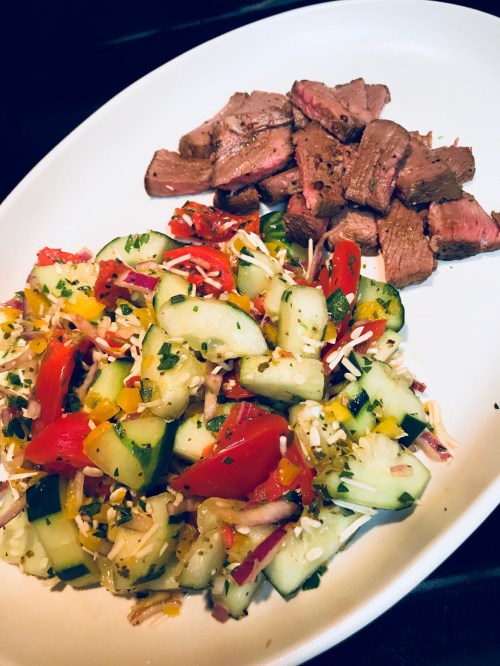
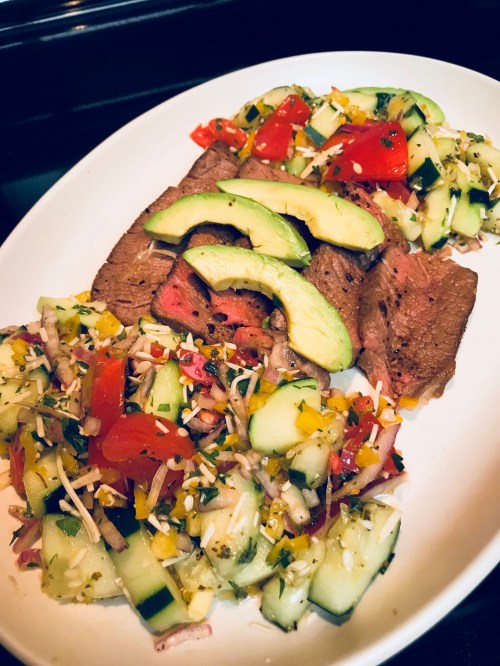
  • or 12 oz cooked steak
  • or 21-24 oz boiled shrimp
  • or 18 oz chicken breast (boneless, roasted or baked or pan-fried but not breaded)

Instructions:

Rinse lettuce? In a very large bowel, place the lettuce, spinach or kale, cucumber, bell peppers, tomatoes, onion, olives, and cheese.

Then make your dressing. In a separate bowl, whisk together the olive oil, vinegar, lemon juice, oregano, salt, and sugar. Poor the dressing over the salad then toss thoroughly.

The serving size is one third of all this. You should have about 12 cups of salad, so a serving is four cups. Divide your protein of choice into thirds and serve 1/3 in chunks on top of the salad or on the side. Salt and pepper to taste.

If you’re having fish as your protein, you can squirt some lemon juice on it for extra zing.

If you’re preparing this ahead of mealtime, chop and combine all the salad vegetables, then add the dressing and cheese just before serving.

Number of servings: 3 (4 cups of salad per serving)

Nutrient analysis per serving with 7-8 oz canned salmon (Fitday.com):

Calories: 840

Calories from fat: 61%

Calories from carbohydrate: 11%

Calories from protein: 28%

Fiber: 9 g

Protein grams: 56

Prominent features (over 50% of RDA): Vitamin D, protein, vitamin A, vitamin B6, vitamin B12, vitamin C, vitamin E, vitamin, calcium, copper, iron, niacin phosphorus, riboflavin, selenium.


Remember the Ol’ Milk Diet?

hiking, Arizona, Steve Parker MD,

Tom’s Thumb trail in Scottsdale, AZ

I recall a milk diet to treat stomach ulcers in the mid-20th century. Tagamet changed that!

I’ve been reading scientific articles on low-energy liquid diets for weight loss and diabetes remission, and ran across a reference to a milk diet. I found impressive results in a 16-week study.

This was a small randomized trial that enrolled 45 very fat folks — BMI 41-47, average weight 122 kg (268 lb), mostly women — and assigned them to one of three diets:

  1. Control: conventional balanced diet of normal foods providing about 800 calories/day and at least 36 grams of protein.
  2. Milk: “variable combination of full cream or semi-skimmed milk and unsweetened yoghurt,” about 800 calories/day. BTW, a cup (240 ml) of whole milk has 150 calories.
  3. Milk Plus: same as the milk diet plus “unlimited amount of a single food selected by the patient on each day of the week. Of these seven extra foods, three were a fruit or vegetable, two were a high protein food, and two were a “favourite” food. The seven foods were repeated on the same day of successive weeks.” (If you understand this, you’re smarter than me, which wouldn’t be unusual.) Average calories were 1,350/day.

The researchers figured these adults were eating about 2,500 calories/day at baseline. Diabetics were excluded.

Results

The Milk group lost the most weight. Eleven of the 14 participants completed the 16-week study, with an average weight loss of 11.2 kg (24.6 lb). Constipation was the only “serious” side effect reported. The authors admitted that deficiencies in some vitamins and iron might be a problem, but cited a similar but longer trial (24 weeks) that found no such deficiencies.

Eleven of the 17 in the Milk Plus group persevered for the whole 16 weeks. Average weight loss was 8.2 kg (18 lb).

Nine of the 14 in the Control Group were able to put up with it for the duration. Average weight loss was only 2.6 kg (5.7 lb). I suspect they had a bit of a compliance problem. When you weigh 268 lb, a 5.7 lb loss isn’t much.

“Analysis of compliance (not reported) showed that it was similar for the two milk diets but much lower for the conventional diet.”

Comments

The researchers opine that…

  • “Patients are more likely to respond to a simple diet which they have not tried before than to advice on conventional diets.”
  • Probably the best strategy is to rotate diets,…[to prevent compliance from falling].”

I wonder how well the Milk diet would work for someone who weighs 205 lb (93 kg) and just wants to lose 25 lb (11.4 kg).

I wonder how important are the exact proportions of “full cream or semi-skimmed milk and unsweetened yoghurt.”

As with all diets, weight regain will be a problem after the 16 weeks.

The Milk diet might be a good temporary option for someone who wants to lose more excess weight but has hit a weight-loss plateau in their current regimen.

I’m skeptical about the nutritional adequacy of the Milk diet.

My Advanced Mediterranean Diet is actually two diets, making diet rotation easy. And I tell you the secrets to prevention of weight regain!

Steve Parker, M.D.

Reference: Summerbell, C.D., et al. Randomised controlled trial of novel, simple, and well supervised weight reducing diets in outpatients. British Medical Journal, 317: 1487-1489. November 28, 1998.

Steve Parker MD, Advanced Mediterranean Diet

Two diet books in one


Macular Degeneration: Mediterranean diet cuts risks of age-related blindness

From Xinhua..

Researchers from the European Union (EU) have found mounting evidence that the Mediterranean diet provides a better and more balanced lifestyle in daily consumption of food varieties that helps prevent potential blindness in later stages of life, said a study released Sunday.The EU scientists expanded their research on previous studies and discovered that a poor diet plays an important role in developing age-related macular degeneration (AMD), a leading cause of blindness in the United States.In analyzing the connection between genes and lifestyle on the development of AMD, the researchers found that people who maintain a Mediterranean diet, which features less meat but more fish, vegetables, fruits, legumes, unrefined grains and olive oil, cuts their risk of developing late-stage AMD by 41 percent.

Source: Mediterranean diet cuts risks of age-related blindness: study – Xinhua | English.news.cn

Which country does the Mediterranean diet actually come from? 

From SBS:

Rich in fruits, vegetables, whole grains, legumes and olive oil, the diet is famed for being low in saturated fats and high in lean sources of protein like fish. Red wine, drunk in moderation, is even a bonus inclusion.

Yet the term ‘Mediterranean diet’ is a bit loose. It’s meant to infer a particular ‘Mediterranean’ identity to a specific cultural dietary pattern. But the fact is, the Mediterranean basin spans 22 countries across Europe, Asia and Africa, and each country along the Mediterranean Sea boasts a different diet, religion and culture.

Source: Which country does the Mediterranean diet actually come from? | SBS Food

New Research: Mediterranean Diet May Reduce Risk For Depression

From Forbes…

There’s no arguing with the fact that a Mediterranean-style diet is just about the best choice for physical health and longevity. But a growing body of evidence is also reporting that the famous diet is good not only for the body, but also for the brain—and importantly, the mind. A new study in the Nature journal Molecular Psychiatry finds that a Mediterranean diet also reduces the risk for depression, considerably. It’s not the first to suggest this, but it is the largest meta-analysis to date.

Source: Mediterranean Diet May Reduce Risk For Depression, Study Finds