Posted onOctober 30, 2021|Comments Off on QOTD: Men and Women…Together
“Yes, the kids are long gone, but we’re still together.”
Men offer women what other women can’t, and when they do it right, everyone is better off. Women at their best bring out the best in men. They — men, that is — are more inclined to behave themselves, to work harder, scrape off their rougher edges, and be more dependable. This extends into other arenas of social life, like being a good father, a reliable worker, and a helpful neighbor. Women get to have men around to be “the fathers” to the children that they cannot be, to share the burdens and joys of child-rearing, and, together, ease the chastening of old age.
-Stephen Paul Foster, July 1, 2021 (I’d link to the source but the website owner has blocked my IP address)
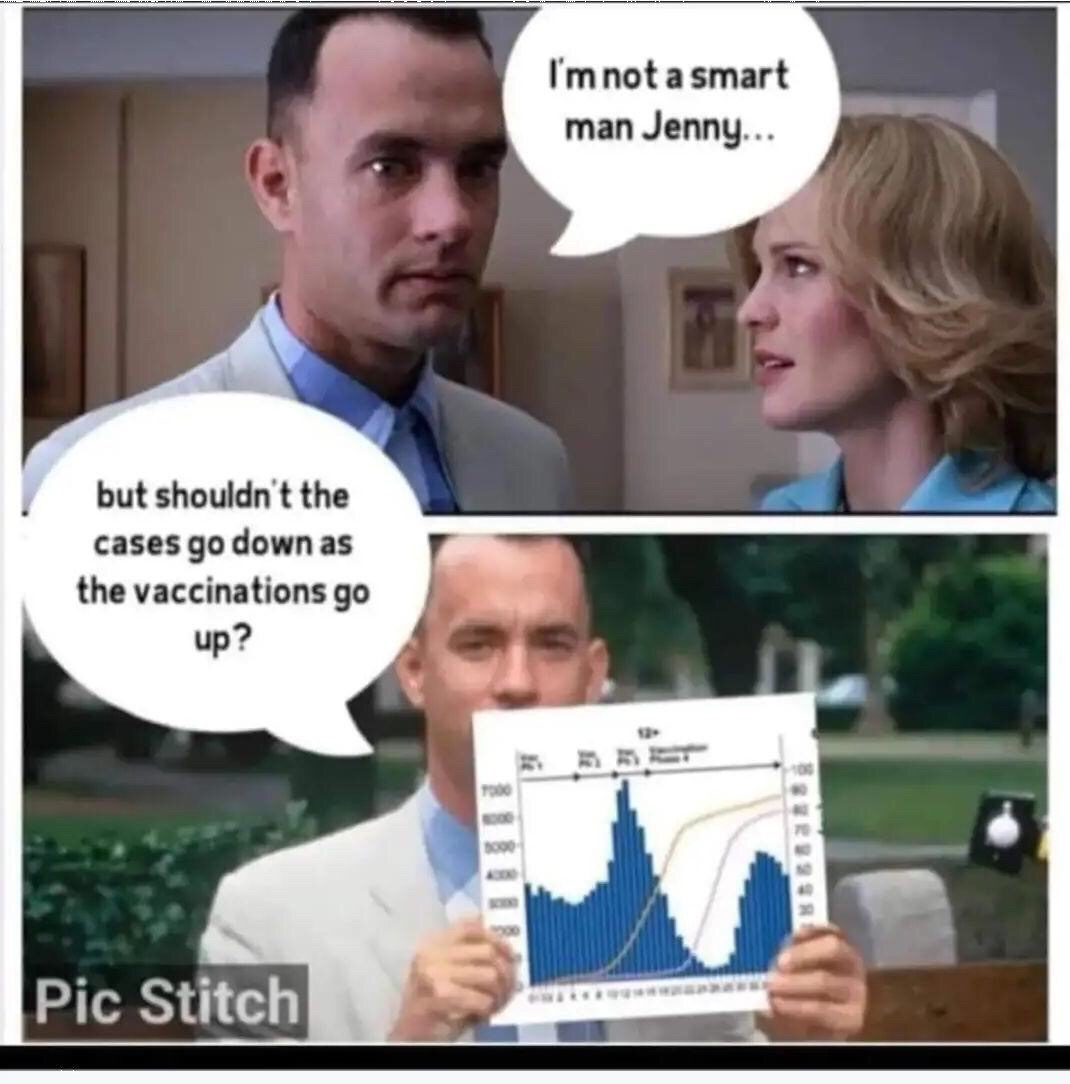
“At the country-level, there appears to be no discernable relationship between percentage of population fully vaccinated and new COVID-19 cases in the last 7 days (Fig. 1). In fact, the trend line suggests a marginally positive association such that countries with higher percentage of population fully vaccinated have higher COVID-19 cases per 1 million people. Notably, Israel with over 60% of their population fully vaccinated had the highest COVID-19 cases per 1 million people in the last 7 days. The lack of a meaningful association between percentage population fully vaccinated and new COVID-19 cases is further exemplified, for instance, by comparison of Iceland and Portugal. Both countries have over 75% of their population fully vaccinated and have more COVID-19 cases per 1 million people than countries such as Vietnam and South Africa that have around 10% of their population fully vaccinated.
Across the US counties too, the median new COVID-19 cases per 100,000 people in the last 7 days is largely similar across the categories of percent population fully vaccinated (Fig. 2). Notably there is also substantial county variation in new COVID-19 cases within categories of percentage population fully vaccinated. There also appears to be no significant signaling of COVID-19 cases decreasing with higher percentages of population fully vaccinated (Fig. 3).”
So why are vaccines being mandated? Cui bono? Big Pharma. Us sheep are being fleeced.
Steve Parker, M.D.
PS: I admit the possibility that the vaccines reduce the odds of hospitalization and death. I await further data. But can we trust date generated and released by Pfizer, Moderna, and J&J?
People who already had their first heat attack or stroke were excluded from the study.
The research was published in FEBS Journal in Feb 2021.
How could aspirin have an antiviral effect? The researchers report “Host response and clearance of viral infections heavily depend on the expression of type I interferon (IFN), which modulates cell responses and reprograms cells into an “antiviral state” [[16]]. RNA viruses, such as SARS-CoV and MERS-CoV, can escape immune system recognition via suppression of type I IFN signaling through an inhibition of STAT family transcription factor phosphorylation [[17]]. Another specific mechanism used by RNA viruses to evade host antiviral responses involves upregulation of prostaglandin E2 (PGE2) levels, which leads to an inhibition of type I IFN production and apoptosis in macrophages, thereby causing increased viral replication [[18]]. As low-dose aspirin inhibits PGE2 biosynthesis [[19]], this mechanism might enhance antiviral immunity via induction of type I INF [[20]].”
Read the full free report for additional possible antiviral mechanisms.
I didn’t read the entire report. I couldn’t find the average dose of aspirin these subjects were taking. If you find it, please comment below. I’ll assume 81 mg/day for now.
Aspirin can be harmful. Check with your personal physician before starting taking it.
A key to his argument is differentiating between early and late COVID-19 disease. In the early phase (lasting 5-7 days), viral replication is predominant, causing the fever, chills, myalgias, malaise, etc. His late phase is when blood oxygen levels start to drop and patients are admitted to the hospital. I assume the late phase is the inflammatory response of the lungs, the cytokine storm. Of course, not everyone advances to the late phase. Many of the studies finding no benefit of HCQ involved hospitalized patients in the late phase. It’s too late then, according to Risch.
Dr Risch also says HCQ alone probably is not adequate. Many of the studies he cites utilized one or more of following: azithromycin, doxycycline, zinc, ivermectin, vitamin D, budesonide, low-dose aspirin, montelukast, colchicine, fluvoxamine, and others.
I don’t recall Dr Risch discussing who should be treated early with HCQ. I’m guessing just those with one or more risk factors for life-threatening disease, which might include everyone over 65-70 years old. Remember that the average survival rate for COVID-19 is over 99%.
His presentation is compelling. He’s reading his numbered slides, so you can get through it in half the time by turning off the sound and just reading. Why hasn’t YouTube (Google) censored this yet?
Steve Parker, M.D.
PS: I tried unsuccessfully to find the average age of those who die of COVID-19 in the U.S. But I ran across this report on the recent Italian experience (from Feb to Sept 2021):
MILAN, Oct 20 (Reuters) – People vaccinated against COVID-19 are highly unlikely to die of the disease unless very old and already badly ill before getting it, a study in Italy showed on Wednesday.
The study by the national Health Institute (ISS), contained in a regular ISS report on COVID-19 deaths, shows the average age of people who died despite being vaccinated was 85. On average they had five underlying illnesses.
The average age of death among those not vaccinated was 78, with four pre-existing conditions.
Cases of heart problems, dementia and cancer were all found to be higher in the sample of deaths among those vaccinated.
Note that median age in Italy is 47 compared to 38 in the U.S.
Posted onOctober 20, 2021|Comments Off on William M Briggs on Vaccine Efficacy
We mentioned these two items weeks ago, but it bears repeating.
We’re all gonna die!
I watch local TV news since I no longer read a local newspaper. They still report daily new cases of COVID-19 and never define a “case.” I suspect a case is simply a lab test positive for COVID-19. An unknown number of those cases are false positives, meaning the test is wrong, there is no infection. Another unknown number of cases is folks who harbor the virus but aren’t sick at all, and may or may not become ill in the near future. Two of my first-degree relatives, one quite elderly, were diagnosed with COVID-19 in the pre-delta era; their illnesses were like a head cold or mild flu. Should we care much about the aforementioned “cases”?
Mr Briggs?
Remember that, at least early-on in the pandemic, the diagnostic tests were criticized for being too sensitive (cycle threshold set too high), leading to excessive false positives. I hope that problem has been minimized, but don’t know. Around a third of head colds are caused by coronaviruses. I wonder if my relatives had non-COVID-19 coronavirus infections.
One, the only two outcomes—and it’s really just one—worth studying are illness severity and death. All other derived measures are always a clue you are being fooled.
“Cases” are NOT an illness severity measure. Ignore ALL studies which invoke “cases”, whether they are on “our side” or theirs. “Cases” are NOT cases, but a combination of testing level (still at ridiculous levels), testing sensitivity (still too high), and multiple disease characteristics.
Look at hospitalizations for (and not after-admission-for-something-else-first either) the [COVID-19], or look at deaths of the [COVID-19]. Nothing else.
Two, we cannot examine any study of efficacy without having removed from the data those people with prior infection who recovered.
How often is this done? Something close to never.
Parker here again.
One reason recovery from prior COVID-19 infection is important in studies of vaccine efficacy, is that recovery confers immunity from future infection that is at least as good as immunity gained via vaccination, if not better. So if you’re studying vaccine efficacy in a population, comparing outcomes of vaccinees to the unvaccinated, you won’t know if a better outcome was due to the vaccine or to natural immunity. One way around that would be to ensure equal numbers of “naturally immune” in both study groups. But why muddy the water and increase expense?
I don’t know if Briggs is legit or not. Maybe he’s a dog pawing at a computer in his owner’s basement. Mr Briggs describes himself:
“I am a wholly independent vagabond writer, statistician, scientist and consultant. Previously a Professor at the Cornell Medical School, a Statistician at DoubleClick in its infancy, a Meteorologist with the National Weather Service, and a sort of Cryptologist with the US Air Force (the only title I ever cared for was Staff Sergeant Briggs).
My PhD is in Mathematical Statistics, though I am now a Data Philosopher (I made that up), Epistemologist, Probability Puzzler, Unmasker of Over-Certainty, and (self-awarded) Bioethicist. My MS is in Atmospheric Physics, and Bachelors is in Meteorology & Math.”
Posted onOctober 19, 2021|Comments Off on Claudia Accurately Predicted the Pandemic and Mandatory Vaccinations in SEPTEMBER 2019
Is this a hoax? If memory serves, we in the U.S. learned of COVID-19 in January 2020, maybe late December 2019. U.S Intelligence (sic) services likely knew about it several months earlier.
The time stamp on the video is September 2019. I don’t know if that can by changed at will by the video creator and uploader.
I can’t believe YouTube (Google) hasn’t taken this down yet. Don’t listen to Claudia of Cabin Talk if you have tender ears (language warning, not volume).
Posted onOctober 12, 2021|Comments Off on COVID-19: Any Role for Acetaminophen, Glycine, Glutathione, or Cysteine (NAC)?
Should We Avoid Acetaminophen in COVID-19?
I recently listened to an ZDoggMD interview of Dr Marty Makary. Makary, a pancreas surgeon at Johns Hopkins, said that acetaminophen (aka paracetamol) enhances the cytokine storm linked to serious or fatal COVID-19. This was news to me. If true, it could lead to a worse disease outcome, so maybe we shouldn’t enhance it.
(I think it was this video.)
On the other hand, we know our bodies have evolved many ways to fight infection, so perhaps we shouldn’t interfere. For instance, there is active debate about whether we should try to reduce fevers caused by infection. Some experimental evidence indicates that many germs are less virulent when fever is present. As uncomfortable as it is, could the COVID-19 cytokine storm be an effective infection fighter, even thought it doesn’t always work?
So I tried to find a some articles via DuckDuckGo that would support Makary’s statement.
“Glutathione (GSH) has the function of “master antioxidant” in all tissues; the high concentration of the reduced form (millimolar) highlights its central role in the control of many processes such as detoxification, protein folding, antiviral defense and immune response.”
“A common denominator in all conditions associated with COVID-19 appears to be the impaired redox homeostasis responsible for reactive oxygen species (ROS) accumulation; therefore, levels of glutathione (GSH), the key anti-oxidant guardian in all tissues, could be critical in extinguishing the exacerbated inflammation that triggers organ failure in COVID-19. The present review provides a biochemical investigation of the mechanisms leading to deadly inflammation in severe COVID-19, counterbalanced by GSH…. Drawing on evidence from literature that demonstrates the reduced levels of GSH in the main conditions clinically associated with severe disease, we highlight the relevance of restoring GSH levels in the attempt to protect the most vulnerable subjects from severe symptoms of COVID-19.”
“Oxidative stress constitutes a failure of anti-oxidation defense systems to keep ROS and reactive nitrogen species in check. ROS are signaling molecules that induce the release of pro-inflammatory cytokines, and the dysregulation of this response plays an essential role in the development of inflammation.”
Glutathione (GSH) could be a key player in counteracting or avoiding the super-inflamatory cytokine storm.
“Glutathione, a tripeptide composed of glutamate, cysteine and glycine, is an antioxidant molecule ubiquitous in most living organisms. Intracellular GSH balance is maintained by de novo synthesis, regeneration from the oxidized form, GSSG, and extracellular GSH uptake.”
BTW, vitamin D increases levels of GSH.
Acetaminophen is the best-known drug that lowers GSH levels, by joining GSH to many drugs, thereby taking active GSH out of the picture. So finally we have the explanation of how acetaminophen could enhance cytokine storm.
“Anti-oxidant therapies exert beneficial effects on many diseases characterized by inflammation consequent to impaired redox homeostasis. In the context of inflammatory diseases, systemic oxidative stress is detected as decreased total free thiol levels (free sulfhydryl groups of cysteine in proteins such as albumin as well as low-molecular-weight free thiols, for example cysteine, glutathione, homocysteine and related species). A recent study has concluded that low molecular mass systemic thiols might play a role in the inflammatory and oxidative stress pathways involved in both chronic obstructive pulmonary disease (COPD) and cardiovascular disease. The levels of systemic free thiols can be influenced by nutritional or therapeutic intervention. For these reasons, many clinical trials have evaluated the efficacy of N-acetylcysteine (NAC) administration, and many are still ongoing (714 studies, 349 completed), as well as the effects of GSH supplementation (162 studies, 100 completed).”
“NAC is both a thiol with antioxidant properties and one of the substrates in GSH biosynthesis.”
“Body GSH concentration may be increased with oral intake of either GSH, or proteins enriched in the amino acid constituents of GSH, or the supplementation of the two limiting amino acids cysteine and glycine, as the body availability of glutamate is usually not limiting. Oral administration of GSH is more expensive than supplements with cysteine and glycine, and its systemic bioavailability may be poor due to degradation in the gut; therefore, its suitability for use on a large population could be limited. Interestingly, a case report study has shown that the repeated use of both 2000 mg of oral administration and intravenous injection of glutathione was effective in relieving the severe respiratory symptoms of COVID-19, showing for the first time the efficacy of this antioxidant therapy for COVID-19.
“Dietary supplementation with the glutathione precursors cysteine and glycine, in proper conditions, fully restores glutathione synthesis and concentrations.”
What About Glycine?
You read above that glycine is one of the three amino acid building blocks of glutathione, the master anti-oxidant. My brother told me a physician he trusted told him that COVID-19 is a glycine deficiency disease. If so, taking supplemental glycine can prevent or treat it.
This is the only evidence I found: full textJournal of Functional Foods Jan 2021.
Abstract
“The extracellular matrix, mainly composed of collagen, is a mechanical barrier against infective agents, including viruses. High glycine availability is needed for a healthy collagen turnover. Glycine produced by human metabolism is much lower than the cell’s needs giving a general glycine deficiency of 10 g/day in humans. This effect was tested for three years in 127 volunteers who had virus infections usually once or more times every year. 85 of them took glycine 10 g/day; 42 did not take glycine. Among those who took glycine, only 16 (12 of whom had infections two or more times each year) had the flu just in the first year –but much reduced in severity and duration– while those who did not take glycine, were infected as often and as severely as before. Glycine intake at the afore-mentioned dose prevents the spread of viruses by strengthening the extracellular matrix barriers against their advance.”
From the body of report:
“These results confirm our proposition of the need for glycine to regenerate and strengthen collagen. Invasive agents (bacteria, fungi, protozoa, or viruses) advance in the body to invade new areas through the extracellular matrix, which acts as a mechanical barrier that prevents their expansion within the body. As this matrix consists mainly of collagen, whose renewal and regeneration is difficult due to the lack of glycine, its reinforcement thanks to an increase in glycine in the diet helps to prevent the entry and advance of infectious agents.”
A clinical trial in 2020 was looking for COVID-19 patients on ventilators for treatment with glycine. I imagine it’s difficult to get informed consent from someone about to be intubated or already on a ventilator. The study should have been completed by now but I haven’t seen the write-up.
I think my brother’s physician friend is getting ahead of the science.
The Bottom Line
Should we avoid acetaminophen in COVID-19? Theoretically, maybe. Need more data.
The author of the “COVID-19 is a glycine deficiency disease” idea probably figured that optimal or high glutathione levels will prevent or treat the disease. And oral supplemental glycine can raise glutathione levels. Maybe he’s right. Too soon to tell. Need more data.
Would a cocktail of glutathione, glycine, and cysteine prevent or treat COVID-19? Maybe. Need more data.
Remember, proposed anti-COVID supplements are supposed to work on the theory the anti-oxidant glutathione needs to be boosted. Since the 1990s we’ve had suspicions that anti-oxidants can have serious adverse effects. From Scientific American:
“Antioxidants are supposed to keep your cells healthy. That is why millions of people gobble supplements like vitamin E and beta-carotene each year. Today, however, a new study adds to a growing body of research suggesting these supplements actually have a harmful effect in one serious disease: cancer.”