The American Legion, founded in 1919, is the nation’s largest wartime veterans’ assistance organization. According to its mission statement, the Legion is committed to “devotion to our fellow servicemembers and veterans.”
Yet, Legion honchos are actively hostile to veterans of the USS Liberty – the most decorated ship since World War II. In fact Liberty is among the most decorated ships for a single engagement in the entire history of the U.S. Navy.
Don’t believe everything your government and the mainstream media tells you.
Posted onApril 13, 2022|Comments Off on Will Alcohol Wreck a Ketogenic Diet?
Jameson’s in a hotel bar near Chicago
Judicious alcohol consumption is a reasonable component of many successful ketogenic diets. But the practice can also be a dangerous minefield. Anne Mullins over at DietDoctor has a great article that will steer you away from the mines. An excerpt:
Nyström notes that alcohol is actually the fourth macronutrient after protein, fats and carbohydrates, and that in many nutrition studies its intake is often overlooked. In Mediterranean countries like Greece and Italy, alcohol makes up about 10 % of caloric intake and may partially contribute to the touted benefits of the Mediterranean diet, Nyström says.
Drinking alcohol, however, may slow weight loss for some. Dr. Sarah Hallberg [R.I.P.] advises her patients who are trying to lose weight and/or reverse diabetes to have a maximum 1 glass of wine for women and 2 for men, and not every day. “If they experience any weight stall, I recommend they stop the alcohol completely,” says Hallberg.
Both Dr. Jason Fung and Dr. Ted Naiman discourage any alcohol use among patients in their care who are still trying to lose weight, reverse diabetes or heal a fatty liver (see point 5). “I find alcohol is not conducive to steady weight loss,” says Fung.
Read the whole thing to learn about the dopamine reward system, alcohol abuse and addiction, liver diseases, and hangovers. If you often drink to the point of hangovers, that’s too much alcohol!
Steve Parker, M.D.
PS: The Advanced Mediterranean Diet includes a doctor-designed ketogenic diet as one option for weight loss.
Posted onApril 7, 2022|Comments Off on R.I.P.: Dr Sarah Hallberg, Low-Carb Hero
I was saddened to hear of the untimely death of Dr Sarah Hallberg even though I didn’t know her personally. DietDoctor has a tribute article about her in case you’re not familiar. An excerpt:
Dr. Hallberg first burst onto the low carb scene with a 2015 TED Talk: “Reversing type 2 diabetes starts with ignoring the guidelines” The video advocated using a low carb diet – eating minimally unprocessed whole foods like eggs, meat, and vegetables with butter or cheese – to improve blood sugar and reverse diabetes symptoms.
The video went viral and has now had more than 8.6 million views. As news of her passing spread, hundreds of viewers posted on the site saying how her advice had saved their lives.
Tomorrow is March 5th [2022] and it is five years since I began my personal health and weight recovery journey that I’ve dubbed “A Dietitian’s Journey“. While it began in 2017, in a way it still continues today and that is the point behind this post.
Five years ago, I was obese, had type 2 diabetes for the previous 8 years, and had developed dangerously high blood pressure.
Recommended. You’ll find out if low-carb eating put her diabetes into remission.
A new law that took effect on January 1 protects patients with private insurance from surprise medical bills for services received in an emergency situation or when care at a facility covered by a patient’s health insurance plan is provided by an out-of-network clinician.
The No Surprises Act, which the US Congress passed in 2020 as part of legislation to fund the federal government for fiscal year 2021 and provide stimulus relief for the COVID-19 pandemic, applies to most surprise bills for emergency care and for nonemergency services received at in-network facilities.
According to a recent issue brief from the Kaiser Family Foundation, the federal government estimates that the act will apply to approximately 10 million out-of-network surprise medical bills a year.
Steve Parker, M.D.
PS: Avoid the medical-industrial complex as much as you can by exercising and avoiding obesity. Let me help.
There are really three main problems with this study and its aftermath;
1) Publication Bias: given my personal knowledge of a number of researchers whose profoundly positive ivermectin studies were rejected by JAMA [Journal of the American Medical Association], they, for the second time in a row, reveal a profound publication bias. It is a well-known disinformation tactic for high impact journals like JAMA to somehow only publish studies without “statistically significant benefits” for medicines that Pharma does not want to see in play (generally generic medicines), as they similarly avoid publishing studies of “harms” associated with Pharma favored products (i.e tobacco studies last century and/or vaccine studies this one). What is fascinating is that JAMA’s (“PHAMA’s”) ivermectin papers actually all report important benefits, but most importantly for JAMA, none that reach “statistical significance.”
2) Study Conclusion: JAMA saw fit to ensure inclusion of this phrase at the end of the conclusion, “the findings do not support the use of ivermectin for treatment of mild COVID-19,” despite what could arguably be called a compellingly supportive study based on a number of important, near statistically significant reductions in secondary outcomes like death. An absurdly obvious reason why statistical significance was not reached was that, in this population of patients, like many other upcoming trials (NIH’ ACTIV-6, U Minnesota’s COVID-OUT, Oxford’s Principle trial etc) they allowed patients to enter the trial up to 7 days from first symptoms. It is well known anti-virals efficacy is strongest.. earlier. In this trial, the average time from first symptoms was 5.1 days with a confidence interval of 1.3, meaning, pretty much nobody got treatment within 3 days of symptoms. Yet, this critical feature of this trial gets ignored in the conclusion (many conclusions will include important limitations of the study’s findings, unsurprisingly, not this one).
JAMA, per their strict criteria, also consistently avoids mention in conclusion statements of large differences in massively important secondary outcomes. Best example of this behavior by JAMA was the IV Vitamin C in ARDS trial. Read the conclusion. Then read the paper, and look at Table 2 and Figure 3… you find a massive, statistically significant reduction in mortality in those treated with IV Vitamin C. Hard to find.. but it is there. If JAMA wouldn’t allow those authors to mention it in that paper’s abstract conclusion, no surprise they did it again here.
3) the masses of doctors and media who simply propagate and disseminate that sentence and abstract without reading the actual study or reviewing the actual data while ignorant of the findings from the highest level of medical evidence.. the “meta-analyses” of ivermectin (summary analyses of all trials).
Question Is cataract extraction associated with reduced risk of developing dementia?
Findings In this cohort study assessing 3038 adults 65 years of age or older with cataract enrolled in the Adult Changes in Thought study, participants who underwent cataract extraction had lower risk of developing dementia than those who did not have cataract surgery after controlling for numerous additional risks. In comparison, risk of dementia did not differ between participants who did or did not undergo glaucoma surgery, which does not restore vision.
Meaning This study suggests that cataract extraction is associated with lower risk of developing dementia among older adults.
Importance Visual function is important for older adults. Interventions to preserve vision, such as cataract extraction, may modify dementia risk.
Details in the abstract:
Objective To determine whether cataract extraction is associated with reduced risk of dementia among older adults.
Design, Setting, and Participants This prospective, longitudinal cohort study analyzed data from the Adult Changes in Thought study, an ongoing, population-based cohort of randomly selected, cognitively normal members of Kaiser Permanente Washington. Study participants were 65 years of age or older and dementia free at enrollment and were followed up biennially until incident dementia (all-cause, Alzheimer disease, or Alzheimer disease and related dementia). Only participants who had a diagnosis of cataract or glaucoma before enrollment or during follow-up were included in the analyses (ie, a total of 3038 participants). Data used in the analyses were collected from 1994 through September 30, 2018, and all data were analyzed from April 6, 2019, to September 15, 2021.
Exposures The primary exposure of interest was cataract extraction. Data on diagnosis of cataract or glaucoma and exposure to surgery were extracted from electronic medical records. Extensive lists of dementia-related risk factors and health-related variables were obtained from study visit data and electronic medical records.
Main Outcomes and Measures The primary outcome was dementia as defined by Diagnostic and Statistical Manual of Mental Disorders (Fourth Edition) criteria. Multivariate Cox proportional hazards regression analyses were conducted with the primary outcome. To address potential healthy patient bias, weighted marginal structural models incorporating the probability of surgery were used and the association of dementia with glaucoma surgery, which does not restore vision, was evaluated.
Results In total, 3038 participants were included (mean [SD] age at first cataract diagnosis, 74.4 (6.2) years; 1800 women (59%) and 1238 men (41%); and 2752 (91%) self-reported White race). Based on 23 554 person-years of follow-up, cataract extraction was associated with significantly reduced risk (hazard ratio, 0.71; 95% CI, 0.62-0.83; P < .001) of dementia compared with participants without surgery after controlling for years of education, self-reported White race, and smoking history and stratifying by apolipoprotein E genotype, sex, and age group at cataract diagnosis. Similar results were obtained in marginal structural models after adjusting for an extensive list of potential confounders. Glaucoma surgery did not have a significant association with dementia risk (hazard ratio, 1.08; 95% CI, 0.75-1.56; P = .68). Similar results were found with the development of Alzheimer disease dementia.
Conclusions and Relevance This cohort study found that cataract extraction was significantly associated with lower risk of dementia development. If validated in future studies, cataract surgery may have clinical relevance in older adults at risk of developing dementia.
What else reduces risk of dementia? The Mediterranean Diet!
Posted onMarch 19, 2022|Comments Off on Weight-Loss Drugs: Semaglutide Versus Liraglutide
How much does it cost?
Semaglutide and liraglutide are drugs that were developed to treat diabetes and are FDA-approved for that. They are given by subcutaneous injection. Semaglutide is also FDA-approved for weight loss in non-diabetics if certain conditions are met.
Once-weekly semaglutide outperformed daily liraglutide in overweight and obese non-diabetics.
Question Among adults with overweight or obesity without diabetes, what is the effect of once-weekly subcutaneous semaglutide, 2.4 mg, vs once-daily subcutaneous liraglutide, 3.0 mg, on weight loss when each is added to counseling for diet and physical activity?
Findings In this randomized clinical trial that included 338 participants, mean body weight change from baseline to 68 weeks was –15.8% with semaglutide vs –6.4% with liraglutide, a statistically significant difference.
Meaning Among adults with overweight or obesity without diabetes, once-weekly subcutaneous semaglutide, compared with once-daily subcutaneous liraglutide, added to counseling for diet and physical activity resulted in significantly greater weight loss at 68 weeks.
For prevention or improvement of overweight- and obesity-related illnesses, aim for loss of at least 5 to 10% of body weight. Assuming you’re overweight or obese in the first place. 16% body weight change is significant. 16% of 300 pounds (136 kg) would be 48 pounds (22 kg).
Posted onMarch 11, 2022|Comments Off on Green-Mediterranean Diet Out-Performed the Mediterranean Diet for Loss of Liver Fat
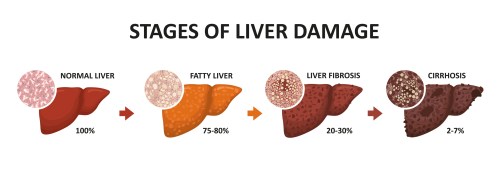
Stages of liver damage. Healthy, fatty, liver fibrosis and cirrhosis
About one quarter of the world’s adults have excess fat accumulation in the the liver called non-alcoholic fatty liver disease (NAFLD). This can lead to liver inflammation, scarring (cirrhosis), and liver cancer. The adverse effects of liver fat can be prevented by loss of that fat. The most common medical recommendation to accomplish that is to loss excess body weight via any reasonable method.
A study published in Gut last year found greater reduction in liver fat in those eating a “green-Mediterranean” diet compared to a regular Mediterranean diet over 18 months. Both diets were supplemented with walnuts 28 grams/day. Details of the green-Med diet:
In addition to [physical activity] and the provision of 28 g/day walnuts, the green-MED diet was restricted in processed and red meat and was richer in plants and polyphenols. The participants were guided to further consume the following provided items: 3–4 cups/day of green tea and 100 g/day of frozen Wolffia globosa (Mankai strain) plant frozen cubes, as a green shake replacing dinner. Both green tea and Mankai together provided additional daily intake of 800 mg polyphenols ((GAE), according to Phenol-Explorer and Eurofins lab analysis, including catechins (flavanols)) beyond the polyphenol content in the prescribed MED diet. Both the MED and green-MED diets were equally calorie-restricted (1500–1800 kcal/day for men and 1200–1400 kcal/day for women).
The researchers don’t tell us where to get frozen Wolffia globosa (Mankai strain) plant frozen cubes.
Study participants were almost all men, so results may not apply to women.





 Advanced Mediterranean Diet