Dukan Diet Creator Loses Libel Lawsuit Against Dr. Cohen

Dr. Pierre Dukan sued another diet doctor, Jean-Michel Cohen, for claiming that the Dukan diet could harm dieters.  A French court ruled in Dr. Cohen’s favor last year.  U.K.’s The Telegraph has a few of the details. Claire Al-Aufi has more at Hive Health Media.

I reviewed the Dukan diet last April.  Gee, I hope I’m not Dr. Dukan’s next target!

Steve Parker, M.D.

Which Diet Is Better for Weight Loss: Low-Carb or Low-Fat?

I’ve written about a 2009 New England Journal of Medicine article comparing weight-loss diets of various macronutrient (fat, protein, carbohydrate) composition. Its conclusion: Cut back on calories and you will lose weight, regardless of macrontrient percentages.

A blurry low-carb high-fat breakfast

A blog reader, Matt, brought up some interesting comments and questions. What follows will make little sense unless you read that prior post.

Matt writes:

Dr. Parker,

If the study folks didn’t do the real low carb diet because they “knew” that ketosis wouldn’t occur, couldn’t they at least have tried it, since what they were trying to prove was a calorie is a calorie?

Looking at the menus, the diet that they are purporting as low carb is really nothing close to a real low carb diet. It is a slightly lower carb diet, and not high enough in fat to prove anything. 35% carb is not Atkins phase anything. For a participant consuming 1600 calories, that’s 140g carb — too high for anyone attempting to restrict carbohydrates for health.

Please comment on the fact that the highest carb diet provided the worst lipid improvement.

Following up a little more, there really is no inference whatsoever that can be made with regard to a low carb diet with this study. Did you read the sample menu? No low carb diet phase would have any of the following as a typical meal. You can tell by looking at the menus that they had to be really PC about a “high fat” diet as well. I mean skim milk on a low carb / high fat diet? Note my level of surprise by the ? and ! in the parens with each “typical meal” option:

Breakfast:

1 poached egg

1/2 bagel (??)

4 oz apple juice (????!!!!)

skim (????) milk

Lunch:

1/2 cup spaghetti (??!!)

1/2 cup squash

1/2 cup peppers

1/2 cup mushrooms

1.5 T Olive Oil

1 small banana (????)

Dinner:

2 oz beef

1 small potato (????!!!!)

3/4 mixed veggies/legumes corn/carrots/lima/peas/green beans (???? since these are among the higher carb veggie choices)

1/2 cup cabbage

1 mini box raisins (??)

1 small apple (?????)

4 t Olive Oil

7 walnut halves

Snack

Skim (???) Milk

1 Graham cracker sheet (??????)

If you want a LC diet with what LC would consider a higher level of carbs (~60g) you need to do this:

Breakfast:

2-4 poached eggs

2 T olive oil

spinach

1 cup whole milk

Lunch:

1/2 cup squash

1/2 cup peppers

1/2 cup mushrooms

2 T Olive Oil

4-6 oz fish

Dinner:

4-6 oz beef

3/4 mixed lower carb (cruciferous/leafy) veggies such as broccoli, collards or other greens,

1/2 cup cabbage

2 T Olive Oil

20 walnut halves

1/2 cup low carb fruit such as cantaloupe

Snack

1/2 cup strawberries

1 cup whole milk yogurt ot cottage cheese

*******************************************

My response:

Thanks for your thoughtful comments/questions, Matt.

You’re right: The “low-carb” diet they studied indeed was not very low-carb, as succinctly illustrated by the sample menu you provided. (I didn’t read the supplementary appendix myself.)

You mention that the “highest carb diet provided the worst lipid improvement.” It’s not that clear-cut.

(Lipid changes are on pages 865-7 of the article, for anyone following along. Conventional wisdom is that better cardiovascular health is associated, generally, with lower total cholesterols, higher HDL chol, lower total LDL chol, and lower triglycerides.)

The study had two low-fat diets, with either 55 or 65% of total calories derived from carbohydrates. The two high fat diets had either 35 or 45% of total calories from carbohydrates.

Total cholesterol levels dropped by about 3 mg/dl in the low-fat diets compared to “no change” in the high-fat diets (2-year values). Measured at 6 months, total chol levels were down by about 5.5 mg/dl in the low-fat groups, and about 3 mg/dl in the high-fat groups. Baseline total chol levels for the whole group averaged 202 mg/dl.

The authors on page 865 write:

All the diets reduced risk factors for cardiovascular disease and diabetes at 6 months and 2 years. At 2 years, the two low-fat diets and the highest-carbohydrate diet decreased low-density lipoprotein [LDL] cholesterol levels more than did the high-fat diets or lowest-carbohydrate diet.

The lowest-carb diet increased HDL chol more than the highest carb diet, but we’re only talking about a 2 mg/dl difference measured at 2 years. HDL rose in all groups. Average baseline HDL level for the entire study group was 49 mg/dl.

All diets decreased triglycerides similarly, by 12-17%.

The magnitude of these changes is not great, and I question whether clinically important. The take-home point for me is that low-carb eating may not be (and probably isn’t) as atherogenic as warned by the medical community 15-20 years ago, judging purely from lipid changes. Other studies found similar numbers. But we’ve already agreed the this was not a serious trial of low-carb dieting.

The study authors write that HDL chol is a biomarker for carbohydrate intake: reducing dietary carbs tends to increase HDL chol levels, and vice versa.

If I understand “Nutrient Intake per Day” in Table 2 correctly, the participants who were told to increase their percentage of calories from fat really didn’t do it: they reduced it by 3.5% (!?). The low-fat cohorts had more success with compliance.

Clearly, it’s quite difficult to get free-living people to change their macronutrient intake and sustain the change for even six months, much less two years. Would compliance have been better if subjects had been allowed to choose a diet according to their natural inclinations? Maybe.

A recent study suggests that eating low-carb helps with prevention of weight regain because it burns an extra 300 calories a day compared to those eating low-fat.  Dr. Barbara Berkeley took a close look at this research on June 30.

Steve Parker, M.D.

How Much Exercise Is Enough?

Not Darrin Carlson

Darrin Carlson last March shared his ideas on the minimal amount of exercise and equipment needed to achieve reasonable fitness benefits.

Public health authorities for years have recommended physical activity in the range of 150 minutes a week. That ain’t gonna happen for most folks. Darrin says “Two hours a week will work for most people….”

Jonathan Bailor, Chris Highcock, and others suggest 30-60 minutes a week may be enough. Even Darrin admits as much, for the super-dedicated.

I was recently able to pass U.S. Army physical fitness standards by just working out for 70 minutes a week.

-Steve

I’m as Fit as a U.S. Army Soldier!

“Drop and gimme 50, maggot!”

U.S. soldiers, at least those in the Army, have to take a physical fitness test twice a year.  I wondered how I, at 57-years-old, stacked up so I self-administered the three fitness components.  I did not run in army boots, nor carry a rifle or backpack!  Soldiers need to score a minimum of 60 points on each exercise.

The Army Physical Fitness Test (APFT) performance requirements are adjusted for age and sex.

  1. Push-ups: 32 (76 points)
  2. Army sit-ups: 32 (65 points)
  3. Timed two-mile run: 17 minutes, 38 seconds (80 points)

I gotta say I feel pretty good about this, especially since I’ve only been working out for 60-70 minutes a week over the last three months.

Steve Parker, M.D.

Notes:

My first mile of the run was done in 8 minutes and 30 seconds.

Does Our Labor-Saving Technology Make Us Fat?

Relaxing after a hard day gathering nuts and berries

Have our modern conveniences contributed to the fact that two thirds of us are overweight or obese?  It would make sense, because we should be burning fewer calories in the activities of daily living.  If our daily workload decreases but we eat the same old calories, they gotta go somewhere, right?  Like into our fat stores.

We no longer have to walk down to the river to fetch a five-gallon bucket of water for washing.  No longer do we go out a forage for food and firewood. We don’t even have to get up off the couch to change the channel on the TV.

Hunter-gatherer societies don’t have our modern conveniences.  You’d think they burn a lot more calories than us in activities of daily living.  You’d be wrong.

At least one group of hunter-gatherers doesn’t burn any more calories in physical activity than Western cultures.  So much for blaming our excess weight on low activity levels and labor-saving technology.

BBC article on energy expenditure of the Hazda hunter-gatherer culture.

—Steve

h/t Colby Vorland at nutsci.org

Tuna Preserves Brain Blood Flow In People Over 65

Among people over 65, consumption of tuna/other fish is associated with preserved blood flow to the brain, according to a 2008 research report in the journal Neurology.

“Silent” brain infarcts – tiny strokes that are not obvious – are very common with advancing age. If a group of people 65 and older is MRI scanned and found to have no strokes, MRI scans performed five years later will show tiny strokes in 20% of them. Almost 90% of these new strokes are simply incidental findings without clinically evident stroke or transient ischemic attack.

As the authors point out:

Subclinical infarcts and white matter abnormalities are considered to be of vascular origin, presumably resulting from occlusion of small arteries in the brain and subsequent ischemia.

These subclinical strokes, along with brain white matter abnormalities, are not benign. They are associated eventually with impairment in thinking and behavior, and with higher risk of future obvious stroke.

Eating tuna or other broiled or baked fish tends to raise plasma omega-3 fatty acid levels and is associated with lower stroke risk and dementia and Alzheimer disease. Researchers wondered if fish consumption affected the risk of subclinical brain infarcts or other subclinical brain abnormalities.

Methodology

Scientists studied 3,660 participants over 65 years old in the Cardiovascular Health Study, by MRI scanning, lab testing, physical exam, and food frequency questionnaire. Five years later, 2,313 were rescanned. Hospital and clinic records were reviewed. Participants were men and women in four U.S. communities. Fish intake was classified as to whether tuna, other broiled or baked fish, and fried fish or fish sandwiches (fish burgers). In a subset of participants, blood levels of omega-3 fatty acids were measured.

Conclusions of the Scientists

Among older adults, modest consumption of tuna/other fish, but not fried fish, was associated with lower prevalence of subclinical infarcts and white matter abnormalities on MRI examinations. Our results add to prior evidence that suggest that dietary intake of fish with higher eicosapentaenoic acid [EPA] and docosahexaenoic acid [DHA] content, and not fried fish intake, may have clinically important health benefits.

…the results of the present article support the growing evidence that the type of fish meal consumed is important for obtaining the health benefits of fish consumption.

Discussion

The fish with higher omega-3 fatty acids, such as EPA and DHA, are the cold-water fatty fish such as albacore tuna, salmon, trout, sardines, anchovies, herring, halibut, sea bass, swordfish, and mackerel. These are sometimes referred to as dark meat fish or oily fish. These are the same types of fish most closely associated with lower rates of coronary artery disease and sudden cardiac death.

The types of fish used in fish sticks, fish burgers, and other fried fish meals are typically low in omega-3 fatty acids.

If you choose to eat fish for the health benefits, aim for two servings per week of cold-water fatty fish. The Friday night all-U-can-eat fried catfish buffet doesn’t cut it.

Steve Parker, M.D.

Reference: Virtanen, J.K., et al. Fish consumption and risk of subclinical brain abnormalities on MRI in older [U.S.] adults. Neurology, 71 (2008): 439-446.

My Fitness Experiment #3: Results

One……more……rep!

After finishing six weeks ofChris Highcock’s Hillfit earlier this year, I designed another fitness program using dumbbells and high intensity interval running on a treadmill.

I’ve preached about the benefits of baseline and periodic fitness measurements.  Here are mine, before and after roughly six weeks of my fitness experiment #3:

  • weight: no change (170 lb or 77.3 kg)
  • maximum consecutive push-ups: 34 before, 32 after
  • maximum consecutive pull-ups: no change (8)
  • maximum consecutive sit-ups: 37 before, 35 after
  • time for one-mile walk/run: 8 minutes and 35 seconds before, up to 8 minutes and 54 seconds after (*)
  • vertical jump (highest point above ground I can jump and touch): 279.5 cm before, to 276 cm after
  • toe touch (wearing shoes, stand and lock knees, bend over at waist to touch toes: no change (22 cm)

I worked out twice weekly for a total of 70 minutes.  The U.S. Centers for Disease Control and Prevention recommends 150 minutes a week of moderate-intensity aerobic activity and muscle-strengthening exercise at least twice a week; or 75 minutes per week of vigorous-intensity aerobic activity plus muscle-strengthening activity at least twice a week.

Bottom Line

I was a bit fitter after completing Hillfit a couple months ago.

Or I just had a bad day when I tested this time.  Nevertheless, I prefer my current program to Hillfit.  (Click for report on my six-week Hillfit experience.)

What Next?

For strength and endurance gains, perhaps I should incorporate some Hillfit features into my current plan.

I don’t feel like I’m getting much out of Romanian deadlifts.  Drop ’em?  Do they add anything to squats?  Try Hillfit-style wall squats while hold dumbbells?

How does my fitness compare to other 57-year-old men?  I’m not sure.  One of these days I’ll see how I stack up against U.S. Army fitness standards, which involve a timed two-mile run.

Is my current level of fitness good enough?  Again, not sure.

My highest dumbbell weights are 40 lb (18 kg).  I’m already using those for squats, deadlifts, and one-arm rows.  For future strength gains, I’d have to do those exercise for longer, or more days per week, or buy some 50-lb weights.  A pair of 50-lb dumbbells will cost $50 (used) or $100 (new).

I’ll put together yet another fitness program within the next few months.

I don’t like to exercise, but I want the health benefits.  My general goal is to maximize health benefits while minimizing exercise time.

Steve Parker, M.D.

Notes:

Next time I do the mile run on the treadmill, start at 7.5 mph and increase to 8 mph as much as tolerated.

(*) About 10 days after this I ran a mile in 8 minutes and 30 seconds on a high school track.

Nuts: What’s Not to Love?

MPj04031620000[1]Nut consumption is strongly linked to reduced coronary heart disease, with less rigorous evidence for several other health benefits, according to the American Journal of Clinical Nutrition.

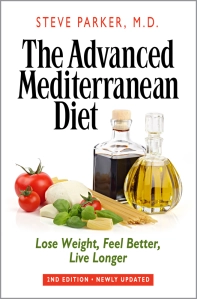
This is why I’ve included nuts as integral components of the Ketogenic Mediterranean Diet and the Advanced Mediterranean Diet.

Regular nut consumption is associated with health benefits in observational studies of various populations, within which are people eating few nuts and others eating nuts frequently. Health outcomes of the two groups are compared over time. Frequent and long-term nut consumption is linked to:

  • reduced coronary heart disease (heart attacks, for example)
  • reduced risk of diabetes in women (in men, who knows?)
  • less gallstone disease in both sexes
  • lower body weight and lower risk of obesity and weight gain

The heart-protective dose of nuts is three to five 1-ounce servings a week.

Steve Parker, M.D.

Reference: Sabaté, Joan and Ang, Yen. Nuts and health outcomes: New epidemiologic evidence. American Journal of Clinical Nutrition, 89 (2009): 1,643S-1,648S.

Huge U.S. Study Confirms Health and Longevity Benefits of the Mediterranean Diet

This is a reprint of my very first blog post, from December 24, 2007, at the old Advanced Mediterranean Diet Blog

We now have results of the first U.S. study on mortality and the Mediterranean dietary pattern.  380,000 people, aged 50-71, were surveyed on their dietary habits and scored on their conformity to the Mediterranean diet.  They were visited again 10 years later.  As you would expect, some of them died.  12,105 to be exact: 5985 from cancer, 3451 from cardiovascular disease, 2669 from other causes.  However, the people with the highest adherence to the Mediterranean diet had better survival overall, and specifically better odds of avoiding death from cardiovascular disease and cancer.  Compared to the people with low conformity to the Mediterranean diet, the high conformers were 15-20% less likely to die over the 10 years of the study.  The study authors, funded by the National Institutes of Health, noted eight similar studies in Europe and one in Australia with similar results.

Once again, my promotion of the Mediterranean diet is vindicated by the scientific literature.  I’m not aware of any other diet that can prove anywhere near this degree of health benefit.  If you are, please share

Reference: Mitrou, Panagiota N., et al.  Mediterranean Dietary Pattern and Prediction of All-Cause Mortality in a US Population,  Archives of Internal Medicine, 167 (2007): 2461-2468.


Mediterranean Diet Prolongs Life in Alzheimer Disease

A small scientific study of New York Alzheimer patients demonstrated significant increase in lifespan in those who had the highest adherence to the Mediterranean diet.  192 community-based individuals were followed for an average of 4.4 years (up to 13.6 years).  They were divided into three groups of Mediterranean diet adherence: low, medium, and high.  Compared to the people with low adherence, the others lived between 1 and 4 years longer.  Those with highest adherence lived the longest, suggesting a dose-response effect like we would see with many drugs.  No other diet has demonstrated this effect.

This same research group had previously reported that the Mediterranean diet lowered the risk for developing Alzheimer Disease in the first place.

Unfortunately, they did not report on whether the Mediterranean diet helped preserve brain function.  Prolongation of life by itself may be more of a curse than a blessing in advanced Alzheimer Disease.

Steve Parker, M.D.

Reference: Scarmeas, N., et al.  Mediterranean diet and Alzheimer disease mortality.  Neurology, 69 (2007):1,084-1,093.