QOTD: Mark Steyn on Judges

In my cultural tradition, a judge is just a bloke in a wig. He may be a smart bloke in a wig, or he may be an idiot in a wig. But the wig itself is not dispositive. As the English barrister F E Smith is said to have responded when a judge asked if he was trying to show contempt for this court, “No, my Lord. I am attempting to conceal it.”

—Mark Steyn

Has Eating-Out Contributed to Overweight and Obesity?

So easy to over-eat!

So easy to over-eat!

The U.S. trend of increasing overweight and obesity started about 1970. I wonder if eating away from home is related to the trend. I found a USDA report with pertinent data from 1977 to 1995. It also has interesting info on snacking and total calories consumed. Some quotes:

“We define home and away-from-home foods based on where the foods are obtained, not where they are eaten. Food at home consists of foods purchased at a retail store, such as a grocery store, a convenience store, or a supermarket. Food away from home consists of foods obtained at various places other than retail stores (mainly food-service establishments).”

***

“Over the past two decades, the number of meals consumed has remained fairly stable at 2.6 to 2.7 per day. However, snacking has increased, from less than once a day in 1987-88 to 1.6 times per day in 1995. The increased popularity in dining out is evident as the proportion of meals away from home increased from 16 percent in 1977-78 to 29 percent in 1995, and the proportion of snacks away from home rose from 17 percent in 1977-78 to 22 percent in 1995. Overall, eating occasions (meals and snacks) away from home increased by more than two-thirds over the past two decades, from 16 percent of all eating occasions in 1977-78 to 27 percent in 1995.”

***

“Average caloric intake declined from 1,876 calories per person per day in 1977-78 to 1,807 calories per person per day in 1987-88, then rose steadily to 2,043 calories per person per day in 1995.”

***

“These numbers suggest that, when eating out, people either eat more or eat higher-calorie foods or both.”

Parker here. I’m well aware that these data points don’t prove that increased eating-out, increased snacking,  and increased total calorie consumption have caused our overweight and obesity problem. But they sure make you wonder, don’t they? None of these factors was on a recent list of potential causes of obesity.

If accurate, the increased calories alone could be the cause. Fast-food and other restaurants do all they possibly can to satisfy your cravings and earn your repeat business.

If you struggle with overweight, why not cut down on snacking and eating meals away from home?

Steve Parker, M.D.

Update January 23, 2013:

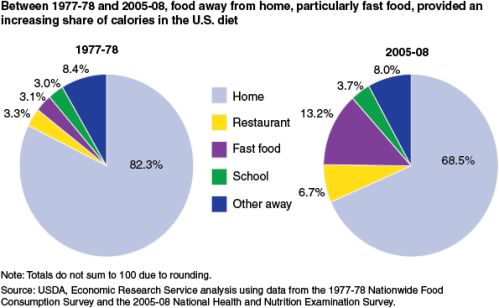
Here’s a pie chart I found with more current and detailed information from the U.S. government (h/t Yoni Freedhoff):

feb13_feature_guthrie_fig03

Low-Carb Diets Poised for Resurgence?

I’ve been predicting major renewed interest in l0w-carb weight loss diets for the  last three or four years. Perhaps it’s starting. Evidence? Two recent online articles noting increased sales at Atkins Nutritionals. Here’s one at NPR and one at TakePart. The search terms “low-carb diet” didn’t reveal any blip at Google Trends, however.

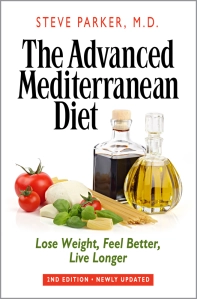
My Advanced Mediterranean Diet (2nd edition) offers a low-carb option that’s worked well for many, along with a traditional portion-control program.

Steve Parker, M.D.

Book Review: Zest for Life – The Mediterranean Anti-Cancer Diet

51VBKOWQ3dL._SX258_PJlook-inside-v2,TopRight,1,0_SH20_BO1,204,203,200_.jpg

A couple years ago I read and reviewed Zest For Life: The Mediterranean Anti-Cancer Diet, by Conner Middelmann-Whitney, published in 2011. I guess I forget to pull and re-post my review off my old Advanced Mediterranean Diet blog. Per Amazon.com’s rating system, I give it five stars (I love it). Here it is.

 ♦   ♦   ♦

The lifetime risk of developing invasive cancer in the U.S. is four in ten: a little higher for men, a little lower for women.  Those are scary odds.  Cancer is second only to heart disease as a cause of death in western societies.  The Mediterranean diet has a well established track record of protecting against cancers of the prostate, colon/rectum, uterus, and breast.  Preliminary data suggest protection against melanoma and stomach cancer, too.  I’m not aware of any other way of eating that can make similar claims.

So it makes great sense to spread the word on how to eat Mediterranean-style, to lower your risk of developing cancer.  Such is the goal of Zest For Life’s author.  The Mediterranean diet is mostly, although by no means exclusively, plant-based.  It encourages consumption of natural, minimally processed, locally grown foods.  Generally, it’s rich in vegetables, fruits, legumes, olive oil, whole grains, red wine, and nuts. It’s low to moderate in meat, chicken, fish, eggs, and dairy products (mostly cheese and yogurt).

Note that one of the four longevity hot spots featured in Dan Buettner’s Blue Zones was Mediterranean: Sardinia.  All four Blue Zones were characterized by plant-based diets of minimally processed, locally grown foods. (I argue that Okinawa and the Nicoya Peninsula dwellers ate little meat simply due to economic factors.)

Proper diet won’t prevent all cancer, but perhaps 10-20% of common cancer cases, such as prostate, breast, colorectal, and uterine cancer.  A natural, nutrient-rich, mostly plant-based diet seems to bolster our defenses against cancer.

Ms. Middelmann-Whitney is no wacko claiming you can cure your cancer with the right diet modifications.  She writes, “…I do not advocate food as a cancer treatment once the disease has declared itself….”

She never brings it up herself, but I detect a streak of paleo diet advocacy in her.  Several of her references are from Loren Cordain, one of the gurus of the modern paleo diet movement.

She also mentions the ideas of Michael Pollan very favorably.

She’s not as high on whole grains as most of the other current nutrition writers.  She points out that, calorie for calorie, whole grains are not as nutrient-rich as vegetables and fruits.  Speaking of which, she notes that veggies generally have more nutrients than fruits. Furthermore, she says, grain-based flours probably contribute to overweight and obesity. She suggests that many people eat too many grains and would benefit by substituting more nutrient-rich foods, such as veggies and fruits.

Some interesting things I learned were 1) the 10 most dangerous foods to eat while driving, 2) the significance of organized religion in limiting meat consumption in some Mediterranean regions, 3) we probably eat too many omega-6 fatty acids, moving the omega-6/omega-3 ratio away from the ideal of 2:1 or 3:1 (another paleo diet principle), 4) one reason nitrites are added to processed meats is to create a pleasing red color (they impair bacterial growth, too), 5) fresh herbs are better added towards the end of cooking, whereas dried herbs can be added earlier, 6) 57% of calories in western societies are largely “empty calories:” refined sugar, flour, and industrially processed vegetable oils, and 7) refined sugar consumption in the U.S. was 11 lb (5 kg) in the 1830s, rising to 155 lb (70 kg) by 2000.

Any problems with the book? Only relatively minor ones. The font size is a bit small for me; if that worries you, get the Kindle edition and choose your size.  She mentions that omega-6 and omega-3 fatty acids are “essential” fats. I bet she meant to say specifically that linolenic and linoleic fatty acids are essential (our bodies can’t make them); linolenic happens to be an omega-3, linoleic is an omega-6.  Reference #8 in chapter three is missing.  She states that red and processed meats cause cancer (the studies are inconclusive).  I’m not sure that cooking in or with polyunsaturated plant oils causes formation of free radicals that we need to worry about.

As would be expected, the author and I don’t see eye to eye on everything.  For example, she worries about bisphenol-A, pesticide residue, saturated fat, excessive red meat consumption, and strongly prefers pastured beef and free-range chickens and eggs.  I don’t worry much.  She also subscribes to the “precautionary principle.”

The author shares over 150 recipes to get you started on your road to cancer prevention.  I easily found 15 I want to try.  She covers all the bases on shopping for food, cooking, outfitting a basic kitchen, dining out, shopping on a strict budget, etc.  Highly practical for beginning cooks.  Numerous scientific references are listed for you skeptics.

I recommend this book to all adults, particularly for those with a strong family history of cancer.  But following the author’s recommendations would do more than lower your risk of cancer.  You’d likely have a longer lifespan, lose some excess fat weight,  and lower your risk of type 2 diabetes, dementia, heart disease, stroke, and vision loss from macular degeneration.  Particularly compared to the standard American diet.

Steve Parker, M.D.

Disclosure: The author arranged a free copy of the book for me, otherwise I recieved nothing of value for writing this review.

Did You Waste Money on Sensa?

The U.S. Federal Trade Commission has taken action action. Janet Helm has the details. For example:

The makers of  Sensa will need to pay $26.5 million to consumers to settle federal charges that the company used deceptive weight-loss claims and misleading endorsements to sell these sprinkles.

The FTC charged that California-based Sensa Products, LLC, its parent, and Sensa creator Dr. Alan Hirsch and CEO Adam Goldenberg, deceptively advertised that Sensa enhances food’s smell and taste, making users feel full faster, so they eat less and lose weight, without dieting or exercising.

Mediterranean Diet Beats Low-Fat for Heart Disease Prevention

Ughh

Ughh

The American Journal of Medicine has an article entitled “Diets to Prevent Coronary Heart Disease 1957- 2013: What Have We Learned?” The authors conclude:

The Mediterranean-style diet, with a focus on vegetables, fruit, fish, whole grains and olive oil, has proven to reduce cardiovascular events to a degree greater than low fat diets, and equal to or greater than the benefit observed in statin trials.

You May Need to Rein In Your Doctors at the End of Your Life

The Wall Street Journal has a sad article about end-of-life care and being in control. Some statistics caught my eye:

This disconnect has ruinous economic costs. About a quarter of Medicare’s $550 billion annual budget pays for medical treatment in the last year of life. Almost a third of Medicare patients have surgery in their last year of life, and nearly one in five in their last month of life. In their last year of life, one-third to one-half of Medicare patients spend time in an intensive care unit, where 10 days of futile flailing can cost as much as $323,000. Medical overtreatment costs the U.S. health care system an estimated $158 billion to $226 billion a year.

But you don’t care about the money because you’re not paying for it, right? Remember that physicians are much less aggressive with end-of-life care when it comes to their own lives. It’s not about the money.

Read the whole thing.

Steve Parker, M.D.

Moderate Alcohol Consumption Linked to Preservation of Hearing

I’ll drink to that!

It’s an old study from 2000 that I should have known about. It’s an observational study, not interventional. So it’s suggestive but not proof of hearing protection by alcohol.


h/t Glenn Reynolds (Instapundit)

The Solution to High U.S. Healthcare Cost is LESS Government Intervention, Not More

For the argument, click through for an article at The Heritage Foundation. A quote:

The United States does not have a private-sector health insurance system, let alone a functioning competitive market for insurance or health services. In fact, the federal government has been the dominant force in American health care for decades, long before the recent massive expansion of the government’s role in the 2010 Patient Protection and Affordable Care Act (PPACA) [Obamacare]. Through overly restrictive policies, Medicare, Medicaid, and tax subsidies, the federal government has dominated the operation of the U.S. health care system for the past half-century. It is primarily federal policies that are responsible for driving up costs and making health insurance unaffordable for so many Americans.

You’ll read how Democrats helped deregulate the airline and trucking industries, leading to lower consumer costs.

2013 Was Good For the Mediterranean Diet

Larry Huston, a long-time writer on things cardiologic, notes that:

It was a good year for the Mediterranean Diet. The PREDIMED study provided the best supporting evidence yet, though it seems unlikely if anyone will ever be able to sort out the specific role of the individual components of the Mediterranean diet, which include wine, olive oil, nuts, fish, and, of course, less tangible things like sunshine and lifestyle. The nuts component received a separate boost from the publication of an influential paper in the New England Journal of Medicine.

Actually, Harvard and U. of Athens researchers have an idea which components of the Mediterranean diet prolong life.