Here’s a beautiful rendition of an Anglican hymn I’d never heard before, “Abide With Me.”
Visit YouTube and you can see the printed lyrics. Written in 1847, the author reportedly died of tuberculosis three weeks later.
h/t John Derbyshire
Here’s a beautiful rendition of an Anglican hymn I’d never heard before, “Abide With Me.”
Visit YouTube and you can see the printed lyrics. Written in 1847, the author reportedly died of tuberculosis three weeks later.
h/t John Derbyshire
Comments Off on Ashes to Ashes, Dust to Dust…
Posted in Uncategorized
Tagged Abide With Me, John Derbyshire
Yes, according to a meta-analysis in a recent AJCN. They drop systolic pressure about 5 units and diastolic only about 1.5 units (mmHg). Although modest, that may be enough to help reduce the need for blood pressure medications.
Steve Parker, M.D.
Comments Off on Do Salt Substitutes Help Lower Blood Pressure?
Posted in Uncategorized
Tagged blood pressure, hypertension, salt substitutes
As a hospitalist, I may be called by an emergency department physician today with the following scenario.
“Hey, Steve, I’ve got an admission for you. The patient just got off the plane at Sky Harbor and drove straight here with flu-like symptoms. He was in Liberia 10 days ago. This might be Ebola.”
My first inclination might be to run in the opposite direction from the ER and leave the hospital. But I probably won’t.
I’ve never seen a case of Ebola. At this point, very few U.S. doctors and hospitals have experience with it. I don’t remember anything about Ebola from medical school—for all I know it didn’t even existed back then.
In preparation for that call from the emergency department, here are some links for pertinent info, until I can memorize it all. Many of these links are to the U.S. Centers for Disease Control and Prevention and should be (better be) updated soon.
World Health Organization Guidelines on Personal Protective Equipment (October, 2014). This document is more detailed and probably a bit more stringent than the CDC’s advice, although the two have much overlap. A few points to remember:
World Health Organization Guidelines on Both Direct and Non-direct Care to Ebola Patients (September, 2014). Non-Direct care includes waste management, lab activities, movement and burial of human remains, etc.
The Nebraska Ebola Method: This dynamic and evolving course will provide videos, media, and guidelines as used in Nebraska to care for Ebola patients. The materials share current processes being used to safely care for patients with this dangerous, highly infectious disease. The course will be updated frequently to disseminate lessons learned.
A Detailed Ebola Case Report From Germany Published in NEJM. “Staff members…were protected by pressurized suits…that were equipped with ventilators with high-efficiency particulate air filters to provide fresh air supply with a maximum airflow of 160 liters per minute….” Does your hospital have these? “Decontamination [of healthcare workers] in the airlock is performed by two shower-cycles with 2% perchloric acid for 2 minutes and a residence time of 7 minutes. Finally acid residues are rinsed by showering with water.”
Lessons Learned Treating Ebola Patients at Emory University Hospital (pdf). Video of same presentation (didn’t work on my Mac).
Infection Prevention and Control Recommendations for Hospitalized Patients with Known or Suspected Ebola Virus Disease in U.S. Hospitals (I’m not sure these are adequate as of Oct. 15, 2014)
Interim Guidance for Environmental Infection Control in Hospitals for Ebola Virus
Donning and Removing Personal Protective Equipment
Personal Protective Equipment Training Demonstration Video from GNYHA. One way to do it, which may or may not be adequate.
Ebola Overview for Clinicians in U.S. Healthcare Settings
Algorithm for Evaluation of the Traveler Returned From Ebola-Affected Areas
Checklist for Patients Being Evaluated For Ebola in the U.S.
2008 Doctors Without Borders Practical Guidelines on Ebola and other Filoviruses
University of Nebraska Medical Center’s Biosafety Level 4 Facility Guidelines for Donning and Doffing Personal Protective Equipment Around Viral Hemorrhagic Fever Patients (these took 30-60 seconds to load on my computer)
Updated: November 3, 2104, 2345 hrs
I didn’t think so. None of mine ever has. And the worst carbohydrates for your teeth seem to be sugars.
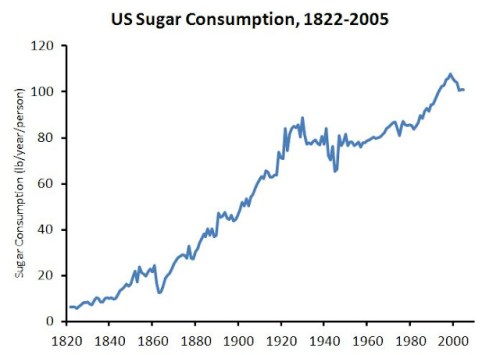
(Thanks to Dr. Stephan Guyenet and Jeremy Landen for this sugar consumption graph.)
MNT on September 16, 2014, published an article about the very prominent role of sugars as a cause of cavities, aka dental caries. This idea deserves much wider dissemination.
I’ve written before about the carbohydrate connection to dental health and chronic systemic disease. Furthermore, sugar-sweetened beverages are linked to 200,000 yearly worldwide deaths.
Investigators at University College London and the London School of Hygiene & Tropical Medicine think the World Health Organization’s recommendation of a maximum of 10% total daily calories from “free sugar” should be reduced to 3%, with 5% (25 grams) as a fall-back position.
Six teaspoons of granulated table sugar (sucrose) is 25 grams. That should be enough daily sugar for anyone, right? But it’s incredibly easy to exceed that limit due to subtly hidden sugars in multiple foods, especially commercially prepared foods that you wouldn’t expect contain sugar. Chances are, for instance, that you have in your house store-bought sausage, salad dressings, and various condiments with added sugars such as high fructose corn syrup. Sugar’s a flavor enhancer.
The aforementioned “free sugar” as defined as any monosaccharides and disaccharides that a consumer, cook, or food manufacturer adds to foods. In the U.S., we just call these “added sugars” instead of free sugars. From the MNT article, “Sugars that are naturally present in honey, syrup, and fruit juices are also classed as free sugars.” Sugar in the whole fruit you eat is not counted as free or added sugar.
The London researchers found that—in children at least—moving from consuming almost no sugar to 5% of total daily calories doubled the rate of tooth decay. This rose with every incremental increase in sugar intake.
From the MNT article:
“Tooth decay is a serious problem worldwide and reducing sugar intake makes a huge difference,” says study author Aubrey Sheiham, of the Department of Epidemiology & Public Health at University College London. “Data from Japan were particularly revealing, as the population had no access to sugar during or shortly after the Second World War. We found that decay was hugely reduced during this time, but then increased as they began to import sugar again.”
I’m convinced. How about you?
Comments Off on Has Your Dentist Ever Told You, “No Carbs, No Cavities”?
Posted in Uncategorized
Tagged cavities, dental caries, free sugar, limit added sugar, sugar
Let’s say you’re not happy with the ideology of your current church or you quit going to church years ago and are thinking about returning. Do you want a liberal or a conservative church? How would you find a church where you fit in?
One starting point would be to review a neat graphic put together by Tobin Grant. (Sorry, non-Americans, this is mostly about American churches. But there are data points for atheists and agnostics, too.)
Based on surveys of churchgoers, Mr. Grant classifies churches by where they stand on size of government and “protection of morality.” I’m not saying this is the best way to choose a church; it’s one way to get started.
Happy hunting!
Steve Parker, M.D.
Comments Off on Skipping Breakfast Doesn’t Affect Weight Loss
Posted in Uncategorized
…at least in Swedes. Regular non-processed red meat consumption was NOT associated with shorter life. Maybe you should cut back on the bacon and bologna.
Comments Off on Processed Red Meat Consumption Linked to Shorter Life
Posted in Uncategorized
Comments Off on Added Sugars Constitute 14% of Total Calories in Americans
Posted in Uncategorized
The NYT’s Well blog has the details. The brain’s hippocampus is a critical center for memory. Alzheimers disease is associated with a gene called apo-E4. Carriers of that gene who exercise regularly have less shrinkage of the hippocampus than non-exercisers.
To PROVE that regular exercise prevents dementia-related shrinkage of the hippocampus, you’d have to force some folks to exercise and stop others who wanted to exercise. A couple years later, scan their brains and compare the two groups. That study may never be done.
The Mediterranean diet also seems to prevent or forestall dementia.
Comments Off on Exercise Once Again Linked to Avoidance of Dementia
Posted in Uncategorized
The answer is sugar, according to John Yudkin and Robert Lustig, among others. The Age has the details. A quote:
[Robert] Lustig is one of a growing number of scientists who don’t just believe sugar makes you fat and rots teeth. They’re convinced it’s the cause of several chronic and very common illnesses, including heart disease, cancer, Alzheimer’s and diabetes. It’s also addictive, since it interferes with our appetites and creates an irresistible urge to eat.
This year, Lustig’s message has gone mainstream; many of the New Year diet books focused not on fat or carbohydrates, but on cutting out sugar and the everyday foods (soups, fruit juices, bread) that contain high levels of sucrose. The anti-sugar camp is not celebrating yet, however. They know what happened to Yudkin and what a ruthless and unscrupulous adversary the sugar industry proved to be.
In 1822, we in the U.S. ate 6.2 pounds of sugar per person per year. By 1999, we were up to 108 pounds.
The U.S. Department of Agriculture estimates that added sugars provide 17% of the total calories in the average American diet. A typical carbonated soda contain the equivalent of 10 tsp (50 ml) of sugar. The average U.S. adult eats 30 tsp (150 ml) daily of added sweeteners and sugars.
On the other hand, Fanatic Cook Bix found a study linking higher sugar consumption with lower body weight, which you might think would protect against type 2 diabetes, heart disease, and some cancers.
Read the rest at The Age. It’s mostly about John Yudkin.
Steve Parker, M.D.
h/t Jamie Scott
Comments Off on Riddle Me This: What’s Pure, White, and Deadly?
Posted in Sugar, Uncategorized
Tagged Bix, Fanatic Cook, John Yudkin, pure white and deadly, Robert Lustig, sugar