…according to a meta-analysis published in the British Medical Journal.
At this point, it’s more accurate to say the two are associated than to say the drinks cause diabetes.

…according to a meta-analysis published in the British Medical Journal.
At this point, it’s more accurate to say the two are associated than to say the drinks cause diabetes.

Cubes of Diabetes?
A Pharm.D (Dr of Pharmacology) and a pair of MD’s surveyed much of the available scientific literature—both animal and human studies—and concluded that fructose is a major culprit in the rise of type 2 diabetes and prediabetes. Fructose does its damage by increasing insulin resistance. ScienceDaily has the details.
Be aware that their conclusion is certainly not universally accepted. I just read “Pathogenesis of type 2 diabetes mellitus” at UpToDate.com and saw no mention of fructose. Under dietary factors, they mainly talked about obesity and how that increases insulin resistance, leading to elevated blood sugars, while the reverse happens with weight loss. I haven’t looked at all the research so I have no definite opinion yet on the fructose-diabetes theory; I’m skeptical.
Fructose is a type of simple sugar. Common dietary sources of fructose are fruits, table sugar (aka sucrose, a 50:50 combination of glucose and fructose molecules), and high-fructose corn syrup (which is usually 42 or 55% fructose).

Damaging effects, if any, of fructose in these fruits may be mitigated by the fiber
A few quotes from ScienceDaily:
“At current levels, added-sugar consumption, and added-fructose consumption in particular, are fueling a worsening epidemic of type 2 diabetes,” said lead author James J. DiNicolantonio, PharmD, a cardiovascular research scientist at Saint Luke’s Mid America Heart Institute, Kansas City, MO. “Approximately 40% of U.S. adults already have some degree of insulin resistance with projections that nearly the same percentage will eventually develop frank diabetes.”
* * *
While fructose is found naturally in some whole foods like fruits and vegetables, consuming these foods poses no problem for human health. Indeed, consuming fruits and vegetables is likely protective against diabetes and broader cardiometabolic dysfunction, explained DiNicolantonio and colleagues. The authors propose that dietary guidelines should be modified to encourage individuals to replace processed foods, laden with added sugars and fructose, with whole foods like fruits and vegetables. “Most existing guidelines fall short of this mark at the potential cost of worsening rates of diabetes and related cardiovascular and other consequences,” they wrote.
If you’re eating a typical Western or American diet, you’ll reduce your fructose consumption by moving to the Mediterranean diet, the Advanced Mediterranean Diet, Low-Carb Mediterranean Diet, or the Paleobetic Diet.
RTWT.
Steve Parker, M.D.
Comments Off on Yet Another Potential Cause of Type 2 Diabetes: Fructose
Posted in Diabetes
Tagged cause of diabetes, diabetes, fructose
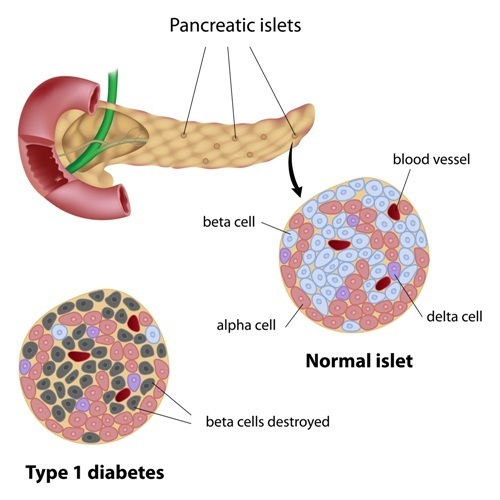
Insulin from the pancreas’ beta cells is a major regulator of blood sugar levels
A recent meta-analysis found that elevated fasting blood glucose levels, even below the diabetic range, are associated with higher risk of developing pancreatic cancer. This is important because you can take action today to lower your fasting blood sugar level, which may lower your risk of pancreatic cancer over the long-term. The researchers conclude that…
Every 0.56 mmol/L [10 mg/dl] increase in fasting blood glucose is associated with a 14% increase in the rate of pancreatic cancer.
In the developed world, your risk of getting an invasive cancer is roughly one in four. Pancreatic cancer is the most lethal. Surgery is the way to cure it, but at the time of diagnosis only two in 10 patients are candidates for surgery because the cancer has already spread. Pancreatic cancer is the fourth leading cause of cancer death in the USA and the fifth in the UK. Nevertheless, pancreas cancer is not terribly common; the US has 50,000 new cases annually. As a hospitalist, I run across one or two new cases of pancreas cancer every year.
We’ve known for years that type 2 diabetes is linked to pancreatic cancer, with diabetics having twice the risk of nondiabetics.
What if you have elevated fasting blood sugars? There’s no proof that reducing them to the normal range will reduce your risk of pancreatic cancer. But if it were me, that’s what I’d shoot for, by losing excess fat weight, exercising, and eating a Low-Carb Mediterranean Diet book detail page at Amazon.com.
Other that type 2 diabetes and prediabetes, some other risk factors for pancreas cancer are:
You can alter most of those risk factors. Why not get started today?
PS: If you’re not sure if your fasting blood sugar’s elevated, click here.
Comments Off on Elevated Fasting Blood Sugars May Increase Your Risk for Pancreatic Cancer
Tagged diabetes, elevated fasting blood sugar, hyperglycemia, pancreatic cancer, prediabetes
We don’t know with certainty yet. But a recent study suggests that non-caloric artificial sweeteners do indeed cause overweight and type 2 diabetes in at least some folks. The study at hand is very small, so I wouldn’t bet the farm on it. I’m not even changing any of my recommendations at this point.

“Too many diet sodas” doesn’t explain this whole picture
The proposed mechanism for adverse metallic effects is that the sweeteners alter the mix of germs that live in our intestines. That alteration in turn causes the overweight and obesity. See MedPageToday for the complicated details. The first part of the article is about mice; humans are at the end.
Some quotes:
“Our results from short- and long-term human non-caloric sweetener consumer cohorts suggest that human individuals feature a personalized response to non-caloric sweeteners, possibly stemming from differences in their microbiota composition and function,” the researchers wrote.
The researchers further suggested that these individualized nutritional responses may be driven by personalized functional differences in the micro biome [intestinal germs or bacteria].
***
Diabetes researcher Robert Rizza, MD, of the Mayo Clinic in Rochester, Minn., who was not involved with the research, called the findings “fascinating.”
He noted that earlier research suggests people who eat large amounts of artificial sweeteners have higher incidences of obesity and diabetes. The new research, he said, suggests there may be a causal link.
“This was a very thorough and carefully done study, and I think the message to people who use artificial sweeteners is they need to use them in moderation,” he said. “Drinking 17 diet sodas a day is probably a bad idea, but one or two may be OK.”
I won’t argue with that last sentence!
Finally, be aware the several clinical studies show no linkage between human consumption of non-caloric artificial sweeteners and overweight, obesity, and T2 diabetes.
Comments Off on Do Artificial Sweeteners Cause Overweight and Type 2 Diabetes?
Posted in Diabetes, Overweight & Obesity, Sugar Substitutes
Tagged artificial sweeteners, mice, non-caloric artificial sweeteners, obesity, overweight, type 2 diabetes

Like type 1 diabetics, many type 2’s need insulin shots
Researchers affiliated with the U.S. Centers for Disease Control estimate that 40% of American adults will develop diabetes, mostly type 2. The CDC’s prior estimate was the one of every three Americans born in 2000 would develop diabetes. Some snippets from the article abstract:
On the basis of 2000—11 data, lifetime risk of diagnosed diabetes from age 20 years was 40·2% for men and 39·6% for women, representing increases of 20 percentage points and 13 percentage points, respectively, since 1985—89.
The number of life-years lost to diabetes when diagnosed at age 40 years decreased from 7·7 years in 1990—99 to 5·8 years in 2000—11 in men, and from 8·7 years to 6·8 years in women over the same period.
Years spent with diabetes increased by 156% in men and 70% in women.
The good news is that you can decrease your odds of type 2 diabetes via diet and exercise. I can’t prove it, but I bet the Advanced Mediterranean Diet prevents some cases of diabetes. The single most important issue in preventing type 2 diabetes is avoiding obesity.
Comments Off on Four In Ten U.S. Adults Will Develop Diabetes
Posted in Diabetes
Tagged Advanced Mediterranean Diet, CDC, diabetes incidence, prevent diabetes, type 2 diabetes
At this point, no one knows with certainty what cause type 2 diabetes. There may be multiple different causes. For instance, click here, here, here, and finally here.
At least one recent study implicated red meat consumption as a cause of type 2 diabetes. Dr. Richard Feinman at his blog takes a close look at the 2013 study and points out the great difficulty in making the leap from red meat to diabetes. I think Dr. Feinman’s point is best made by his graph about half way through the post, showing steadily decreasing red meat consumption as T2 diabetes takes off over the last four decades. (I assume all the figures are based on U.S. data.)
For the opposing viewpoint, read the original study (linked at Dr. F’s blog) or search at Fanatic Cook.
If red meat causes diabetes, it might make existing diabetes worse.
Do I worry that red meat causes diabetes? Not much. I await definitive research.
Comments Off on Does Red Meat Cause Diabetes?
Posted in Diabetes
Tagged causes of type 2 diabetes, diabetes, red meat
This isn’t news to many of us. Click if you want to see some evidence at AJCN. Confused about glycemic index and load? Click here.
Comments Off on High Glycemic Load and High Glycemic Index Eating Increase Risk of Type 2 Diabetes
Posted in Diabetes, Glycemic Index
It sounds like Jerome Ruzzin is convinced it does. I put some thought into it last August and was skeptical—still am, but I’m keeping an open mind. Mr. Ruzzin has a review article published in 2012 at BMC Public Health (“Public health concern behind the exposure to persistent organic pollutants and the risk of metabolic diseases”). Here’s his summary:
The global prevalence of metabolic diseases like obesity and type 2 diabetes, and its colossal economic and social costs represent a major public health issue for our societies. There is now solid evidence demonstrating the contribution of POPs [persistent organic pollutants], at environmental levels, to metabolic disorders. Thus, human exposure to POPs might have, for decades, been sufficient and enough to participate to the epidemics of obesity and type 2 diabetes. Based on recent studies, the fundaments of current risk assessment of POPs, like “concept of additive effects” or “dioxins and dl-PCBs induced similar biological effects through AhR”, appear unlikely to predict the risk of metabolic diseases. Furthermore, POP regulation in food products should be harmonized and re-evaluated to better protect consumers. Neglecting the novel and emerging knowledge about the link between POPs and metabolic diseases will have significant health impacts for the general population and the next generations.

Salmon are a good source of omega-3 fatty acids, but are they dangerously polluted?
The cold-water fatty fish I so often recommend to my patients could be hurting them. They are major reservoirs of food-based POPs.
Comments Off on Is Pollution Causing Type 2 Diabetes and Obesity?
Posted in Diabetes, Overweight & Obesity
Tagged diabetes, fish, obesity, persistent organic pollutants, POPs
There are ways of slowing or reversing losses in cognitive function. The most effective discovered so far is physical exercise, which protects the brain by protecting the body’s cardiovascular health. Mental exercise, often called brain training, is widely promoted, but it boosts only the particular skill that is practised – its narrow impact mirroring that of educational interventions at other ages. Various drugs are being investigated for their value in staving off normal cognitive decline, but for now preventive maintenance is still the best bet – avoid smoking, drinking to excess, head injuries and the like.
Don’t forget regular exercise. Also, I think the Mediterranean diet helps preserve brain function, but it’s difficult to prove.

MRI scan of brain
That quotes from an Instant Expert paper on intelligence. It’s full of interesting facts such as the typical difference in IQ between strangers is 17 points. It answers the question whether an enriched school or home environment can increase intelligence.
The article mentions overload of patients’ brains when medical care is too complicated:
Given the complexity of self-care regimes, it is hardly surprising that some people make dangerous errors or fail to comply. The effective management of diabetes, for example, requires a person to keep blood sugar levels within a healthy range, which means coordinating diet, exercise and medication throughout the day, which in turn requires planning for contingencies, recognising when blood sugar is veering too high or low, knowing how to regain control and conceptualising the imperceptible but cumulative damage caused by failing to maintain control. There is no set recipe for people with diabetes to follow – their bodies and circumstances differ. Moreover, they get little training, virtually no supervision and no days off. Effectively managing your diabetes is a cognitively complex job and poor performance has serious consequences, including emergency room visits, lost limbs or eyesight, and even death. The lower the diabetic person’s IQ, the greater the risks.
You’ll also learn about the Flynn effect and possible explanations for it:
Over the past century, each successive generation has answered more IQ test items correctly than the last, the rise being equivalent to around 3 IQ points per decade in developed nations. This is dubbed the “Flynn effect” after the political scientist James Flynn, who most thoroughly documented it. Are humans getting smarter, and if so, why?
I’m more inclined to think Idiocracy describes our future.
h/t James Fulford
Comments Off on How to Preserve Brain Function Despite Aging
Tagged brain function, brain preservation, cognitive function, diabetes, intelligence, Mediterranean diet
I recently finished an ebook, The Heart Healthy Lifestyle: The Prevention and Treatment of Type 2 Diabetes by Sean Preuss, published in 2013. Per Amazon.com’s rating system, I give it five stars (I love it).
♦ ♦ ♦
This is an invaluable resource for 1) anyone recently diagnosed with type 2 diabetes or prediabetes, 2) those who aren’t responding well to their current therapeutic regimen, and 3) type 2 diabetics who want to reduce their drug use.

Strength Training Helps Get Excess Blood Sugar Out of Circulation
Mr. Preuss is a fitness trainer who has worked with many type 2 diabetics. He demonstrates great familiarity with the issues diabetics face on a daily basis. His science-based recommendations are familiar to me since I reviewed many of his references at on of my other blogs, Diabetic Mediterranean Diet.
Like me, Mr. Preuss recognizes the primacy of lifestyle modification over drug therapy for type 2 diabetes, as long as drugs can safely be avoided or postponed. The main lifestyle factors are diet and exercise. Too many physicians don’t spend enough time on these, preferring instead to whip out the prescription pad and say, “Here ya go. I’ll see you in three months.”
I have gradually come to realize that most of my sedentary type 2 diabetes patients need to start a work-out program in a gym where they can get some personal attention. That’s Mr. Preuss’s opinion, too. The clearly explained strength training program he recommends utilizes machines most commonly found in a gym, although some home gyms will have them also. His regimen is easily done in 15-20 minute sessions two or three times a week.
He also recommends aerobic activity, such as walking at least several days a week. He recommends a minimum of 113 minutes a week of low intensity aerobic work, citing evidence that it’s more effective than higher intensity effort for improving insulin sensitivity.
I don’t recall specific mention of High Intensity Interval Training. HIIT holds great promise for delivering the benefits of aerobic exercise in only a quarter of the time devoted to lower intensity aerobics. It may be that it just hasn’t been studied in type 2 diabetics yet.
I was glad to see all of Mr. Preuss’s scientific references involved humans, particularly those with type 2 diabetes. No mouse studies here!
Another strength of the book is that Sean tells you how to use psychological tricks to make the necessary lifestyle changes.
The author notes that vinegar can help control blood sugars. He suggests, if you can tolerate it, drinking straight (undiluted) red wine vinegar or apple cider vinegar – 2 tbsp at bedtime or before carbohydrate consumption. I’ve heard rumors that this could be harmful to teeth, so I’d do some research or ask my dentist before drinking straight vinegar regularly. For all I know, it could be perfectly harmless. If you have a definitive answer, please share in the comments section below.
I read a pertinent vinegar study out of the University of Arizona from 2010 and reviewed it at one of my blogs. The most effective dose of vinegar was 10 g (about two teaspoons or 10 ml) of 5% acetic acid vinegar (either Heinz apple cider vinegar or Star Fine Foods raspberry vinegar). This equates to two tablespoons of vinaigrette dressing (two parts oil/1 part vinegar) as might be used on a salad. The study authors also say that “…two teaspoons of vinegar could be consumed palatably in hot tea with lemon at mealtime.”
The diet advice herein focuses on replacement of a portion of carbohydrates with proteins, healthy oils, and vegetables.
I highly recommend this book. And sign up for Mr. Preuss’s related tweets at @HeartHealthyTw.
Disclosure: Mr. Preuss gave me a free copy of the book, otherwise I have received no monetary compensation for this review. I met him once, about two years ago.
Comments Off on Book Review: The Heart Healthy Lifestyle – The Prevention and Treatment of Type 2 Diabetes, by Sean Preuss
Tagged book review, exercise, physical activity, Sean Preuss, The Heart Healthy Lifestyle, type 2 diabetes

Click the pic to purchase at Amazon.com. E-book versions also available at Smashwords.com.

 Advanced Mediterranean Diet