Tag Archives: Advanced Mediterranean Diet

Low-Carb Diets Poised for Resurgence?

I’ve been predicting major renewed interest in l0w-carb weight loss diets for the  last three or four years. Perhaps it’s starting. Evidence? Two recent online articles noting increased sales at Atkins Nutritionals. Here’s one at NPR and one at TakePart. The search terms “low-carb diet” didn’t reveal any blip at Google Trends, however.

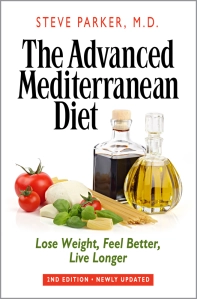
My Advanced Mediterranean Diet (2nd edition) offers a low-carb option that’s worked well for many, along with a traditional portion-control program.

Steve Parker, M.D.

Can You Eat Low-Carb at Fast-Food Restaurants?

Most emphatically, yes! But you have to be careful and able to withstand temptation. Laura Dolson tells you how over at About.com. For example:

Occasionally, you’ll see salads with other protein, but chicken is the mainstay of fast-food meal salads. Tips: 1. Skip the croutons, tortilla strips, and similar additions. 2. Be very careful about sugars in the dressing. 3) For best nutrition, look for salads with a mixture of greens, and a variety of vegetables. 4) Make sure the chicken is grilled, not “crispy fried”, or other chicken with breading.

 On the Advanced Mediterranean Diet, you have the option of:

  1. Traditional portion- and calorie-controlled eating, or
  2. Low-carb eating with the worlds’ first Low-Carb Mediterranean Diet

Are Low-Carb Diets More Effective Than Others?

DietDoctor Andreas Eenfeldt has a list of 16 scientific studies suggesting the superiority of low-carb diets for weight loss. I hope he keeps updating it. Here it is.

For my version of a low-carb diet, see KMD: Ketogenic Mediterranean Diet or Advanced Mediterranean Diet (2nd Ed.). The latter book also has a traditional “balanced” calorie-controlled diet with greater variety than a very low-carb diet. Ketogenic diets are getting a boost recently from Dr. Georgia Ede, Dr. Peter Attia, and the Livin’ La Vida Low-Carb Man, Jimmy Moore.

Steve Parker, M.D.

Dietitian Franziska Spritzler’s Six-Month Ketogenic Diet Trial Results

Steve Parker MD, Advanced Mediterranean Diet

Two diet books in one: 1) portion control, and 2) ketogenic

Ketogenic diets help many folks lose excess weight, return blood sugar levels toward normal, and move HDL cholesterol and triglycerides to a healthier range. I include a ketogenic diet as an option in my Advanced Mediterranean Diet (2nd Ed.). They are not for everybody.

Read about Franziska Spritzler’s experience with a ketogenic diet (not my version). Some quotes:

Well, after consistently consuming 30-45 grams of net carbs a day for six months, I have only positive things to say about my very-low-carb experience. Not only are my blood sugar readings exactly where they should be — less than 90 fasting and less than 130 an hour after eating — but I truly feel healthier,  less stressed, and more balanced than ever.

My diet consists of lots of fat from avocados, nuts and nut butters, olive oil, and cheese; moderate amounts of fish, chicken, beef, Greek yogurt, and eggs; and at least one serving of nonstarchy vegetables at every meal and a small serving of berries at breakfast.  It’s truly a rich, satisfying, and luxurious way to eat.

What Do Dietitians Think About Ketogenic Diets?

You get it?

Registered Dietitian Franziska Spritzler recently reviewed the concept of low-carb ketogenic diets.  She thinks they are a valid approach to certain clinical situations.  Among dietitians, this puts her in a small but growing minority.

One of your weight-loss choices in my Advanced Mediterranean Diet (2nd Edition) is a ketogenic diet.  Here’s the basic program.

I hesitate to mention this, but I will anyway.  Many, if not most, dietitians too easily just go along with the standard party line on low-carb eating: it’s rarely necessary and quite possibly unhealthy.  Going along is much easier than doing independent literature review and analysis.  I see the same mindset among physicians.

Franziska breaks the mold.

Steve Parker, M.D.

How To Overcome Your Weight-Loss Stall

"This can't be right!"

“This can’t be right!”

It’s common on any weight-loss program to be cruising along losing weight as promised, then suddenly the weight loss stops although you’re still far from goal weight.  This is the mysterious and infamous stall.

Once you know the cause for the stall, the way to break it becomes obvious.

The most common reasons are:

  • you’re not really following the full program any more; you’ve drifted off the path, often unconsciously
  • instead of eating just until you’re full or satisfied, you’re stuffing yourself
  • you need to start or intensify an exercise program
  • you’ve developed an interfering medical problem such as adrenal insufficiency (rare) or an underactive thyroid; see your doctor
  • you’re taking interfering medication such as a steroid; see your doctor
  • your strength training program is building new muscle that masks ongoing loss of fat (not a problem!).

If you still can’t figure out what’s causing your stall, do a nutritional analysis of one weeks’ worth of eating, with a focus on daily digestible carb (net carbs) and calorie totals.  You can do this analysis online at places like FitDay (http://fitday.com/) or Calorie Count (http://caloriecount.about.com/).

What you do with your data depends on whether you’re losing weight through portion control (usually reflecting calorie restriction) or carb counting.  Most of my patients lose weight with one of these two methods.  Both are outlined in my Advanced Mediterranean Diet, 2nd Edition.

If you’re a carb counter, you may find you’ve been sabotaged by “carb creep”: excessive dietary carbs have insidiously invaded you.  You need to cut back.  Even if you’re eating very-low-carb, it’s still possible to have excess body fat, even gain new fat, if you eat too many calories from protein and fat.  It’s not easy, but it’s possible.

Those who have followed a calorie-restriction weight loss model for awhile may have become lax in their record-keeping.  The stall is a result of simply eating too much.  Call it “portion creep.”  You need to re-commit to observing portion sizes.

A final possible cause for a weight loss stall is that you just don’t need as many calories as you once did.  Think about this.  Someone who weighs 300 lb (136 kg) is eating perhaps 3300 calories a day just to maintain a steady weight.  He goes on a calorie-restricted diet (2800/day) and loses a pound (0.4 kg) a week.  Eventually he’s down to 210 lb  (95.5 kg) but stalled, aiming for 180 lb (82 kg).  The 210-lb body (95.5 kg) doesn’t need 3300 calories a day to keep it alive and steady-state; it only needs 2800 and that’s what it’s getting.  To restart the weight loss process, he has to reduce calories further, say down to 2300/day.  This is not the “slowed down metabolism” we see with starvation or very-low-calorie diets.  It’s simply the result of getting rid of 90 pounds of fat (41 kg) that he no longer needs to feed.

Steve Parker, M.D.