Recipe: Rosemary Roasted Brussels Sprouts With Onion

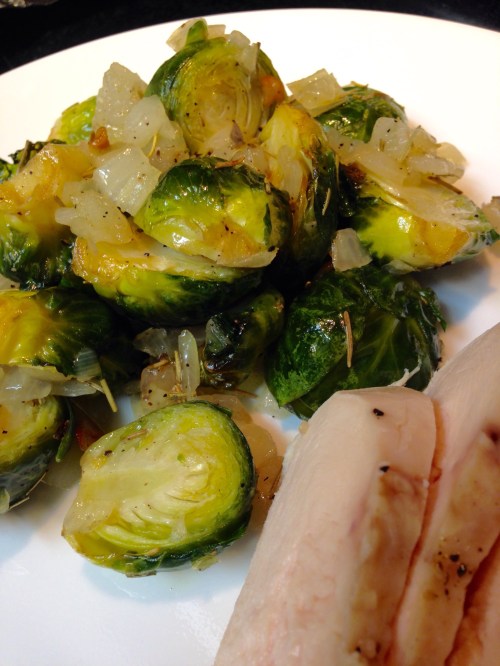
Final product without Parmesan sprinkles. That's sous vide chicken in the foreground.

Final product without Parmesan sprinkles. That’s sous vide chicken in the foreground.

At my request, my wife bought me a mess o’ Brussels sprouts, and I’ve been experimenting with recipes.

Sprouts sliced in half

Sprouts sliced in half

Ingredients this time are the sprouts, dried rosemary (i.e., not fresh although it grows where I live), salt, pepper, extra virgin olive oil, fresh garlic, and diced onion.

FYI, rosemary is used as an ornamental landscaping plant in southern Arizona.

To promote release of flavor, I sautéed three garlic cloves and the rosemary in EVOO.

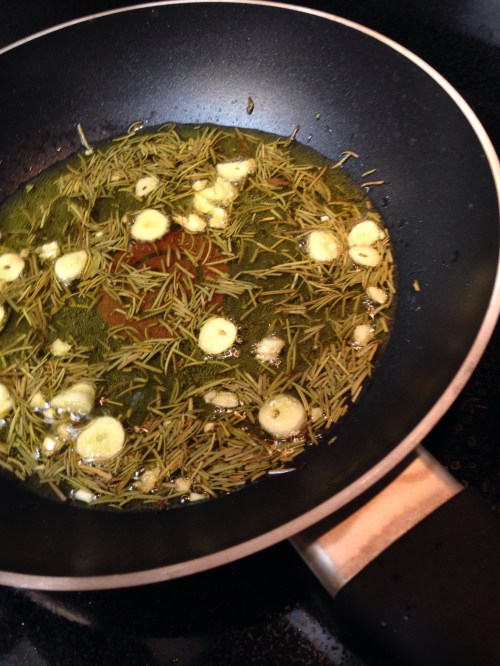
Releasing the flavors of garlic and rosemary over medium heat for perhaps 3 minutes

Releasing the flavors of garlic and rosemary over medium heat for perhaps 3 minutes

Then I sliced the sprouts in half along their long axis, to reduce cooking time. (Cut them so the leaves stay attached to the internal stalk.) You’d have to cut them in half before you eat ’em anyway.

I dumped all ingredients into a bowel and mixed thoroughly to ensure the sprouts were coated with oil.

Ready for the oven

Ready for the oven. I used about 3/4 cup of diced onion.

Everything except the bowl was transferred to a cooking sheet covered with aluminum foil (easy clean-up!), which I then popped into an oven pre-heated to 425°F. I cooked for 25 minutes. At around the 10 and 17-minute marks, I pulled the concoction out of the oven and stirred/flipped the ingredients to promote even cooking and browning. Your cooking time will vary from 17 to 25 minutes depending on your preferences. If you want some browning of the sprouts, you likely need to cook longer than 17 minutes. Unless your oven runs hotter than mine.

This is my favorite roasted Brussels sprouts recipe thus far. For an extra flavor zing, sprinkle with some Parmesan cheese just before eating. In the future, I may  top the ingredients with some other type of cheese a minute before the cooking is completed. Bacon bits are another tasty option.

Steve Parker, M.D.

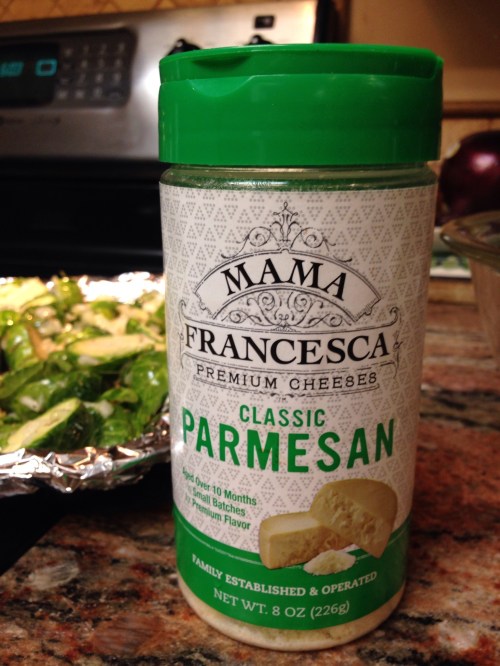
Not "real" Parmesan from Italy. For example, this one contains cellulose "to prevent caking."

Not “real” Parmesan from the Parma region of Italy. For example, this one contains cellulose “to prevent caking.”


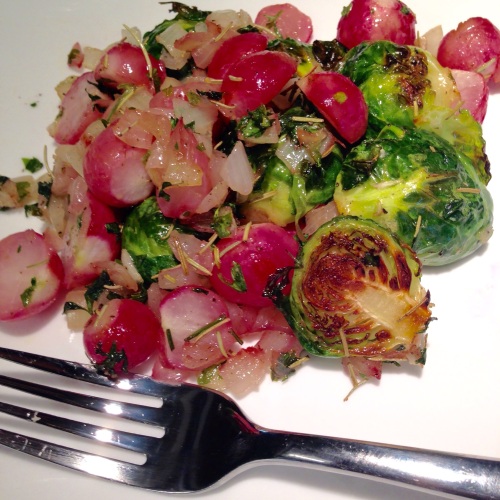
Roasted Radishes and Brussels Sprouts

Roasted Radishes and Brussels Sprouts. Copyright Steve Parker MD

Roasted Radishes and Brussels Sprouts

A year ago I ran across online praise for roasted radishes. I’m not a big fan of radishes, perhaps because they weren’t part of Parker cuisine when I was growing up, but finally gave them a try.

Beautiful, huh?

Beautiful, huh?

This won’t be as detailed as most of my recipes because I ran out of time.

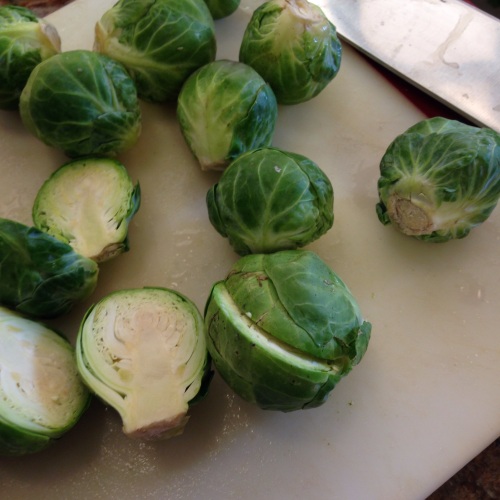
Raw Brussels Sprouts

Raw Brussels Sprouts

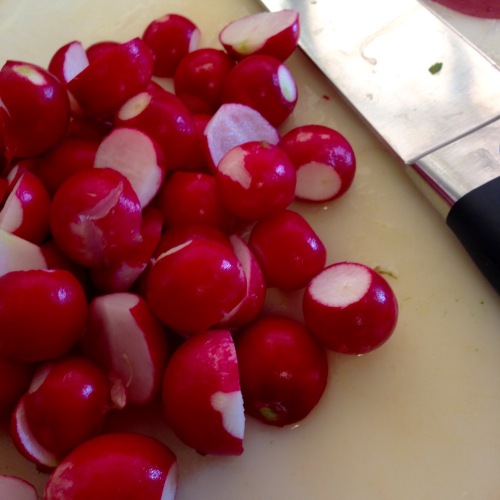
My basic ingredients were raw radishes and Brussels sprouts, diced onions, a bit of parsley (probably not needed), extra virgin olive oil, dried rosemary (i.e., not fresh), coarse salt, and pepper.

With the radishes, I cut off the little rootlet and green top, then cut them in half unless they were tiny radishes. Brussel sprouts take longer to cook, so I cut them in half, too. I put all the veggies  into a bowl, added just enough olive oil to coat them, sprinkled in some salt and pepper, then mixed with a spoon. Then I spread all that on a cooking sheet and popped it into an oven pre-heated to 425°F. (I covered my cooking sheet with aluminum foil to ease cleanup.)

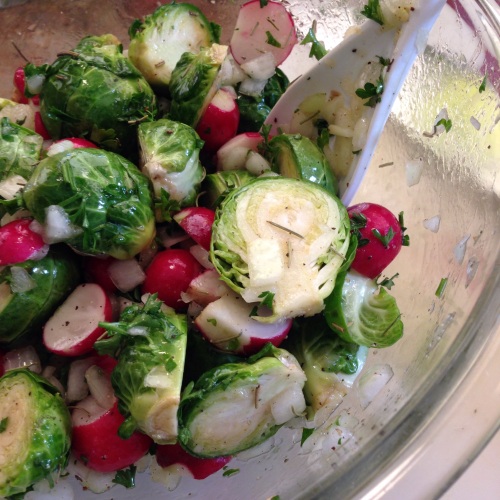
All ingredients mixed in a bowl

All ingredients mixed in a bowl

I cooked in the oven for 17 minutes (15-20), using a turner to flip the veggies once or twice while cooking.

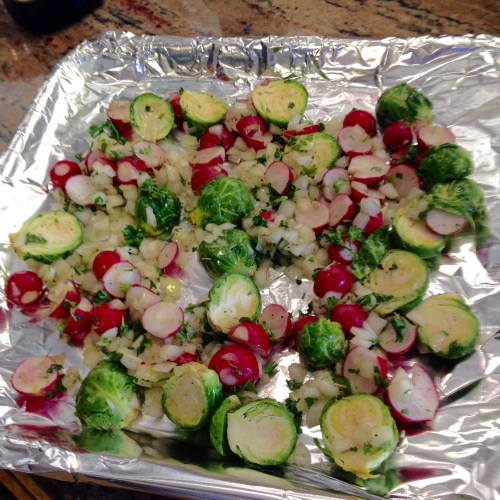
Ready for roasting

Ready for roasting

They were a little bland, so I topped off with Weber Roasted Garlic and Herb Seasoning. I enjoyed them and will do it again. Next time I may try coating with melted butter rather than olive oil. I felt very virtuous for eating my vegetables.

Steve Parker, M.D. 

PS: I ate half of this in one sitting. I refrigerated the rest and ate it about six hours later. It was much more flavorful. If you’re one of those people who never eats leftovers…

…reconsider.

Mediterranean Diet Lowered Blood Pressure By a Whopping 1 Point

Or more accurately, 1.1 to 1.3 mmHg over the course of six months in an Australian population. Systolic pressure, if you’re wondering. This isn’t clinically significant.

Details:

“A total of 166 men and women aged >64 y were allocated via minimization to consume either a MedDiet (n = 85) or their habitual diet (HabDiet; control: n = 81) for 6 mo. The MedDiet comprised mainly plant foods, abundant extra-virgin olive oil, and minimal red meat and processed foods. A total of 152 participants commenced the study, and 137 subjects completed the study. Home blood pressure was measured on 5 consecutive days at baseline (n = 149) and at 3 and 6 mo. Endothelial function (n = 82) was assessed by flow-meditated dilatation (FMD) at baseline and 6 mo. Dietary intake was monitored with the use of 3-d weighed food records. Data were analyzed with the use of linear mixed-effects models to determine adjusted between-group differences.Results: The MedDiet adherence score increased significantly in the MedDiet group but not in the HabDiet group (P < 0.001). The MedDiet, compared with the HabDiet, resulted in lower systolic blood pressure (P-diet × time interaction = 0.02) [mean: −1.3 mm Hg (95% CI: −2.2, −0.3 mm Hg; P = 0.008) at 3 mo and −1.1 mm Hg (95% CI: −2.0, −0.1 mm Hg; P = 0.03) at 6 mo]. At 6 mo, the percentage of FMD was higher by 1.3% (95% CI: 0.2%, 2.4%; P = 0.026) in the MedDiet group.”

Source: AJCN | Mobile

OMG I’ve Got PFP

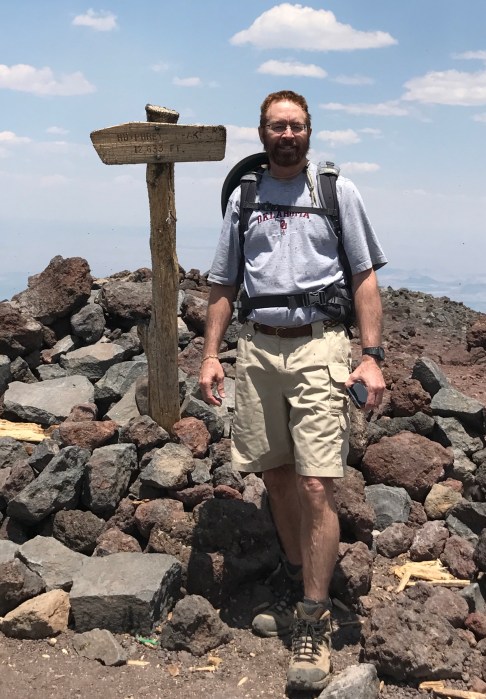
My daughter and I at Tom’s Thumb on June 3. She got her good looks from her mom, obviously.

I posted this here a couple weeks ago:

I’ve developed over the last month some bothersome pain in my right knee. It’s not interfered much with my actual hiking, but I pay for it over the subsequent day or two. I’m starting to think this may put the kibosh on my Humphries Peak trek next month.

The pain is mostly anterior (front part of the knee) and is most noticeable after I’ve been sitting for a while with the bent knee, then get up to walk. The pain improves greatly after walking for a minute or less. It also hurts a bit when I step up on something using my right leg. If I sit with my knee straight (in full extension), it doesn’t hurt when I get up. The joint is neither unusually warm nor swollen. Ibuprofen doesn’t seem to help it. These pain characteristics seem classic for something, but I don’t know what, yet….My twice weekly hikes always include a fair amount of elevation gain. I suspect an over-use syndrome, basically a training error. I plan to take an entire week off from hiking and Bulgarian Split Squats, and taking ibuprofen 600 mg three times a day.

The view looking south from the base of Tom’s Thumb

I did some research in the literature and think I’ve got patellofemoral pain, aka PFP or PFP Syndrome. Can’t say I’d heard of it before. Sounds more like a description than a diagnosis. Like saying someone has fever.

This guy posed for my daughter

I got most of my info on PFP from UpToDate.com, but you probably don’t have access to that. You healthcare professionals, click for a 2007 article at American Family Physician. Mayo Clinic has info for muggles. So does American Academy of Orthopaedic Surgeons.

I hope she thinks of this hike when she sees Tom’s Thumb from Hwy 101

I may have some age-related osteoarthritis in both knees, but that’s not causing this pain.

My PFP was caused by over-use. Too much hiking with elevation gain and  accelerating my program too rapidly. Also, prior experience taught me that using trekking poles helped take strain off my knees, and I have not been using them.

The newest resident at the Parker Compound. He’s eight weeks old.

I took a week off from hiking while taking ibuprofen 600 mg three times a day, when I could remember it. The combo helped, probably the rest more than the NSAID. Then I did two six-mile walks on the flat without much trouble. On June 3, I hiked Tom’s Thumb trail with my trekking poles, 4 miles round trip, and only had mild discomfort. Most importantly, I learned that I get relief from icing down the knee for 30-45 minutes after I get home.

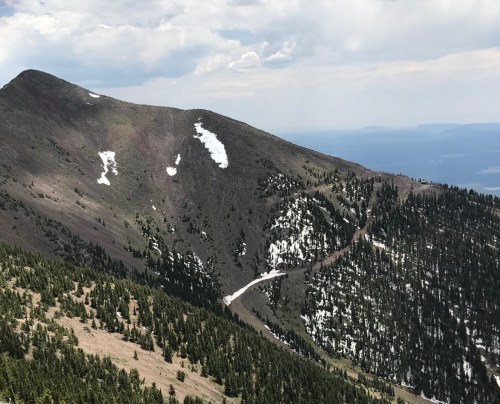
I’m disappointed I can’t climb Thompson Peak in preparation for Humphries Peak. It would probably kill my chance to summit Humphries (right now I put those odds at 50:50).

Steve Parker, M.D.


Is Drinking Tea Healthful?

Green tea isn’t always green

From P.D. Mangan’s new book “Best Supplements for Men“:

Green tea, which is commonly drunk in China and Japan, is associated with lower rates of cancer, about 30% lower in those who drank the highest amounts of green tea compared to the lowest. Deaths from cardiovascular disease were about 25% lower in the highest consumption group versus the lowest. This is of course epidemiological evidence, meaning that it can’t show whether green tea actually prevented disease, or that there’s some other connection such as that heather people drank more green tea.

Laboratory and other evidence, however, provides some good reasons to think that green tea is the real deal when it comes to sides prevention.

A recent study of the elderly in Singapore found tea consumption linked to much lower risk of neurocognitive decline in women and carriers of the “dementia gene” APOE ε4.

P.D. suggests that the health-promoting dose of tea is 3 to 5 cups a day, and black tea may be just as good as green.

Steve Parker, M.D.


Hike Report: Romero Canyon Trail to Romero Pools (near Tucson, Arizona)

One of a string of pools

This was a 4.5 mile round-trip on the Romero Canyon Trail to see the Romero Pools, which are about 2.2 miles from the trailhead. I was fortunate to have my daughter with me. Her house is a 30-minute drive from the trailhead. Elevation gain, if memory serves, was 800 or 900 feet.

This is rugged and wild land. I’m sure there are bears and mountain lions here.

There were not many people on the trail when we did this on May 14. At the pools per se were 10-14 folks, including a couple topless women.

My hiking buddy

This trail is difficult due to the rocky footing and steepness. It was a good workout. We never came close to losing the trail, and we never had to scramble over large boulders.

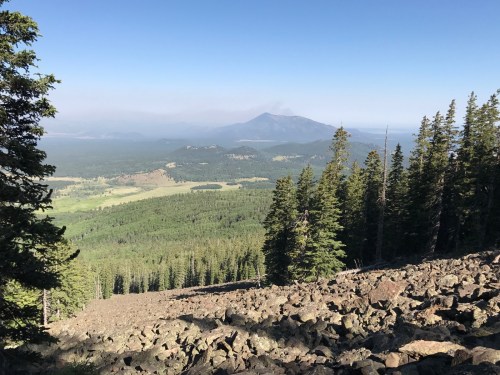
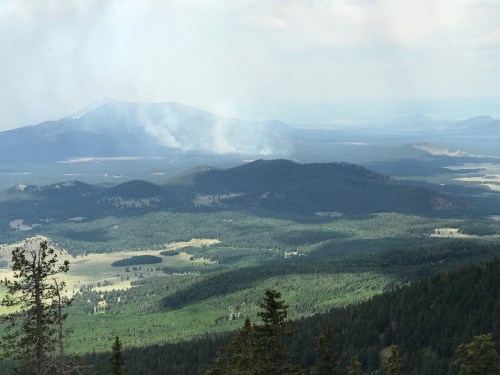
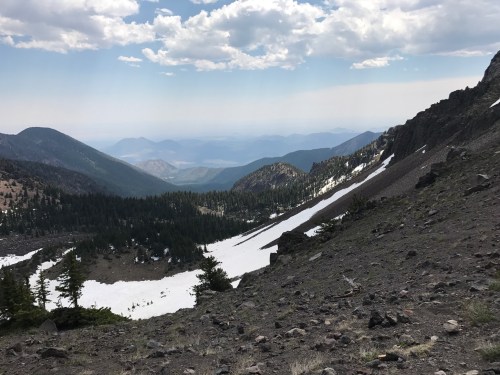
View from first part of the trail

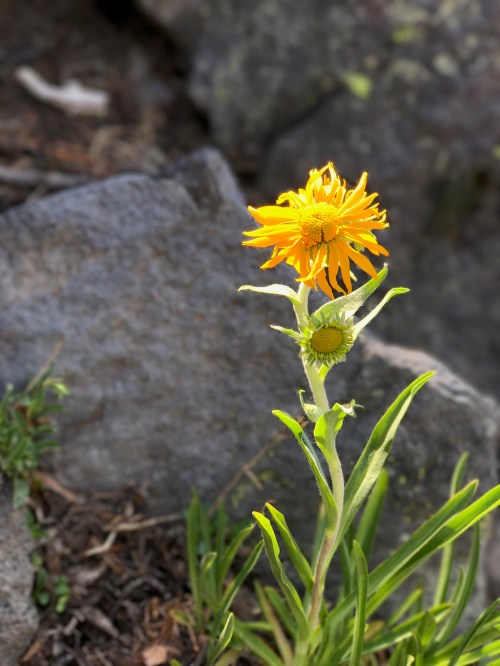
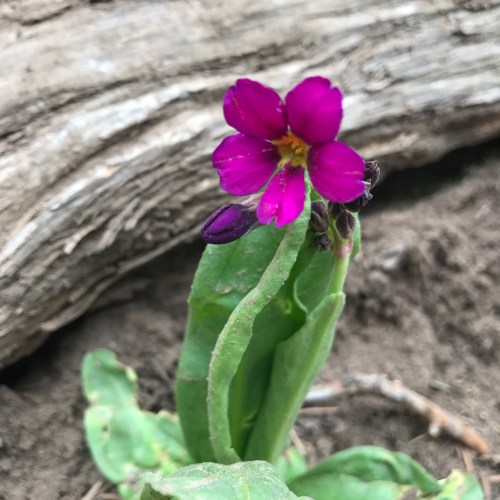
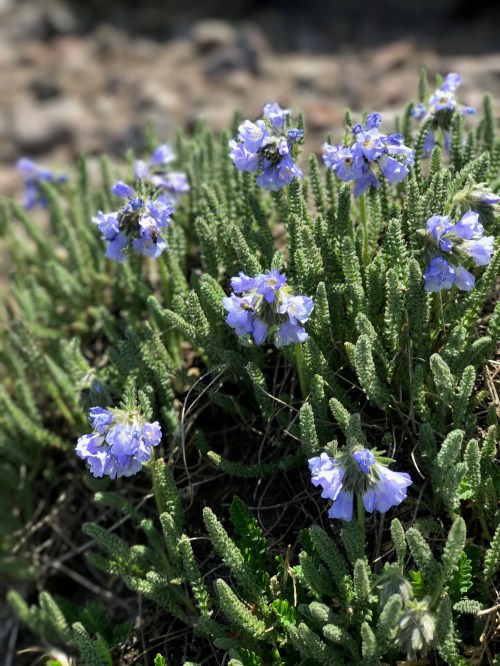
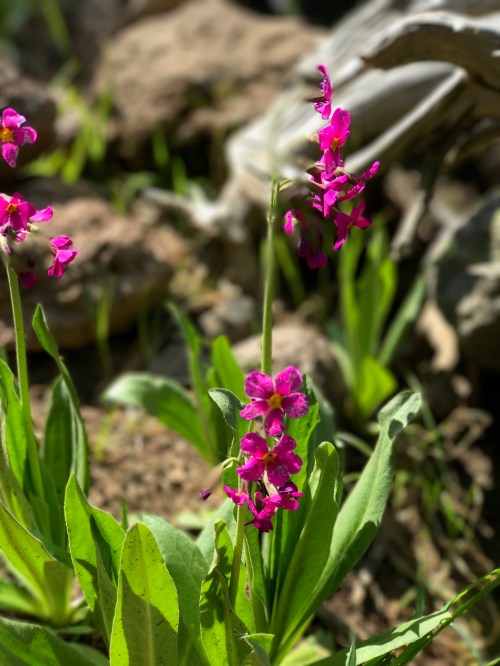
Trail-side flower

My beautiful daughter

I saw about five pools clustered together but there are probably more

Uh Oh: My Knee Hurts

I’ve developed over the last month some bothersome pain in my right knee. It’s not interfered much with my actual hiking, but I pay for it over the subsequent day or two. I’m starting to think this may put the kibosh on my Humphries Peak trek next month.

The pain is mostly anterior (front part of the knee) and is most noticeable after I’ve been sitting for a while with the bent knee, then get up to walk. The pain improves greatly after walking for a minute or less. It also hurts bit when I step up on something using my right leg. If I sit with my knee straight (in full extension), it doesn’t hurt when I get up. The joint is neither unusually warm nor swollen. Ibuprofen doesn’t seem to help it. These pain characteristics seem classic for something, but I don’t know what, yet. Possibilities include degenerative joint disease, chondromalacia patellae, patellar tendonitis, or an internal derangement such as a torn cartilage or meniscus. My twice weekly hikes always include a fair amount of elevation gain. I suspect an over-use syndrome, basically a training error. I plan to take an entire week off from hiking and Bulgarian Split Squats, and taking ibuprofen 600 mg three times a day.

Steve Parker, M.D.

How To Stop Chronic Daily Narcotic Use

Not your typical street-level drug pusher, but a great source of oxycodone

The mainstream news outlets in the U.S. tell us we are in the midst of a narcotic use epidemic. People are dropping like flies from overdose.

Narcotics are also called opioids. I’m talking about oxycodone, hydrocodone, hydromorphone (Dilaudid), morphine, fentanyl, heroin, etc. Not Xanax, Ativan, or Valium.

On average, it takes three weeks of daily narcotic use to get physically dependent on it. This means that when you stop the drug completely and suddenly, your body may crave it and you could have withdrawal symptoms. The severity of withdrawal symptoms varies from person to person. Possible symptoms include anxiety, sweating, nausea, vomiting, diarrhea, hyperactivity, restless legs, weakness, easy fatigue, shaking, suicidal thoughts, insomnia, and muscle pain or cramps.

Good and bad news, bad news first: Narcotic withdrawal can be very uncomfortable but rarely causes medically serious complications. The serious complications are usually in folks with pre-existing heart disease, high blood pressure, low blood pressure, or heart rhythm disturbances.

Here’s how you stop your chronic daily narcotic habit without suffering a withdrawal syndrome (if needed, see the postscript for an example):

  1. Total up your current total daily dose in milligrams
  2. Determine 10% of the amount by dividing the milligrams by 10
  3. Reduce your daily milligram intake by that 10% every week
  4. Nine weeks later you’ll be off narcotics

Congratulations! You’ve done your part to solve America’s opioid use epidemic. You’ve reduced your drug bill, avoided Opiate Use Disorder, and reduced your risk of narcotic overdose death by 100%. And you did it without political meddling or an expensive stay at a detox center.

Be aware that as you taper off your narcotic, you may have a flare of an underlying psychiatric condition such as depression, anxiety, PTSD, bipolar disorder, panic attacks, or psychosis. If so, see a mental health professional posthaste.

Good luck, America!

Steve Parker, M.D.

PS: Take Percocet 10/325 for example. It’s 10 mg of oxycodone and 325 mg of acetaminophen. Say you’re taking Percocet 10/325, four pills at at time, four times a day. That’s a total daily oxydocodone dose of 160 mg (16 pills x 10 mg). 160 mg divided by 10 = 16 mg. We have to round off 16 mg to 15 mg due to the availability of various strengths of Percocet. So starting today, you reduce your daily oxycontin dose by 15 g, which is one-and-a-half pills. After one week, you reduce your daily pill count by another one-and-a-half pills. Etc.

PPS: Let you’re doctor know what you’re doing beforehand. He’ll be overjoyed and ensure it’s safe for you to do this taper.

Mark Rippetoe and Matt Reynolds Talk About Whiskey

As I watched this, I couldn’t help thinking about “wine snobs.” Are these guys whiskey snobs?

Rippetoe is a famous strength trainer. The other gentleman, I don’t know.

They’ve convinced me to try Eagle Rare 10 year old bourbon, Buffalo Trace bourbon, Old Grand Dad 114, and Rittenhouse Bottle and Bond (?) Rye.

I didn’t know it but apparently whiskey has become a thing.

Jamesons Irish Whiskey.
Photo copyright: Steve Parker Parker

Hike Report: The Lookout in McDowell Sonoran Preserve


Looking south from The Lookout, you see Thompson Peak in the center. The highest point in the McDowell range is McDowell Peak on the right, about 10 feet higher than Thompson Peak.

This hike is essentially the same as to Tom’s Thumb trail, but instead of taking the short spur going north to the Thumb, you go a tenth of a mile further and take the half mile spur to The Lookout. This last half mile is easy, and rewarded by  excellent view to the south and east.

A prickly pear cactus blossom

My original goal had been to continue walking past this spur, to the west, until I reached a bizarre mountain spring. Bizarre because you’d never expect it in this desert. But after a quarter or half mile, it was getting hot and no one else was on the narrow trail, which was steep and quite rocky. I didn’t know exactly how far it was to the spring. I could see myself getting injured or over-heated, and decided it just wasn’t worth it. I think I’d rather die than call in a rescue party. So I turned around and headed back to The Lookout spur.

Banana yucca

Total distance for this trip was about 6 miles and it took three hours. Loaded with a 10-lb dumbbell and plenty of water, my backpack weighed about 20 lb.

From The Lookout: Phoenix and Scottdale in the distance

I’m impressed with how many young women I see on this trail, either alone or in small groups. I’m glad they feel safe doing it.

Eastern view from The Lookout: Four Peaks on the horizon

I was delighted to see three people on horseback on the trail, too.

Way in the distance is the Fountain Hills, AZ, fountain. It explodes up 300 feet every hour on the hour for 10 minutes.

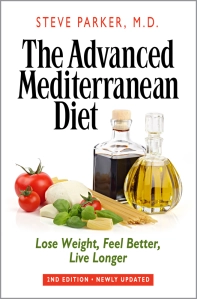
Did you know that exercise isn’t an effective way to lose fat weight? 90% of weight loss comes from altering your diet. Try one of my diets, like the Advanced Mediterranean Diet.

Steve Parker MD, Advanced Mediterranean Diet

Two diet books in one

Thoughts on the Denninger Healthcare Reform Plan

The only way to improve U.S. healthcare while bringing costs down is to introduce serious competition for healthcare dollars.

This post is for U.S. citizens since the federales are going to tinker with our health insurance reform very soon. This would be a great opportunity to make helpful changes  to the system. I have no faith they will do it.

Healthcare in the U.S. consumes one of every five dollars spent in the economy. We are not getting our money’s worth, at least judging from average lifespan.

Karl Dennnger has put a lot of thought into the problem over the last decade, and has a concrete legislative proposal that makes a lot of sense. I endorse it. As you consider the possibilities, you need to keep in mind that the cost of healthcare will drop drastically. Not just by 50%. More like 80% or more. Healthcare will be so cheap you won’t even need insurance to pay for most of it.

How are these price reductions possible? Because the Dennniger plan introduces competition and moves us closer to a free market situation without third-party interference from insurers and government.

Here are the major points:

  • All healthcare providers must publicly post (e.g., on the web) prices which apply to everyone. E.g., not  a price depending on which insurance you have, whether you are paying cash up front, etc.
  • All customers must be billed for actual charges at the same posted prices at the time services or product is rendered. This removes the third party (insurer or government). You file the claim and every one pays the same price. In a way, medical care isn’t too expensive; too often it’s “free,” because someone else is paying. So there’s no comparison shopping. You see posted prices and you pay them yourself when you buy gasoline, groceries, cell phones, computers, TVs, cars, and houses. A valid and collectible bill must be consented to in writing before the service or product is provided. Actual price, no open-ended add-ons.
  • No event caused by or a consequence of treatment can be billed to the customer. (I’m not sure I like this. What about unforeseeable complications like C diff infection after antibiotics, or anaphylactic reactions to drugs? Providers could eventually get insurance to cover those costs, but it would be a brand new insurance market.)
  • True emergency patients who are unable to consent must receive the same price for same service as a person who consents to said service.
  • All medical records belong to the patient and shall be delivered to the patient (customer) at the time of service.
  • Auxiliary services (e.g., x-rays, lab work) may not be required to be purchased at the point of use. Example: an orthopedist wants you to get a knee MRI scan on his machine. You can shop around other places for a cheaper or better-quality MRI scan.
  • All anti-trust and consumer protection laws shall be enforced against all medically-related firms, and any claimed exemptions are hereby deemed void. Stiff penalties and fines for violations. Private lawyers must have access to sue.
  • You are free to purchase any medical test you want if no radiation or drug is required to perform the test. (You can already do this in Arizona, but in many states you need a “doctors order” for the test.)
  • There will be no government payments for care or products when a lifestyle change will provide a substantially equivalent or better benefit, when the customer refuses to implement the lifestyle change. (This point needs some fine-tuning. Who decides when and which lifestyle change would provide an equivalent benefit?])
  • Health insurance companies must sell true insurance, to sell any health-related policy at all. No insurance coverage for an event or condition of which you received treatment over the last 24 months.  If an adverse event occurs, insurance pays for all of it. E.g,, if you get an expensive cancer, the insurance company cannot drop you. The insurance must cover, with a selection of available deductibles, all accidental injuries and true life-threatening emergencies. Medical underwriting is permitted (e.g., insurers can charge higher premiums for smokers, couch potatoes, obese folks, etc. I have long thought that people in the top 25% of fitness, determined by a treadmill exercise test, should get a discount on insurance premiums).
  • All health insurers providers selling true insurance, in whole or in part, must provide within their “true insurance” the ability to replace like with like.” (I don’t know what Karl means by this.)
  • Medicare becomes just another insurance provider. No more Part B (outpatient services).
  • Medicaid is repealed entirely.
  • What about U.S. citizens and “lawful permanent residents” who can’t pay for care but still need attention? For true emergencies, the hospital or Emergency Department bills the U.S. Treasury, who pays within 30 days. For non-emergencies, the provider bills the U.S. Treasury and will be paid within 30 days except no billing for government payment if the condition resulted from a lifestyle decision the patient made. After the Treasury Department pays the provider, Treasury will send an invoice to the customer (patient or taxpayer), which may be settled within 90 days at no penalty. If charges are not paid, they become a tax lien subject to collection from refundable tax credits, tax refunds, other entitlement checks (except Social Security retirement), and windfall amounts (either money or property).
  • Repeal all aspects of Obamacare/PPACA.

You need a break after all that. Almost done. Hang in there!

I don’t recall Karl recommending a specific deductible amount, but often saw mention of $2,000 as a deductible. “Deductible” is what you pay out of pocket before insurance pays anything. I like a high deductible over “first-dollar” coverage, because the high deductible automatically creates 200 million shoppers who are going to check prices for sure before buying healthcare. (Of 320 million people in the U.S., I’m guessing 200 million are adults.)

Karl favors “catastrophic” policies, as do I. Your car needs new tires every few years, oil changes much more often, and periodic repairs, but you don’t expect car insurance to pay for those non-catastrophic costs.

Who would get hurt by this plan? Lobbyists, insurance and healthcare administrators, drug reps, pharmacy benefits managers, and those who refuse to make healthy lifestyle changes.

I don’t recall Karl addressing unreasonable insurance mandates, managed care plans (like Kaiser Permanente in CA), accountable care organizations, liability reform (we need the English Rule), tax parity (businesses buying insurance for employees get a tax break, but private individuals buying their own policies don’t), or much about enforcement. But he may have; Karl’s a very smart guy.

Steve Parker, M.D.