We’re Eating 500 More Calories Per Day Than We Did in the 1970s

The U.S. adult population in the 1970s ate an average of 2400 calories a day. By the 2000s, our calories were up to 2900.

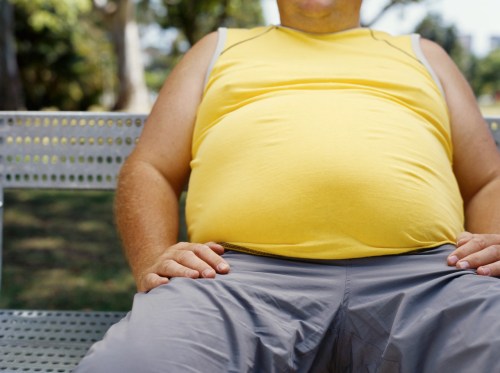
Putting a face on the statistics

Putting a face on the statistics

What did average adult weight do as we increased daily calories by 500? Increased by 8.6 kg, from 72.2 to 80.6 kg. In U.S. units, that’s a 19 lb gain, from 159 to 178 lb.

Children increased their average intake by 350 cals/day over the same time frame.

If I recall correctly, I’ve seen other research suggesting the daily calorie consumption increase has been more like 150 to 350 per day (lower end for women, higher for men).

Details are in the American Journal of Clinical Nutrition.

The study authors don’t say for sure why we’re eating more, but offhand mention an “obesogenic food environment.”  They don’t think decreased physical activity is the cause of our weight gain; we’re fatter because we eat too much.

Steve Parker, M.D.

h/t Ivor Goodbody

Still Taking Fish Oil Supplements? Think Again

Salmon is one the the cold-water fatty fish loaded with omega-3 fatty acids

Salmon is one the the cold-water fatty fish loaded with omega-3 fatty acids

I’ve been sitting on this research report a few years, waiting until I had time to dig into it. That time never came. The full report is free online (thanks, British Medical Journal!). I scanned the full paper to learn that nearly all the studies in this meta-analysis used fish oil supplements, not the cold-water fatty fish the I recommend my patients eat twice a week. If you’re taking fish oil supplements on your doctor’s advice, don’t stop without consulting her.

Here’s the abstract:

Objective: To review systematically the evidence for an effect of long chain and shorter chain omega 3 fatty acids on total mortality, cardiovascular events, and cancer.

Data sources: Electronic databases searched to February 2002; authors contacted and bibliographies of randomised controlled trials (RCTs) checked to locate studies.

Review methods Review of RCTs of omega 3 intake for 3 6 months in adults (with or without risk factors for cardiovascular disease) with data on a relevant outcome. Cohort studies that estimated omega 3 intake and related this to clinical outcome during at least 6 months were also included. Application of inclusion criteria, data extraction, and quality assessments were performed independently in duplicate.

Results: Of 15 159 titles and abstracts assessed, 48 RCTs (36 913 participants) and 41 cohort studies were analysed. The trial results were inconsistent. The pooled estimate showed no strong evidence of reduced risk of total mortality (relative risk 0.87, 95% confidence interval 0.73 to 1.03) or combined cardiovascular events (0.95, 0.82 to 1.12) in participants taking additional omega 3 fats. The few studies at low risk of bias were more consistent, but they showed no effect of omega 3 on total mortality (0.98, 0.70 to 1.36) or cardiovascular events (1.09, 0.87 to 1.37). When data from the subgroup of studies of long chain omega 3 fats were analysed separately, total mortality (0.86, 0.70 to 1.04; 138 events) and cardiovascular events (0.93, 0.79 to 1.11) were not clearly reduced. Neither RCTs nor cohort studies suggested increased risk of cancer with a higher intake of omega 3 (trials: 1.07, 0.88 to 1.30; cohort studies: 1.02, 0.87 to 1.19), but clinically important harm could not be excluded.

Conclusion: Long chain and shorter chain omega 3 fats do not have a clear effect on total mortality, combined cardiovascular events, or cancer.

Steve Parker, M.D.

Reference: Hooper, Lee et al. Risks and benefits of omega 3 fats for mortality, cardiovascular disease, and cancer: systematic review. BMJ  2006;332:752-760 (1 April), doi:10.1136/bmj.38755.366331.2F (published 24 March 2006).

Ebola Link Love for Healthcare Professionals

"Go back! This is a quarantine zone."

“Go back! This is a quarantine zone.”

As a hospitalist, I may be called by an emergency department physician today with the following scenario.

“Hey, Steve, I’ve got an admission for you. The patient just got off the plane at Sky Harbor and drove straight here with flu-like symptoms. He was in Liberia 10 days ago. This might be Ebola.”

Universal biohazard symbol

Universal biohazard symbol

My first inclination might be to run in the opposite direction from the ER and leave the hospital. But I probably won’t.

I’ve never seen a case of Ebola. At this point, very few U.S. doctors and hospitals  have experience with it. I don’t remember anything about Ebola from medical school—for all I know it didn’t even existed back then.

In preparation for that call from the emergency department, here are some links for pertinent info, until I can memorize it all. Many of these links are to the U.S. Centers for Disease Control and Prevention and should be (better be) updated soon.

World Health Organization Guidelines on Personal Protective Equipment (October, 2014). This document is more detailed and probably a bit more stringent than the CDC’s advice, although the two have much overlap. A few points to remember:

  • use nitrile gloves instead of latex
  • medical/surgical mask must be fluid-resistant (e.g, “surgical N95 respirator”; if not surgical, it may not be water-resistant
  • either fluid-resistant gown or coveralls, covered by a waterproof apron
  • wear waterproof boots

World Health Organization Guidelines on Both Direct and Non-direct Care to Ebola Patients (September, 2014). Non-Direct care includes waste management, lab activities, movement and burial of human remains, etc.

The Nebraska Ebola Method: This dynamic and evolving course will provide videos, media, and guidelines as used in Nebraska to care for Ebola patients. The materials share current processes being used to safely care for patients with this dangerous, highly infectious disease. The course will be updated frequently to disseminate lessons learned.

A Detailed Ebola Case Report From Germany Published in NEJM. “Staff members…were protected by pressurized suits…that were equipped with ventilators with high-efficiency particulate air filters to provide fresh air supply with a maximum airflow of 160 liters per minute….” Does your hospital have these? “Decontamination [of healthcare workers] in the airlock is performed by two shower-cycles with 2% perchloric acid for 2 minutes and a residence time of 7 minutes. Finally acid residues are rinsed by showering with water.”

Lessons Learned Treating Ebola Patients at Emory University Hospital (pdf). Video of same presentation (didn’t work on my Mac).

An Emergency Physician Ponders the Reality of a Serious Infectious Pandemic and Suggests Management Outside of Traditional Healthcare Facilities

New York Times Oct. 15, 2014, article on CDC intensifying (Oct. 4) their initially lax healthcare worker infection control guidelines

Diagnosis

Infection Prevention and Control Recommendations for Hospitalized Patients with Known or Suspected Ebola Virus Disease in U.S. Hospitals (I’m not sure these are adequate as of Oct. 15, 2014)

Generic 2007 Guideline for Isolation Precautions: Preventing Transmission of Infectious Agents in Healthcare Settings

Interim Guidance for Environmental Infection Control in Hospitals for Ebola Virus

Donning and Removing Personal Protective Equipment

Personal Protective Equipment Training Demonstration Video from GNYHA. One way to do it, which may or may not be adequate.

Ebola Overview for Clinicians in U.S. Healthcare Settings

Algorithm for Evaluation of the Traveler Returned From Ebola-Affected Areas

Checklist for Patients Being Evaluated For Ebola in the U.S.

Treatment

2008 Doctors Without Borders Practical Guidelines on Ebola and other Filoviruses

University of Nebraska Medical Center’s Biosafety Level 4 Facility Guidelines for Donning and Doffing Personal Protective Equipment Around Viral Hemorrhagic Fever Patients (these took 30-60 seconds to load on my computer)

Steve Parker, M.D.

Hazmat-suited healthcare worker in a decontamination shower

Hazmat-suited healthcare worker in a decontamination shower

Updated: November 3, 2104, 2345 hrs

Recipe: Beef Soup, Asparagus, and Blackberries

low-carb diet, paleobetic diet, diabetic diet

Yum!

The entree is a cross between stew and soup. Stoup?

Since I provide the recipe’s carbohydrate grams in the nutritional analysis below, you can fit this into the Ketogenic Mediterranean Diet and Low-Carb Mediterranean Diet, as well as the Advanced Mediterranean Diet.

Ingredients:

2 lb (0.9 kg) stew meat, lean, bite-sized chunks (tenderized by the butcher if able)

1 garlic clove, finely minced

6 sprigs cilantro, de-stemmed, whole leaves

2 oz (58 g) sweet onion, diced (1/2 of a small onion)

1/4 of a medium-size green bell pepper, de-seeded, diced (medium bell pepper weighs about 5.5 oz or 155 g)

8 oz (227 g) canned tomato sauce

2.5 cups (590 ml) water

1.25 tsp (6.2 ml) table salt

freshly ground black pepper to taste (1/4 tsp or 1.2 ml?)

16 oz (454 g) fresh raw asparagus, no larger in diameter than your little finger, with any dry or woody stalk cut off and discarded

1.5 tbsp extra virgin olive oil

7.5 oz (213 g) raw blackberries

Instructions:

Stoup first. In a frying pan or electric skillet, place the stew meat, cilantro, garlic, bell pepper, onion, and cook over medium heat (350º F or 177º C) until the meat is done. Then add the tomato sauce, two cups of the water, one tsp of the salt, and pepper to taste. Simmer for two hours, then add a half cup water to replace evaporation loss.

low-carb diet, paleobetic diet, diabetic diet

Cooking stew meat. NOTE: this is double the amount the recipe calls for.

paleobetic diet, low-carb diet, diabetic diet

Meat is done and the “gravy” has magically appeared

low-carb diet, diabetic diet, paleobetic diet

Appearance after addition of the tomato sauce and 2 cups water

Now the asparagus. Preheat oven to 400º F or 204º C. Place asparagus on a cooking sheet covered with foil, brush the asparagus with the olive oil, then lightly salt (1/4 tsp?) and pepper to taste. (If you don’t mind cleaning up, just use a baking dish without the foil.) Roast in oven for 8–15 minutes; thicker asparagus takes longer. It’s hard to tell when it’s done just by looking; if it’s still hard, it’s not done. Click for another post I wrote on cooking asparagus and brussels sprouts.

paleobetic diet, low-carb diet, diabetic diet

Asparagus roasted at 400 degrees F for 12 minutes

Enjoy the berries for desert.

low-carb diet, diabetic diet, paleobetic diet

2.5 oz or 1/2 cup of blackberries

Servings: 3 [one serving is 1.5 cups (355 ml) of soup, a third of the asparagus (5 oz (140 g), and 2.5 oz (70 g) berries]

Advanced Mediterranean Diet boxes: 2 veggies, 2 fats, 1 protein

Nutritional Analysis per Serving:

40 % fat

12 % carbohydrate

48 % protein

590 calories

19 g carbohydrate

8.5 g fiber

10.5 g digestible carb

1,557 mg sodium

1,778 mg potassium

Prominent features: Rich in protein, B6, B12, copper, iron, niacin, phosphorus, selenium, and zinc

low-carb diet, paleobetic diet, diabetic diet

The fresh cilantro is a nice touch


Despite Ebola, Life Expectancy in U.S. Reaches Record High

Life expectancy at birth reached a record high of 78.8 years in 2012, according to the Centers for Disease Control.

Life expectancy was 81.2 years for females and 76.4 for males. The leading causes of death were the same as in 2011.

Are Estrogens Causing the Obesity Epidemic?

Eating too much tofu?

Too much tofu?

James P. Grantham and Maciej Henneberg of the School of Medical Sciences (University of Adelaide, Adelaide, Australia) suggest that estrogen-like compounds in the environment are causing obesity. Read about their hypothesis in a recent issue of PLOS One. I don’t know if they’re right, but their idea deserves consideration.

A couple estrogen-like substances they mention are in soy and polyvinyl chloride (PVC). We ingest these xenoestrogens. I had not been aware that soy consumption is positively linked to obesity.

The authors don’t instill confidence by using weak references such as #22.

I didn’t see the trendy “endocrine disruptors” moniker in the article.

Read the whole enchilada.

Steve Parker, M.D.

Has Your Dentist Ever Told You, “No Carbs, No Cavities”?

I didn’t think so. None of mine ever has. And the worst carbohydrates for your teeth seem to be sugars.

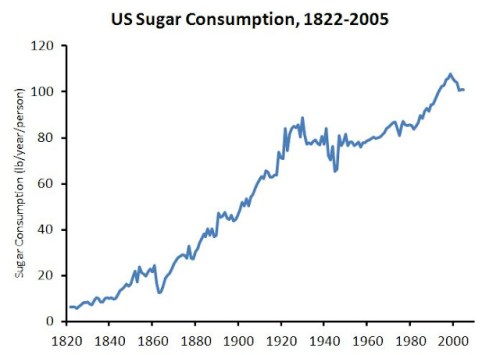
173 Years of U.S. Sugar Consumption

(Thanks to Dr. Stephan Guyenet and Jeremy Landen for this sugar consumption graph.)

MNT on September 16, 2014, published an article about the very prominent role of sugars as a cause of cavities, aka dental caries. This idea deserves much wider dissemination.

I’ve written before about the carbohydrate connection to dental health and chronic systemic disease. Furthermore, sugar-sweetened beverages are linked to 200,000 yearly worldwide deaths

Investigators at University College London and the London School of Hygiene & Tropical Medicine think the World Health Organization’s recommendation of a maximum of 10% total daily calories from “free sugar” should be reduced to 3%, with 5% (25 grams) as a fall-back position.

Six teaspoons of granulated table sugar (sucrose) is 25 grams. That should be enough daily sugar for anyone, right? But it’s incredibly easy to exceed that limit due to subtly hidden sugars in multiple foods, especially commercially prepared foods that you wouldn’t expect contain sugar. Chances are, for instance, that you have in your house store-bought sausage, salad dressings, and various condiments with added sugars such as high fructose corn syrup. Sugar’s a flavor enhancer.

The aforementioned “free sugar” as defined as any monosaccharides and disaccharides that a consumer, cook, or food manufacturer adds to foods. In the U.S., we just call these “added sugars” instead of free sugars. From the MNT article, “Sugars that are naturally present in honey, syrup, and fruit juices are also classed as free sugars.” Sugar in the whole fruit you eat is not counted as free or added sugar.

The London researchers found that—in children at least—moving from consuming almost no sugar to 5% of total daily calories doubled the rate of tooth decay. This rose with every incremental increase in sugar intake.

From the MNT article:

“Tooth decay is a serious problem worldwide and reducing sugar intake makes a huge difference,” says study author Aubrey Sheiham, of the Department of Epidemiology & Public Health at University College London. “Data from Japan were particularly revealing, as the population had no access to sugar during or shortly after the Second World War. We found that decay was hugely reduced during this time, but then increased as they began to import sugar again.”

I’m convinced. How about you?

Steve Parker, M.D.

Obese Male Teens Earn Less Later in Life

…according to an article at Science Daily. How much less do they make? “Up to 18%.” The association was found in multiple Western nations.

Not really new info, but there you go.

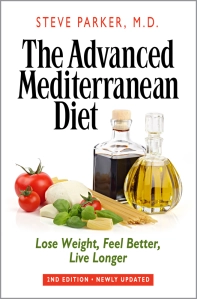
My Advanced Mediterranean Diet book for about $14 (USD) could pay huge dividends over time to an obese young man. The Kindle version‘s only $8!

Steve Parker, M.D.

Recipe: Low-Carb Spaghetti Sauce

paleobetic diet, low-carb  spaghetti sauce

A spaghetti squash in the background

My wife is Italian so we eat a lot of spaghetti at the Parker Compound. When spaghetti squash is in season, we use it instead of wheat-based pasta with this sauce, to make it less fattening. The substitution also makes the combo compliant with paleo and diabetic diets.

A definitely non-paleo ingredient below is Truvia, a sweetener that’s a combination of stevia and erythritol. Stevia is supposedly “natural.” I don’t know where erythritol, a sugar alcohol, comes from. The purpose of a sweetener is to counteract the tartness or bitterness of the tomatoes. Honey would probably serve this purpose—for those of you on a pure paleo kick—but I’ve never tried it in this recipe. If you use the honey or the table sugar option below, it will increase the digestible carb count in each cup by three grams. Whatever your favorite non-caloric sweetener, use the equivalent of two tablespoons of table sugar (sucrose).

Ingredients:

1 lb (454 g) sweet Italian sausage, removed from casing

3/4 lb (340 g kg) lean ground beef (lean = up to 10% fat by weight)

1/2 cup (118 ml) onion, minced

2 cloves garlic, crushed

1 can crushed tomatoes (28 oz or 793 g)

2 cans tomato paste (total of 12 oz or 340 g)

2 cans tomato sauce (total of 16 oz or 454 g)

1/2 cup water (118 ml)

2 tsp (10 ml) Truvia (combo of stevia and erythritol; optional substitutes are table sugar  (2 tbsp or 30 ml) or honey (1.5 tbsp or 22 ml), or leave out sweetener

1.5 tsp (7.4 ml) dried basil leaves

1/2 tsp (2.5 ml) fennel seeds

1 tsp (5 ml) Italian seasoning

1/4 tbsp (3.7 ml) salt

1/4 tsp (1.2 ml) ground black pepper

4 tbsp (60 ml) fresh parsley, chopped

Instructions:

Put the sausage, ground beef, onion, and garlic in a pan and cook over medium heat until well browned. Drain off the excess liquid fat if that’s your preference (not mine). You’ll probably have to transfer that mix to a pot, then add all remaining ingredients and simmer on low heat for two or three hours. You may find the flavor even better tomorrow. If it gets too thick, just add water.

If you’re predisposed to carbohydrate toxicity—high blood sugar—eat this over spaghetti squash rather than pasta. Here’s a post on cooking spaghetti squash. Small or inactive folks may find a half cup of sauce over one cup of cooked squash is a reasonable serving (about 250 calories). I prefer to double those portions, making it a whole meal.

Sometimes I just eat this sauce straight. But I’m weird. A cup of sauce with some veggies or fruit is a meal for me. If you have other uses for spaghetti sauce other than over spaghetti squash or grain products, please share in the Comments. One of my readers puts it on zucchini (presumably cooked).

Number of Servings: 9 (1-cup each)

Nutritional Analysis: (assumes you retained all fat)

55% fat

23% carbohydrate

22% protein

345 calories

21 g carbohydrate

4 g fiber

17 g digestible carbohydrate

985 mg sodium

1,117 mg potassium

Prominent features: Rich in vitamin B12, iron, copper, niacin, sodium, and selenium

Advanced Mediterranean Diet boxes: 1 veggie, 1 & 1/2 fats, 1/2 protein (Advanced Mediterranean Diet information here)

Steve Parker, M.D.

Do Artificial Sweeteners Cause Overweight and Type 2 Diabetes?

We don’t know with certainty yet. But a recent study suggests that non-caloric artificial sweeteners do indeed cause overweight and type 2 diabetes in at least some folks. The study at hand is very small, so I wouldn’t bet the farm on it. I’m not even changing any of my recommendations at this point.

exercise for weight loss and management, dumbbells

“Too many diet sodas” doesn’t explain this whole picture


The proposed mechanism for adverse metallic effects is that the sweeteners alter the mix of germs that live in our intestines. That alteration in turn causes  the overweight and obesity. See MedPageToday for the complicated details. The first part of the article is about mice; humans are at the end.

Some quotes:

“Our results from short- and long-term human non-caloric sweetener consumer cohorts suggest that human individuals feature a personalized response to non-caloric sweeteners, possibly stemming from differences in their microbiota composition and function,” the researchers wrote.

The researchers further suggested that these individualized nutritional responses may be driven by personalized functional differences in the micro biome [intestinal germs or bacteria].

***

Diabetes researcher Robert Rizza, MD, of the Mayo Clinic in Rochester, Minn., who was not involved with the research, called the findings “fascinating.”

He noted that earlier research suggests people who eat large amounts of artificial sweeteners have higher incidences of obesity and diabetes. The new research, he said, suggests there may be a causal link.

“This was a very thorough and carefully done study, and I think the message to people who use artificial sweeteners is they need to use them in moderation,” he said. “Drinking 17 diet sodas a day is probably a bad idea, but one or two may be OK.”

I won’t argue with that last sentence!

Finally, be aware the several clinical studies show no linkage between human consumption of non-caloric artificial sweeteners and overweight, obesity, and T2 diabetes.

Steve Parker, M.D.