Don’t watch the video if you’re not ready for a sad, sad, story about a cancer patient.
Steve Parker, M.D.
PS: I can neither defend nor criticize the specific cancer treatment discussed in the video. I don’t know enough about the case and, compared with an oncologist, I know very little about cancer treatment.
I consider infectious disease specialists to be, in general, the smartest non-procedural medical specialists. They are often called in to consult on a hospitalized patient who’s already been evaluated by three or four other doctors, but just isn’t responding to treatment and may have an underlying atypical infection.
Dr. Mark Crislip is a retired infections disease doc who is highly intelligent and a good writer. I don’t know him personally but have had the pleasure of working with a few like him throughout my career (shout out to Dr. Kara Asbury). Here’s what he thinks of the intrusion of AI – artificial intelligence – into medical practice.
I really think we are heading into a world where doctors are going to be mediocre at best. There are many articles about how kids today (remember, I am an old geezer) are unable to read books or even sit through a whole movie. You wonder how they are going to master, yes, master, the immense amount of information, all in dense, dry, complicated, technical textbooks, required just to get through medical school, much less become proficient in whatever medical specialty field they choose.
Now? All the cognitive processing will be offloaded into AI. And people will take the path of least resistance, in the process acquiring only the facade of understanding. And if the AI hallucinates? They are not going to know enough to recognize it.
So there will be three kinds of doctors slowing evolving into one.
A few old geezers like me who will mostly avoid AI. I say mostly. I wouldn’t mind if AI generated my billing codes. But that is it. But their medical mind will remain sharp and be wielded like a samurai blade.
Most current MDs will take the path of least resistance, use AI and their mind will be increasingly rusty and dull and at some point be useless.
And those brought up on AI? Their minds will be plastic sporks. Enshittified from the start.
I recommend you read the whole thing, especially if you’re a physician. Plus he takes a few jabs at EMRs (electronic medical records).
Posted onDecember 19, 2025|Comments Off on HHS Working to End Insurance Pre-Authorization
I’ll believe it when I see it.
Health insurance pre-authorization, for example, is when your eye specialist recommends removal of your cataracts so you can see again, but your insurance company wants some clerk or administrator to review everything and either agree or disagree with your physician. If disagree, no eye surgery for you. Unless you’re willing to pay entirely out-of-pocket. Mind you, the clerk does not have a medical degree and has never examined you or spoken to you. Isn’t this one of the reasons Luigi Mangione executed that healthcare executive?
Health and Human Services (HHS) Secretary Robert F. Kennedy Jr. joined other federal health officials on Monday to promote an initiative to end the practice of healthcare insurance pre-authorization.
Kennedy was joined by Centers for Medicare & Medicaid Services Administrator Mehmet Oz as part of a roundtable discussion with insurers to discuss pledges made by the health insurance industry to streamline and reform the prior authorization process for Medicare Advantage, Medicaid Managed Care and Affordable Care Act Health Insurance Marketplace plans which account for most insured Americans.
The HHS Secretary commented on how when he joined the presidential transition team, he was told that the single most important thing he could do to improve the experience of patients across the nation was to “end the scourge of pre-authorization.”
Of course, the unsurers will argue that pre-authorization is necessary because those greedy doctors are recommending that surgery, MRI scan, specialty consultation, or physical therapy merely out of greed.
I’m talking about the basic economic question: Supply, demand and what happens when you allow someone to force another person to pay your bill.
I keep hammering on this and will until people stop running tropes whether out of sincere (but false) belief or some other reason.
Let’s take Eliquis. Its a common medication and its expensive. Roughly 3.5 million Americans take this drug and it is one of the most-commonly prescribed for people who have atrial fibrillation. It appears to be reasonably effective in reducing the risk of strokes and heart attacks in people with that condition.
The common claim is that “if you cut that off those people will die” because they can’t possibly afford the price.
The claim is false.
In Germany the drug costs about $700 a year, so it is ten times as expensive in the United States.
Parker here. I know why Eliquis (apixaban) so much more expensive in the U.S. I wrote all about it in my latest book. Read Denninger for his opinion. (He’s smarter than me but was wrong about his predicted 2024 severe economic contraction. Making predictions is hard, especially when it’s about the future.)
Posted onDecember 14, 2025|Comments Off on When It Makes Sense to Go Without Health Insurance in the U.S.
The bike repair shop owner in this video is probably looking at one of the Obamacare insurance plans. They want him to pay $4,000 a year, the government is paying the insurer $7,000 yearly, and yet his deductible is $20,000. That means that if he develops a major medical problem or injury, he still has to pay $20,000 out of pocket before insurance pays a penny. Note that he is in his 30s and relatively healthy. He’s seriously thinking about going without insurance. When and if that major medical problem arises, he’ll just go on Medicaid.
He should think about putting money into a Health Savings Account.
One of the reasons I’m still working at age 71 is that my younger wife needs health insurance and we can get it through my employer.
Steve Parker, M.D.
PS: The books I write generate very little $. I’m just trying to help you guys get healthier and avoid the medical-industrial complex.
Crenshaw accepted the opportunity for a sit-down interview with Shawn Ryan, tentatively scheduled for Jan 2, 2026.
Shawn Ryan should have mentioned that he is not suicidal and that his vehicles are in good working order.
Someone in the comment section quoted Harry Truman: “Show me a man that gets rich by being a politician, and I’ll show you a crook.” That’s a legit idea even if Truman never said it.
Sadly, any major reform of the U.S. healthcare system will depend on federal and state legislators like Dan Crenshaw.
Posted onJune 14, 2025|Comments Off on The Unabomber Brought “Manifesto” to the Fore
The Unabomber’s manifesto was 35,000 thousand words long. Mine’s got him beat by 2,000 words, every one of which was carefully curated!
The Unabomber was Ted Kaczynski. He titled his manifesto “Industrial Society and Its Future.” It wasn’t about healthcare. He was found dead in his jail cell at age 81; reportedly killed himself.
Most of my writing on health, nutrition, and fitness is designed to keep you out of the clutches of the medical-industrial complex. Don’t get involved with that system if you can safely avoid it!
Opthalmologist Dr. Will Flannery has put together a whimsical guide to the U. S. healthcare system. It’s well worth a look if you’re relatively new to the system and need help understanding deductibles, co-pays, out-of-pocket maximums (hint: they’re not really maximums), in-network, out-of-network, vertical integration, “surprise” medical bills, etc. I was particularly impressed with the section on fighting claim denials; I hope I remember to re-read it when the time comes.
Remember how Obamacare was supposed to make healthcare more affordable? From the guide, “The 2025 out-of-pocket maximum for an Affordable Care Act plan can’t be more than $9,200 for an individual and $18,400 for a family.” When half of Americans can’t afford an emergency $500 bill, how do they pay up to $9,200.
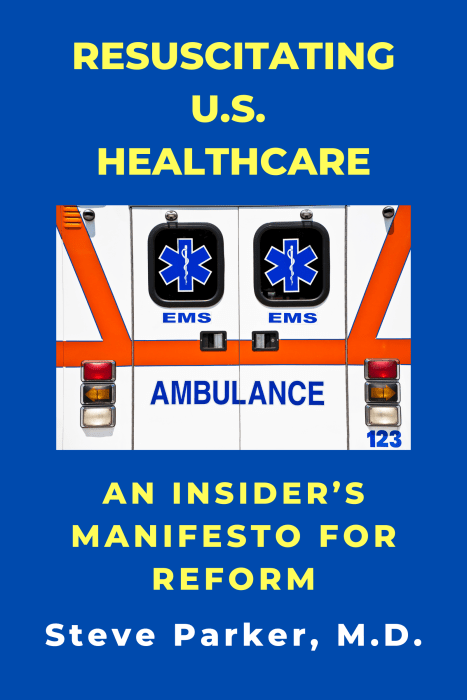
Dr. Glaucomflecken also offers some system improvements that I also advocate in my latest book, Resuscitating U.S. Healthcare: An Insider’s Manifesto for Reform.
To make the book available to more readers, I just dramatically reduced the price at the U.S. Amazon store. $2.99 for the e-book (Kindle) or $9.95 for the paperback. If you’re curious, Amazon pays me $2.06 for each e-book sold, and $2.74 for the paperback.
I don’t care if you leave a favorable or bad review at Amazon. Just be honest. I’ll incorporate helpful and insightful criticism into the 2nd edition.





 Advanced Mediterranean Diet