Category Archives: Exercise

P.D. Mangan’s Science-Based Weight Training 

No evidence of anabolic steroids here. Primarily estrogen.

She won’t be at your home gym

I am a huge advocate of weight training (aka resistance or strength training).

Folks new to weight training, or simply thinking about starting a program, are often intimidated by the jargon and contradictory information available. P.D. Mangan clears up a lot of the confusion in a brief article.

I quote:

“Misconceptions and wrong ideas abound in weight training, probably because so many enthusiastic amateurs are involved in it. In this article, I’ll try to clear up some of the misconceptions with a look at at science-based weight training.

In recent articles, we saw that brief workouts, at 15 minutes, done infrequently, at twice a week, can produce significant strength gains. We saw that compound lifts, not isolation lifts, are the most effective strength exercises, and are essential for the serious strength trainer. And we saw that hard weight lifting causes muscle damage, which necessitates recovery time.

Here I’ll focus on what science has to say about additional aspects of weight lifting (resistance training). These come from “Evidence-Based Resistance Training Recommendations” by Fisher et al.”

Source: Science-Based Weight Training – Rogue Health and Fitness

Resistance Training Cuts Risk of Diabetes and Cardiovascular Disease in Middle-Aged Women

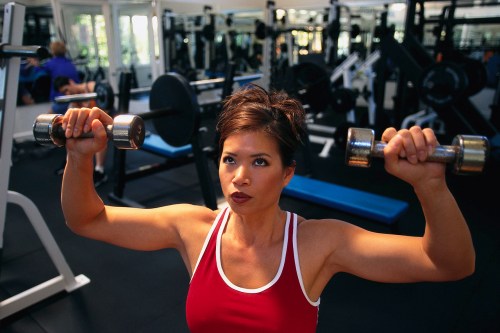
That's a dumbbell in her right hand. I work-out with those myself.

That’s a dumbbell in her right hand. I work-out with those myself.

I don’t have access to the full scientific report, but I’ve posted part of the abstract below.

The biggest problem with the study at hand is that physical activity apparently was surveyed only at the start of this 14-year study. Results would be much more robust if activity was surveyed every year or two. My overall activity level seems to change every two or three years. How about you?

Moving on.

“Compared to women who reported no strength training, women engaging in any strength training experienced a reduced rate of type 2 diabetes of 30% when controlling for time spent in other activities and other confounders. A risk reduction of 17% was observed for cardiovascular disease among women engaging in strength training. Participation in both strength training and aerobic activity was associated with additional risk reductions for both type 2 diabetes and cardiovascular disease compared to participation in aerobic activity only.

CONCLUSIONS: These data support the inclusion of muscle-strengthening exercises in physical activity regimens for reduced risk of type 2 diabetes and cardiovascular disease, independent of aerobic exercise. Further research is needed to determine the optimum dose and intensity of muscle-strengthening exercises.”

PMID 27580152

Source: Strength Training and the Risk of Type 2 Diabetes and Cardiovascular Disease. – PubMed – NCBI

Steve Parker, M.D.

PS: Cardiovascular disease includes heart attack, cardiac death, stroke, coronary angioplasty, and coronary artery bypass grafting.

Your Level of Fitness May Be More Important Than the Number of Hours You Exercise

She can increase intensity by increasing the weight of those dumbbells

She can increase intensity by increasing the weight of those dumbbells

You’ve heard that “sitting is the new smoking,” right?

Regular physical activity prevents disease and prolongs life. But if you nevertheless still spend to much time sitting around either at work or home, the sitting tends to counteract the benefits of your exercise.

A new study says that your fitness level is more important for long-term health than the number of hours you exercise. Fitness level in this context was cardiorespiratory fitness, probably measured by a maximal-effort treadmill or bicycle test.

Some of your fitness level is inherited, but you can also improve your fitness with the proper intensity or duration of exercise. Rather than exercise longer, I prefer more intensity. Just strolling around the mall at 2 mph for two hours isn’t going to improve fitness in most folks.

From MNT:

“The team conducted a cross-sectional study of 495 women and 379 men from Norway aged between 70-77 years. Sedentary time and physical activity were assessed by accelerometers, while cardiorespiratory fitness was determined by peak oxygen uptake (VO2 peak) – the measurement of the volume of oxygen that the body can utilize during physical exertion.

Researchers compared different levels of activity with fitness levels and cardiovascular risk factor clusters. A cardiovascular risk factor cluster was defined as the presence of three to five risk factors for heart disease.

These risk factors included: elevated waist circumference, elevated blood triglycerides or reduced “good” cholesterol levels, high blood pressure or treatment for hypertension, and elevated fasting blood sugar levels – combined symptoms commonly referred to as metabolic syndrome.

High cardiorespiratory fitness reduced risk of heart diseaseFindings – published in Mayo Clinic Proceedings – showed that when compared with women and men who were the least sedentary, women and men from the most sedentary group were 83 percent and 63 percent more likely to have cardiovascular risk factors from extended time sitting, respectively.

However, when the team took participants’ level of fitness into consideration – measured by having high age-specific cardiorespiratory fitness – they found that the fittest 40 percent had a decreased likelihood of cardiovascular risk factors from prolonged sitting.This finding held true even though the fittest participants spent between 12-13 hours per day sedentary and did not meet current moderate to vigorous physical activity guidelines.”

Source: Fitness, not physical activity, mitigates negative effects of prolonged sitting – Medical News Today

PS: If you’re new to exercise, I teach you how to get started in my books.

U.S. kids among the least fit in the world 


I've never played soccer but I bet it's great for aerobic fitness

I’ve never played soccer but I bet it’s great for aerobic fitness

You’re not surprised, are you?

See NY Daily News for the details:

“Cue the sad trombone. America’s kids ranked 47 out of 50 countries measuring aerobic fitness — a key factor for overall health — in a study published in the British Journal of Sports Medicine. By comparison, Tanzania, Iceland, Estonia, Norway and Japan raced away with the top five slots. The least fit country: Mexico.”

Source: Oh no! U.S. kids among least fit in the world – NY Daily News

Canadians were in the middle of the pack.

Brain Benefits of Exercise Diminish After Short Rest, Says Gretchen Reynolds 

Steve Parker MD

Admittedly, Gretchen may not have written the headline to her article at Carlos Slim’s blog. The headline is wrong. The gist is that blood flow to the brain diminishes in older competitive runners if they stop exercising for 10 days. Tests of cognitive function showed no deterioration.

Click the link below to read Gretchen’s article, which is brief. A snippet:

“Before you skip another workout, you might think about your brain. A provocative new study finds that some of the benefits of exercise for brain health may evaporate if we take to the couch and stop being active, even just for a week or so.

I have frequently written about how physical activity, especially endurance exercise like running, aids our brains and minds. Studies with animals and people show that working out can lead to the creation of new neurons, blood vessels and synapses and greater overall volume in areas of the brain related to memory and higher-level thinking.

Presumably as a result, people and animals that exercise tend to have sturdier memories and cognitive skills than their sedentary counterparts.

Exercise prompts these changes in large part by increasing blood flow to the brain, many exercise scientists believe. Blood carries fuel and oxygen to brain cells, along with other substances that help to jump-start desirable biochemical processes there, so more blood circulating in the brain is generally a good thing.”

Source: Brain Benefits of Exercise Diminish After Short Rest – The New York Times

I believe regular physical activity does help preserve brain function over time. But there’s more involved than blood flow.

Steve Parker, M.D.

PS: I bet your brain blood flow increases, compared to watching Dancing With the Stars on TV, if you read one of my books.

PD Mangan Makes the Case for Compound Lifts

And he’s right. RTWT:

“Many people seem to have the wrong idea about weight training.

Whether you are in the gym for overall conditioning, for building muscle to prevent aging, or to become an actual bodybuilder, the process should involve working all of the skeletal muscles.

It appears to me — and this is a guess — that many people look at muscular men and see big arms to the exclusion of anything else. They then proceed to do isolation exercises, like biceps curls and triceps pull downs, to the exclusion of most other things.If your goal is health, work on all of your muscles.

If your goal is size and strength, work on all of your muscles.”

Source: Why Compound Lifts Are Essential – Rogue Health and Fitness

P.D. Mangan: Brief Workouts Produce Significant Strength Gains 

"One more rep then I'm outa here!"

“One more rep then I’m outa here!”

You don’t need to spend lots of time a the gym to gain the benefits. Depending on your goals, 30 minutes a week may be enough.

From P.D. Mangan:

“Bodybuilders, gyms, and most publications devoted to it advocate that you train often, as frequently as five times a week. Is this necessary, and is this optimal?

The fitness industry has an obvious conflict of interest here: it wants you to use their products as much as possible in order for them to earn more money. If you are told to workout more often, you will be more likely to renew your gym membership, buy more supplements and equipment and magazines, and just generally to order your life so it revolves around weight lifting and fitness.

Others, more scientifically oriented, claim that you don’t need to train as often to maximize muscle gains, not that you need to do more than one set of each exercise. In the very informative book Body by Science, Doug McGuff, M.D. advocates once weekly workouts, a far cry from the three to five a week often advocated elsewhere. McGuff bases his recommendation on a number of things, most importantly the speed at which muscle recovers and grows from an intense workout, which is much slower than most people think.”

Source: Brief Workouts Produce Significant Strength Gains – Rogue Health and Fitness

Bodybuilders Sell Steroids to Fund Their Own Use and Maintain Social Status, Report Finds

No evidence of anabolic steroids here. Primarily estrogen.

No evidence of anabolic steroids here. Primarily estrogen.

This study was based in Europe, so may not apply to the U.S.

Anyway…

“Many bodybuilders illegally sell steroids to help fund their own use of performance and image enhancing drugs and maintain their social status in the weightlifting community, a new academic study has found. Researchers at Birmingham City University analysed more than 60 criminal cases and interviewed dozens of people involved in the purchase and sale of performance enhancers in the Netherlands and Belgium, to identify the different types of people drawn to selling the drugs.

The report found that sellers often broke the law to help fund their own use of steroids and that most viewed the substances no differently to high street supplements such as protein powders, energy bars or sports drinks.”

Source: Bodybuilders illegally sell steroids to fund own use and maintain social status, finds report

Is Soreness After a Workout Good or Bad?

exercise for weight loss and management, dumbbells

Lowering the dumbbell is the eccentric component

I think it was Jane Fonda who, decades ago, popularized the phrase, “No pain, no gain.”

Did you know that the muscle soreness that follows a weight training session is caused only by the eccentric component of the exercise you do? “Eccentric” in this context isn’t easy for me to explain.

But here’s a simple try. You lift a barbell over your head with your arms; gradually lowering the barbell to its starting position is the eccentric component.

Learn more about exercise-related muscle soreness from Mark Rippetoe:

“Productive training entails some soreness, and everybody that trains gets used to the idea that getting stronger over time is accompanied by soreness – not the debilitating, crippling kind that makes normal movement difficult, but the mild soreness that accompanies a PR squat. To the extent that PRs are enjoyable, this soreness is welcome. It is possible to train for months and double your squat without being terribly sore at any point in the process.

But doing stupid workouts that cannot make you stronger and have not made you anything but sore indicates that you either don’t know what you’re doing, or that your priorities are other than getting stronger. If I were you, I’d reevaluate my priorities.”

Source: Soreness | Mark Rippetoe

Exercise Cancels the Cancer-Causing Effect of Alcohol

Jamesons Irish Whiskey Photo copyright: Steve Parker MD

Jamesons Irish Whiskey
Photo copyright: Steve Parker MD

It was just a couple weeks ago we learned that you’ll die of cancer if you tipple. Well, a new study says you can counteract the carcinogenic alcohol with adequate physical activity.

A story at CNN tells us how much exercise it takes :

“Specifically, they looked at the impact of the recommended amount of weekly exercise for adults, which is 150 minutes of moderate aerobic activity. That includes brisk walking, swimming and mowing the lawn, according to the US Department of Health and Human Services. HHS also advises strength training for all major muscle groups at least twice a week.”

Source: Exercise can cancel out the booze, says study – CNN.com

The rule of thumb on how much alcohol is relatively safe to drink is 7 typical drinks a week for women, and 14 for men.

Also remember that even one or two drinks under the right circumstances can have devastating consequences.

Steve Parker, M.D.

PS: All of my books have extensive recommendations on getting started with exercise, even if you’re a 300-lb couch potato.