Category Archives: Diabetes

Nuts Improve Blood Sugar and Cholesterol in Diabetics

Eating nuts improves blood sugar control and cholesterol levels in type 2 diabetics, according to a research report in Diabetes Care.

Canadian researchers randomized 117 type 2 diabetics to eat their usual types of food, but also to be sure to eat either

  • mixed nuts (about 2 ounces a day)
  • muffins (I figure one a day)
  • or half portions of each.

They did this daily for three months. Compared to the muffin group, the full nut group ate quite a bit more monounsaturated fatty acids. (I don’t have full study details because I have access only to the article abstract.)

Results

Hemoglobin A1c, a reliable measure of blood sugar control, fell by 0.21% in the mixed nut group. That’s a move in the right direction. LDL cholesterol, the “bad cholesterol” linked to heart and vascular disease, also dropped significantly.

So What?

The investigators suggest that replacement of certain carbohydrates with 2 ounces of daily mixed nuts is good for people with type 2 diabetes.

I must mention that nuts are a mandatory component of the Ketogenic Mediterranean Diet and the Low-Carb Mediterranean Diet, and a recommended option on the Advanced Mediterranean Diet.

Steve Parker, M.D.

References: Jenkins, David J.A., et al. Nuts as a replacement for carbohydrates in the diabetic diet. Diabetes Care, June 29, 2011. doi: 10.2337/dc11-0338

PS: The lead author of this study is the same David Jenkins of glycemic index fame.

Does White Rice Cause Type 2 Diabetes?

Rice was first domesticated in the Yangtze River Valley in China

The following article at Yahoo News suggests it does.

http://ca.news.yahoo.com/white-rice-seen-type-2-diabetes-says-study-233837784.html

Background

Rice was first domesticated 8 or 9000 thousand years ago in China.

Among populations that eat rice as a staple food, white rice is the primary contributor to glycemic load.

Diabetes is characterized by elevated blood sugars.  Glycemic index (GI) is an indicator of how high a carbohydrate source tends to increase blood sugar.  The higher the GI, the higher the blood sugar.  The average glycemic index for white rice is 64; for brown rice it’s 55, and for whole wheat it’s 41. 

Study Method

Boston-based researchers looked for well-designed research that focused on development of diabetes over time, while measuring white rice consumption in the study population.  They found and combined four studies involving populations in China, Japan, the U.S., and Australia.  Out of a total of 352,328 participants, 13,284 developed type 2 diabetes over the course of four to 22 years.

Findings

Comparing the highest white rice consumers (over 450 g/day) with the lowest consumers (under 300 g/day, roughly), the risk of diabetes was 55% higher in the heavy consumers.  This applied only to the Asian populations.  The more rice servings per day, the higher the risk.

The Asian populations ate an average of 3 or 4 servings of white rice daily.  The Western populations ate quite a bit less: 1 or 2 servings weekly.

So What?

Western populations don’t eat nearly as much rice as Asians.  If they did, would they show a similar dose-response to white rice consumption and development of diabetes?  Nobody knows for sure, but I suspect so. 

Glycemic load has already been linked to development of type 2 diabetes in Western populations, at least in women.  To the extent that heavy white rice consumption is a glycemic load, reducing intake may lower risk of diabetes.

Chinese and Japanese at risk for type 2 diabetes should consider cutting back on white rice if they’re at the very high end of consumption.  That’s probably good advice for Westerner’s, too. 

Steve Parker, M.D.

Reference: Hu, Emily, et al.  White rice consumption and risk of type 2 diabetes: Meta-analysis and systemic reviewBritish Medical Journal, 2012:e1454.   doi: 10.1136/bmj.e1454

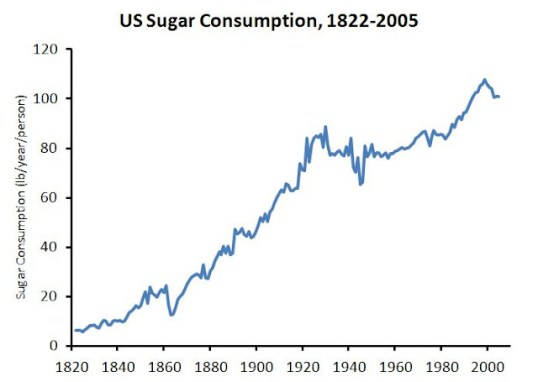
173 Years of U.S. Sugar Consumption

Thanks to Dr. Stephan Guyenet and Jeremy Landen for this sugar consumption graph.  I’d never seen one going this far back in time. 

 Dr. Guyenet writes:
It’s a remarkably straight line, increasing steadily from 6.3 pounds per person per year in 1822 to a maximum of 107.7 lb/person/year in 1999.  Wrap your brain around this: in 1822, we ate the amount of added sugar in one 12 ounce can of soda every five days, while today we eat that much sugar every seven hours.
The U.S. Department of Agriculture estimates that added sugars provide 17% of the total calories in the average American diet.  A typical carbonated soda contain the equivalent of 10 tsp (50 ml) of sugar.  The average U.S. adult eats 30 tsp  (150 ml) daily of added sweeteners and sugars.
 
Note that added sugars overwhelmingly supply only one nutrient: pure carbohdyrate without vitamins, minerals, protein, fat, antioxidants, etc.
 
Do you think sugar consumption has anything to do with diseases of affluence, also known as diseases of modern civilization?  I do.
 
Was our pancreas designed to handle this much sugar?  Apparently not, judging from skyrocketing rates of diabetes and prediabetes.
 

Random Thoughts On Paleo Eating for People With Diabetes

Not really pertinent, but I like buffalo

I was interviewed recently by Amy Stockwell Mercer, author of Smart Woman’s Guide to Diabetes. All I knew beforehand was that she was interested in my thoughts on the paleo diet as applied to diabetes.

In preparation, I collected some random thoughts and did a little research.

What’s the paleo diet?

Fresh, minimally processed food. Meat (lean or not? supermarket vs yuppiefied?), poultry, eggs, fish, leafy greens and other vegetables, nuts, berries, fruit, and probably tubers.

Non-paleo: highly processed, grains, refined sugars, industrial plant/seed oils, legumes, milk, cheese, yogurt.

Is the paleo diet deficient in any nutrients?

A quick scan of Loren Cordain’s website found mention of possible calcium and vitamin D deficits. Paleoistas will get vitamin D via sun exposure and fish (especially cold-water fatty fish). Obtain calcium from broccoli, kale, sardines, almonds, collards. (I wonder if the Recommended Dietary Allowance for calcium is set too high.)

What About Carbohydrates and Diabetes and the Paleo Diet?

Diabetes is a disorder of carbohydrate metabolism. In a way, it’s an intolerance of carbohydrates. In type 1 diabetes, there’s a total or near-total lack of insulin production on an autoimmune basis. In type 2 diabetes, the body’s insulin just isn’t working adequately; insulin production can be high, normal or low. In both cases, ingested carboydrates can’t be processed in a normal healthy way, so they stack up in the bloodstream as high blood sugars. If not addressed adequately, high blood glucose levels sooner or later will poison body tissues . Sooner in type 1, later in type 2. (Yes, this is a gross over-simplification.)

Gluten-rich Neolithic food

If you’re intolerant of lactose or gluten, you avoid those. If you’re intolerant of carbohydrates, you could avoid eating them, or take drugs to help you overcome your intolerance. Type 1 diabetics must take insulin. Insulin’s more optional for type 2’s. We have 11 classes of drugs to treat type 2 diabetes; we don’t know the potential adverse effects of most of these drugs. Already, three diabetes drugs have been taken off the U.S. market or severely restricted due to unacceptable toxicity: phenformin, troglitazone, and rosiglitazone.

Humans need two “essential fatty acids” and nine “essential” amino acids derived from proteins. “Essential” means we can’t be healthy and live long without them. Our bodies can’t synthesize them. On the other hand, there are no essential carbohydrates. Our bodies can make all the carbohydrate (mainly glucose) we need.

Since there are no essential carbohydrates, and we know little about the long-term adverse side effects of many of the diabetes drugs, I favor carbohydrate restriction for people with carboydrate intolerance. (To be clear, insulin is safe, indeed life-saving, for those with type 1 diabetes.)

That being said, let’s think about the Standard American Diet (SAD) eaten by an adult. It provides an average of 2673 calories a day. Added sugars provide 459 of those calories, or 17% o the total. Grains provide 625 calories, or 23% of the total. And most of those sugars and grains are in processed, commercial foods. So added sugars and grains provide 40% of the total calories in the SAD. (Figures are from an April 5, 2011, infographic at Civil Eats.)

Anyone going from the SAD to pure Paleo eating will be drastically reducing intake of added sugars and grains, our current major sources of carbohydrate. Question is, what will they replace those calories with?

That’s why I gave a thumbnail sketch of the paleo diet above. Take a gander and you’ll see lots of low-carb and no-carb options, along with some carb options. For folks with carbohydrate intolerance, I’d favor lower-carb veggies and judicious amounts of fruits, berries, and higher-carb veggies and

Will these cause bladder cancer? Pancreatitis?

tubers. “Judicious” depends on the individual, considering factors such as degree of residual insulin production, insulin sensitivity, the need to lose excess weight, and desire to avoid diabetes drugs.

Compared to the standard “diabetic diet” (what’s that?) and the Standard American Diet, switching to paleo should lower the glycemic index and glycemic load of the diet. Theoreticlly, that should help with blood sugar control.

A well-designed low-carb paleo diet would likely have at least twice as much fiber as the typical American diet, which would also tend to limit high blood sugar excursions.

In general, I favor a carbohydrate-restricted paleo diet for those with diabetes who have already decided to “go paleo.” I’m not endorsing any paleo diet for anyone with diabetes at this point—I’m still doing my research. But if you’re going to do it, I’d keep it lower-carb. It has a lot of potential.

Are There Any Immediate Dangers for a Person With Diabetes Switching to the Paleo Diet?

It depends on three things: 1) current diet, and 2) current drug therapy, and 3) the particular version of paleo diet followed.

Remember, the Standard American Diet provides 40% of total calories as added sugars and grains (nearly all highly refined). Switching from SAD to a low-carb paleo diet will cut carb intake and glycemic load substantially, raising the risk of hypoglycemia if the person is taking certain drugs.

Drugs with potential to cause hypoglycemia include insulin, sulfonylureas, meglitinides, pramlintide, and perhaps thiazolidinediones.

Who knows about carb content of the standard “diabetic diet”? Contrary to poplular belief, there is no monolithic “diabetic diet.” There is no ADA diet (American Diabetes Association). My impression, however, is that the ADA favors relatively high carbohydrate consumption, perhaps 45-60% of total calories. Switching to low-carb paleo could definitely cause hypoglycemia in those taking the aforementioned drugs.

One way to avoid diet-induced hypoglycemia is to reduce the diabetic dug dose.

A type 2 overweight diabetic eating a Standard American Diet—and I know there are many out there—would tend to see lower glucose levels by switching to probably any of the popular paleo diets. Be ready for hypoglycemia if you take those drugs.

Paleo diets are not necessarily low-carb. Konner and Eaton estimate that ancestral hunter-gatherers obtained 35 to 40% of total calories from carbohydrates. I’ve seen other estimates as low as 22%. Reality likely falls between 22 and 65%. When pressed for a brief answer as to how many carbohydrate calories are in the paleo diet, I say “about a third of the total.” By comparison, the typical U.S. diet provides 50% of calories from carbohydrate.

Someone could end up with a high-carb paleo diet easily, by emphasizing tubers (e.g., potatoes), higher-carb vegetables, fruits, berries, and nuts (especially cashews). Compared with the SAD, this could cause higher or lower blood sugars, or no net change.

A diabetic on a Bernstein-style diet or Ketogenic Mediterranean Diet (both very-low-carb) but switching to paleo or low-carb paleo (50-150 g?) would see elevated blood sugars. Perhaps very high glucoses.

Any person with diabetes making a change in diet should do it in consultation with a personal physician or other qualified healthcare professional familiar with their case.

Steve Parker, M.D.

Fun Facts!

  • A typical carbonated soda contain the equivalent of 10 tsp (50 ml) of sugar.
  • The typical U.S. adult eats 30 tsp (150 ml) daily of added sweeteners and sugars.
  • U.S total grain product consumption was at record lows in the 1970s, at 138 pounds per person. By 2000, grain consumption was up by 45%, to 200 pounds per person.
  • Total caloric sweetener consumption (by dry weight) was 110 pounds per person in the 1950s. By 2000, it was up 39% to 150 pounds.
  • Between 1970 and 2003, consumption of added fats and oils rose by 63%, from 53 to 85 pounds. (How tasty would that be without starches and sugars? Not very.)
  • In 2008, “added fat” calories in the U.S. adult diet were 641 (24% of total calories).

Fun Facts provided by the U.S. Department of Agriculture.

(The paleo diet is also referred to as the Paleolithic, Old Stone Age, Stone Age, Ancestral, Hunter-Gatherer, or Caveman diet.)

Famous Folks With Diabetes

  • Nearly 27% of American adults age 65 or older have diabetes (overwhelmingly type 2)
  • Half of Americans 65 and older have prediabetes
  • 11% of U.S. adults (nearly 26 million) have diabetes (overwhelmingly type 2)
  • 35% of adults (79 million) have prediabetes, and most of those affected don’t know it

dLife maintains a list of famous, prominent, or noteworthy folks who have or had diabetes.  I mention it here in case you have diabetes and sometimes feel like it’s got you by the throat and is ruining your life. Be inspired.

Steve Parker, M.D.

PS: Who has a list of infamous diabetics?

PPS: Many cases of type 2 diabetes and prediabetes can be prevented (https://advancedmediterranean.com/2012/02/29/type-2-diabetes-can-be-prevented/)

B.B. King is No.3 on Rolling Stone’s list of 100 Best Guitarists of All Time

Book Review: The Blood Sugar Solution

I just finished reading the No.1 book at Amazon.com, The Blood Sugar Solution: The UltraHealthy Progam for Losing Weight, Preventing Disease, and Feeling Great Now!  Published in 2012, the author is Dr. Mark Hyman. I give it three stars per Amazon’s rating system (“It’s OK”).  Actually, I came close to giving it two stars, but was afraid the review would have been censored at the Amazon site.

♦   ♦   ♦

The book’s promotional blurbs by the likes of Dr. Oz, Dr. Dean Ornish, and Deepak Chopra predisposed me to dislike this book.  But it’s not as bad as I thought it’d be.

The good parts first.  Dr. Hyman favors the Mediterranean diet, strength training, and high-intensity interval training.  His recommended way of eating is an improvement over the standard American diet, improving prospects for health and longevity.  His dietary approach to insulin-resistant overweight/obesity and type 2 diabetes includes 1) avoidance of sugar, flour, processed foods, 2) preparation of your own meals from natural, whole food, and 3) keeping glycemic loads low.  All well and good for weight loss and blood sugar control.  It’s not a vegetarian diet.

The author proposes a new trade-marked medical condition: diabesity. It refers to insulin resistance in association with (usually) overweight, obesity, and/or type 2 diabetes mellitus.  Dr. Hyman says half of Americans have this brand-new disorder, and he has the cure.  If you don’t have overt diabetes or prediabetes, you’ll have to get your insulin levels measured to see if you have diabesity.

He reiterates many current politically correct fads, such as grass-fed/pastured beef, organic food, detoxification, and strict avoidance of all man-made chemicals, notwithstanding the relative lack of scientific evidence supporting many of these positions.

Dr. Hyman bills himself as a scientist, but his biography in the book doesn’t support that label.  Shoot, I’ve got a degree in zoology, but I’m a practicing physician, not a scientist.

The author thinks there are only six causes of all disease: single-gene genetic disorders, poor diet, chonic stress, microbes, toxins, and allergens.  Hmmm… None of those explain hypothyroidism, rheumatoid arthritis, systemic lupus erythematosis, tinnitus, migraines, irritable bowel syndrome, Parkinsons disease, chronic fatigue syndrome, or multiple sclerosis, to name a few that don’t fit his paradigm.

Dr. Hyman makes a number of claims that are just plain wrong.  Here are some:
  – Over 80% of Americans are deficient in vitamin D
  – Lack of fiber contributes to cancer
  – High C-reactive protein (in blood) is linked to a 1,700% increased probability of developing diabetes
  – Processed, factory-made foods have no nutrients
  – We must take nutritional supplements

Furthermore, he recommends a minimum of 11 and perhaps as many as 16 different supplements even though the supportive science is weak or nonexistent.  Is he selling supplements?

After easily finding these bloopers, I started questioning many other of the author’s statements.   

I was very troubled by the apparent lack of warning about hypoglycemia (low blood sugar).  Many folks with diabetes will be reading this book.  They could experience hypoglycemia on this diet if they’re taking certain diabetes drugs: insulin, sulfonylureas, meglitinides, pramlintide plus insulin, exenatide plus sulfonylurea, and possibly thiazolidinediones, to name a few instances.

If you don’t have diabetes but do need to lose weight, this book may help.  If you have diabetes, strongly consider an alternative such as Dr. Bernstein’s Diabetes Solution or my Conquer Diabetes and Prediabetes.

In the interest of brevity, I’ll not comment on Dr. Hyman’s substitution of time-tested science-based medicine with his own “Functional Medicine.”

Steve Parker, M.D.

Type 2 Diabetes CAN Be Prevented

Not Paula Deen

Paula Deen’s recent announcement of her type 2 diabetes got me thinking about diabetes prevention again. If you’re at high risk of developing diabetes you can reduce your risk of full-blown type 2 diabetes by 58% with intensive lifestyle modification. Here’s how it was done in a 2002 study:

The goals for the participants assigned to the intensive lifestyle intervention were to achieve and maintain a weight reduction of at least 7 percent of initial body weight through a healthy low-calorie, low-fat diet and to engage in physical activity of moderate intensity, such as brisk walking, for at least 150 minutes per week. A 16-lesson curriculum covering diet, exercise, and behavior modification was designed to help the participants achieve these goals. The curriculum, taught by case managers on a one-to-one basis during the first 24 weeks after enrollment, was flexible, culturally sensitive, and individualized. Subsequent individual sessions (usually monthly) and group sessions with the case managers were designed to reinforce the behavioral changes.

Although the Diabetes Prevention Program encouraged a low-fat diet, another study from 2008 showed that a low-fat diet did nothing to prevent diabetes in postmenopausal women.

I don’t know Paula Deen. I’ve never watched one of her cooking shows. She looks overweight and I’d be surprised if she’s had a good exercise routine over the last decade. I’m sorry she’s part of the diabetes epidemic we have in the U.S. I wish her well. Amy Tenderich posted the transcript of her brief interview with Paula, who calculates her sweet tea habit gave her one-and-a-half cups of sugar daily).

  • Nearly 27% of American adults age 65 or older have diabetes (overwhelmingly type 2)
  • Half of Americans 65 and older have prediabetes
  • 11% of U.S. adults (nearly 26 million) have diabetes (overwhelmingly type 2)
  • 35% of adults (79 million) have prediabetes, and most of those affected don’t know it

I think excessive consumption of concentrated sugars and refined carbohydrates contribute to the diabetes epidemic. Probably more important are overweight, obesity, and physical inactivity.

The Mediterranean diet has also been linked to lower rates of diabetes (and here). Preliminary studies suggest the Paleo diet may also be preventative (and here).

Greatly reduce your risk of type 2 diabetes by eating right, keeping your weight reasonable, and exercising.

Steve Parker, M.D.

PS: Paula, if you’d like a copy of Conquer Diabetes and Prediabetes: The Low-Carb Mediterranean Diet, have your people contact my people.

Reference: Diabetes Prevention Program Research Group. Reduction in the Incidence of Type 2 Diabetes with Lifestyle Intervention or Metformin. New England Journal of Medicine, 346 (2002): 393-403.