
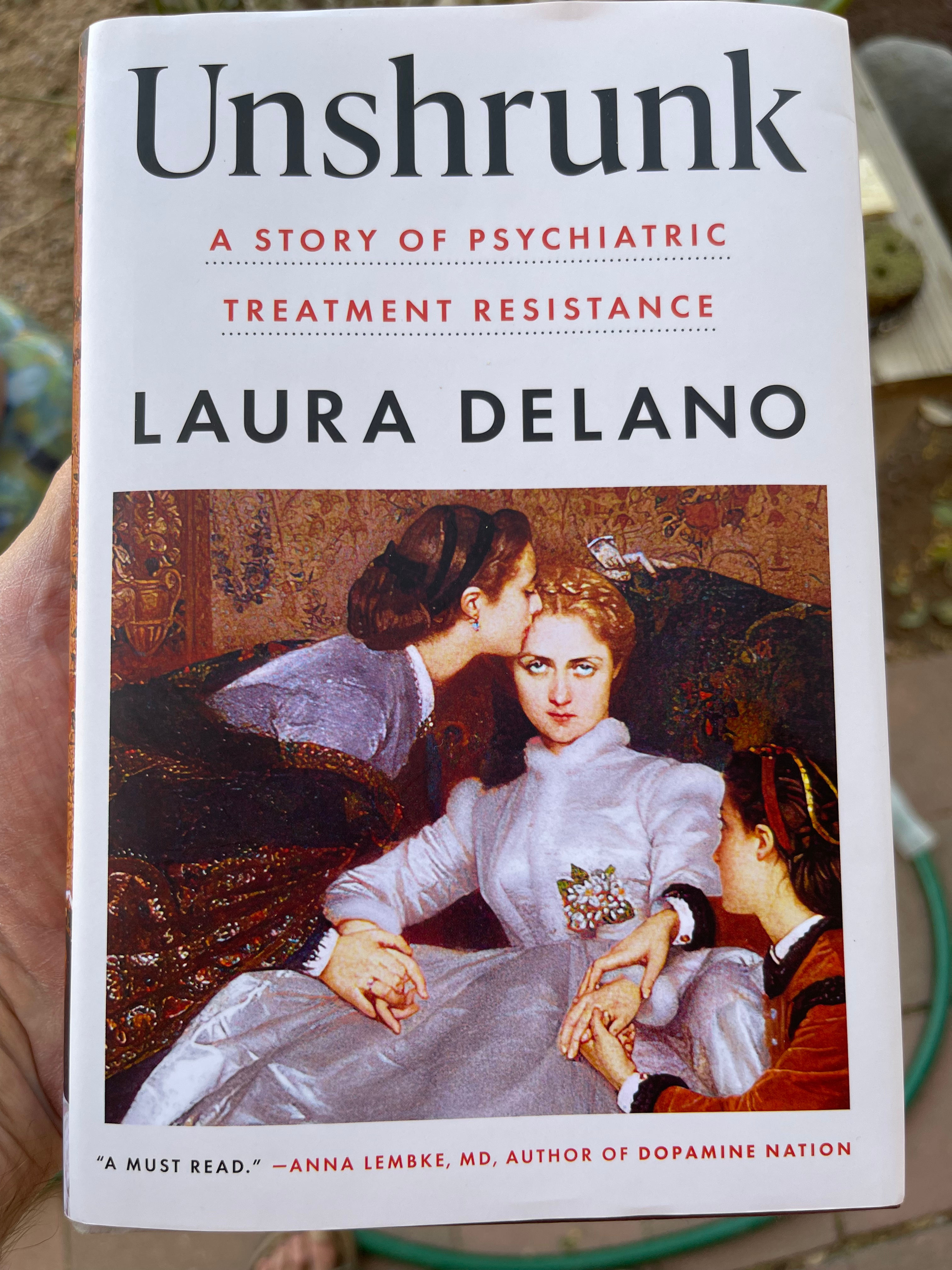
Every shift in my adult hospital medicine practice I run across patients taking one or more psych drugs long-term. I often wonder if the drug is still necessary. Here’s my brief review of Laura Delano’s book, Unshrunk.
For years I’ve been wondering why the U.S. has an apparent epidemic of mental illness, judging from the widespread use of prescription pharmaceuticals like Wellbutrin, Prozac, Xanax, Lexapro, Lamictal, Adderall, and Ritalin. For instance, the Centers for Disease Control reported that in 2023, 24% of adults reported having received mental health treatment (based on taking medication for anxiety or depression or, during the prior 12 months, having taken medication for emotions, concentration, behavior or mental health, or having received mental health therapy from a mental health professional).
And it’s not only adults. A 2021 article in Psychology Today noted that “In the USA, 8.5 percent of children under 18 (1 in 12) are on “medication for ADD/ADHD, autism/ASD, or difficulties with emotions, concentration, or behavior,” according to a national survey. This includes 1.2 percent of pre-schoolers and 12.9 percent of 12- to 17-year-olds (1 in 8).
Laura Delano’s book focuses on her personal experience with “treatment resistant” mental illness. Her psychiatric labels included bipolar disorder, borderline personality disorder, and alcoholism. She would say that the widespread prescribing of psych medications is due to 1) failure to adequately address the underlying causes of mental illness, and 2) widespread acceptance of the (discredited) biochemical model of mental illness. The latter is the idea that a chemical imbalance in the brain is causing distress. You have too much or not enough dopamine, norepinephrine, etc. “Here, take this drug and it will balance your chemicals.” For much of her life, starting at age 13, Laura was on three to six drugs at a time, and she’s convinced they did more harm than good. One drug making you too drowsy? Add this other drug to keep you awake. Years after a serious suicide attempt, Laura eventually got off all of her medications and her life improved greatly. Don’t do this on your own; the tapering off process takes longer than you think. She admits that her wealthy family provided resources that few of us have.
The author points out that FDA approval of psychopharmaceuticals is typically based on safety and efficacy during studies lasting 6-8 weeks in experimental subjects taking only one drug. But what about those patients taking the drug for three years? Along with two or more other drugs?
Laura gives great credit to her involvement with Alcoholics Anonymous, what Dr. Drew Pinsky calls a type of mutual aid. To me, it’s sad that she never believed in the AA idea that “a power greater than us can restore us to sanity.” I pray that she will come to know God/Jesus. I suspect that the clarity of alcohol abstinence helped her brain find a way out of the psychiatrization (her term) that trapped her. Laura’s belief in mutual aid led her to found the Inner Compass Exchange (https://exchange.theinnnercompass.org) to help those hoping escape the mental health industry and its medicalized paradigm.
The book offers hope to those suffering from treatment-resistant mental illness and to those who hope eventually to get off of chronic psych meds. Highly recommended for anyone with a serious interest in mental illness, psychology, or psychiatry.
Steve Parker, M.D.


 Advanced Mediterranean Diet