Monthly Archives: January 2013

This Is How Our Brains Trick Us

“The human brain is capable of 1016 processes per second, which makes it far more powerful than any computer currently in existence. But that doesn’t mean our brains don’t have major limitations. The lowly calculator can do math thousands of times better than we can, and our memories are often less than useless — plus, we’re subject to cognitive biases, those annoying glitches in our thinking that cause us to make questionable decisions and reach erroneous conclusions. Here are a dozen of the most common and pernicious cognitive biases that you need to know about.”

Read the rest at io9.

Major Diabetes Complications on the Run

Here’s a quote from a recent Diabetes Care:

Improved therapeutics and health care delivery have brought remarkable declines in the incidence of … complications, with a 50% reduction in amputations from their peak in 1997 and ∼35% reduction in the incidence of end-stage renal disease. Similarly, 10-year coronary heart disease risk dropped from 21% in 2000 to 16% in 2008.

Exercise helps prevent and control diabetes

Exercise helps prevent and control diabetes

Nevertheless, diabetes remains the leading cause of blindness, renal failure, nontraumatic lower-limb amputation, in adults 18 to 65 years of age.  We gotta stay after it!

In addition to lower rates of major diabetes complications, we now have 11 classes of drugs for treating diabetes, compared with just three or four a generation ago.

The essay by Dr. Robert Ratner also notes 79 million Americans with prediabetes.  They need my Conquer Diabetes and Prediabetes book.  It’s only $9.99 (USD), a drop in the ocean compared to the $174 billion spent on diabetes in 2007 in the U.S.

—Steve

QOTD: Healthcare Insurance

Health care insurance doesn’t mean access to medical care any more than car insurance means you have access to a car.

WhiteCoat’s Call Room, October 6, 2010

Michelle Fields on the Looming Inter-Generational Conflict

One-minute YouTube video.

Sean Preuss Notes That U.S. Obesity is NOT Increasing Any More

Details at his blog.

“The subjectivity of CDC data leads to misreporting. People may misreport due to estimating instead of actually measuring, lie because they are uncomfortable with their weight, overstate their height (which leads to incorrect body mass index calculations), etc. In exercise studies, it’s well-known amongst researchers that people generally overestimate the amount of physical activity that they participate in. In general, we are not perfect when it comes to estimating.”

Is Modern Wheat Making Us Sick?

Monica Reinagel has an answer at her blog.

“All of which suggests that, even if the recent charges against modern wheat don’t hold much water, your New Year’s resolution to cut back on wheat might still be a good one—but not if you simply replace one grain with another. Instead, consider replacing some of the grains in your diet with vegetables and other nutrient-dense foods.”

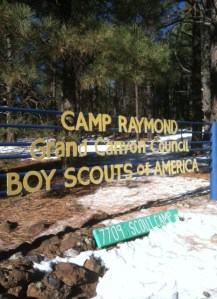
Troop 131 Snow Campout at Camp Raymond

Snow Campout Location West of Flagstaff, Arizona

Snow Campout Location West of Flagstaff, Arizona

Our Boy Scout troop had its annual snow campout at Camp Raymond this last weekend.  It was the first snow camp for me and my son, Paul.  Most of us camped Saturday night although four campers came up for Friday night as well.  Seven adults and 11 scouts participated.

Camp Raymond is at 6,700 feet above sea level and roughly 20 miles west of Flagstaff.  It’s in a Ponderosa pine forest.  The Camp had received a good amount of snow over the last month although none within the last week.  Still, we had a base of six inches of snow and ran across drifts 2-feet deep.  Recent daily high temps have been in the 40s (°F) and the lows in the teens or less.  After the sun goes down, you’re at freezing or below.  The low temp Sunday morning was 13.
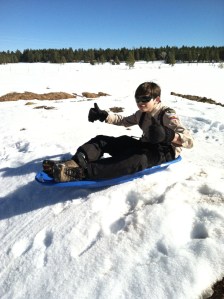
Paul On His Sled

Paul On His Sled

I’ve been in temperatures close to zero before, but never camped overnight below 25°.  Knowing that the temp would be in the teens was intimidating.  Paul and I had decided to wimp out this year, but then he changed his mind after hearing that a snow campout (or simply cold-weather?) was necessary for the camping merit badge, which in turn is necessary for Eagle rank.

After arrival on Saturday, one group of us took a hike up a hill while the others explored Camp Raymond and played around a frozen lake.  Later, the boys had snowball fights with each other and another group of scouts.  The adults sat that out.

The key to surviving the cold temps is to come prepared.  In particular, it’s important to stay dry.  Once your feet get cold and chilled, you’re starting to lose the battle and will be miserable until you turn it around.  Wool socks and other clothing may be ideal, if you can afford it.  You need specific cold-weather gear:

  • multiple pairs of socks (you always want a dry pair available)
  • multiple pairs of gloves (if you plan on getting your one good pair wet)
  • thermal underwear
  • good cover for the your head, neck, and face (a balaclava may be ideal)
  • coats and sweaters
  • boots (ideally waterproof; best to bring two pair in case one gets wet)
  • snow pants like skiers wear
  • something to keep you off the snow when you sleep (some of us had “thermal pads,” others didn’t)
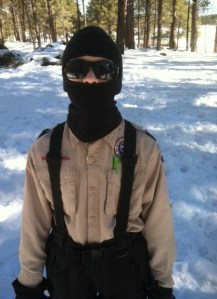
The Balaclava: Thermal Protection for Head, Neck, and Face

The Balaclava: Thermal Protection for Head, Neck, and Face

If you attempt a cold-weather campout, do your own thorough research beforehand or you could die.

You’ll want to dress in layers.  For instance, during the sub-freezing evening, I had on thermal underwear (top and bottom), a non-cotton T-shirt, a cotton long-sleeved knit shirt, a sweater, a balaclava, and a coat.  My lower half had the thermal underwear, my  scouting pants, then snow pants.  For my feet, I like a thin “liner sock” (non-cotton) under a thick wool or wool-blend sock.

The problem with cotton is that it loses it’s insulating property when it’s wet with sweat, rain, or melted snow.  This is where wool shines.  Don’t get wet if you can avoid it!
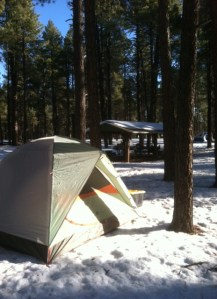
My Three-Season Tent From REI

My Three-Season Tent From REI

You can buy or rent winter-grade tents, but we just used our usual tents.  Theoretically, a smaller tent might retain more heat than a larger tent.  With our thin-walled tents at 13°, I question whether that works.

This was an expensive trip.  We spent several hundred dollars acquiring clothing that would keep us alive with all our fingers and toes.  I’m sure we’ll use this clothing again.

I slept in a synthetic-material mummy bag (rated for zero degree weather) which I had put inside a rectangular bag rated for 30–40 degrees.  Furthermore, I started out with most of my clothes on.  By morning, I had removed my thick socks, snow pants, and sweater.  Turns out I just needed some socks, thermal underwear, my scouting pants, a cotton knit long-sleeve shirt, and a hat that covered my head and ears.  I slept on a 4–inch thick air mattress, which was fine.
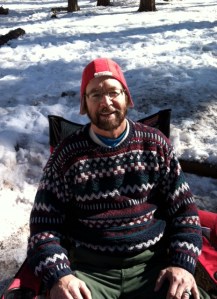
Steve Parker, Happy About Surviving 13 Degrees F.

Steve Parker, Happy About Surviving 13 Degrees F.

It took me at least an hour to fall asleep, and I woke up every hour or two.  Maybe slept three hours for one stretch.  This was a typical pattern among the four adults I surveyed.  My problem wasn’t the temperature.  I think it may have been the altitude, wearing too much clothing, or anxiety about freezing.

A camp caretaker told me she had seen bear tracks recently; a female adult and juvenile are in the area.  So much for hibernation.  An experienced hunter with us said the bears would be bedded down at night at these temperatures.

The only interesting wildlife we saw on the trip was a bald eagle eating roadkill.  Saw plenty of elk tracks.

It was a great trip and I’m proud of the scouts for facing and overcoming the challenges.

—Steve
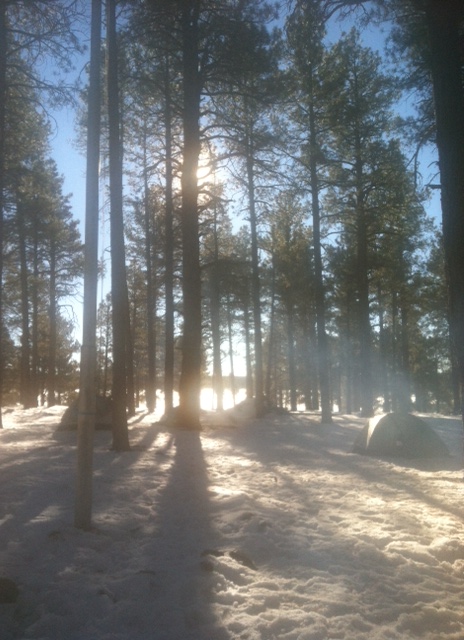
Sunday Morning Sunlight Filtered Through Campfire Smoke

Sunday Morning Sunlight Filtered Through Campfire Smoke
U.S. Cancer Deaths Down 20% From 1991 Peak

Details at MedPageToday.

The 10 Warning Signs of Serious Low Back Pain

By “serious” back pain, I mean potentially life-threatening or disabling.

The warning signs in no particular order:

  1. recent trauma
  2. recent intravenous drug abuse
  3. unexplained weight loss
  4. osteoporosis
  5. history of cancer
  6. prolonged pain
  7. disabling symptoms
  8. immunosuppression (compromised immune system for any reason)
  9. age over 70
  10. progressive focal neurologic deficits, such as loss of bowel or bladder control, numbness, weakness on one side, impaired gait
A position you'll see in the Five Tibetan Rituals for prevention and treatment of back pain

A position you’ll see in the Five Tibetan Rituals for prevention and treatment of back pain

Low back pain is the most common musculoskeletal disorder worldwide.  Eighty percent of us will suffer from it at some point.  For most, a specific cause cannot be established with certainty.  But if you have one of the 10 warning signs of serious back pain, be sure to see a doctor soon.

Steve Parker, M.D.

Mass Murder and Mental Illness

“Taking guns away from single women who live alone and other law-abiding citizens without mental illnesses will do nothing about the Chos, Loughners, Holmeses or Lanzas. Such people have to be separated from civil society, for the public’s sake as well as their own. But this is nearly impossible because the ACLU has decided that being psychotic is a civil right.

Consequently, whenever a psychopath with a million gigantic warning signs commits a shocking murder, the knee-jerk reaction is to place yet more controls on guns. By now, guns are the most heavily regulated product in America.

It hasn’t worked.”

– Ann Coulter