Monthly Archives: July 2012

Does Our Labor-Saving Technology Make Us Fat?

Relaxing after a hard day gathering nuts and berries

Have our modern conveniences contributed to the fact that two thirds of us are overweight or obese?  It would make sense, because we should be burning fewer calories in the activities of daily living.  If our daily workload decreases but we eat the same old calories, they gotta go somewhere, right?  Like into our fat stores.

We no longer have to walk down to the river to fetch a five-gallon bucket of water for washing.  No longer do we go out a forage for food and firewood. We don’t even have to get up off the couch to change the channel on the TV.

Hunter-gatherer societies don’t have our modern conveniences.  You’d think they burn a lot more calories than us in activities of daily living.  You’d be wrong.

At least one group of hunter-gatherers doesn’t burn any more calories in physical activity than Western cultures.  So much for blaming our excess weight on low activity levels and labor-saving technology.

BBC article on energy expenditure of the Hazda hunter-gatherer culture.

—Steve

h/t Colby Vorland at nutsci.org

Tuna Preserves Brain Blood Flow In People Over 65

Among people over 65, consumption of tuna/other fish is associated with preserved blood flow to the brain, according to a 2008 research report in the journal Neurology.

“Silent” brain infarcts – tiny strokes that are not obvious – are very common with advancing age. If a group of people 65 and older is MRI scanned and found to have no strokes, MRI scans performed five years later will show tiny strokes in 20% of them. Almost 90% of these new strokes are simply incidental findings without clinically evident stroke or transient ischemic attack.

As the authors point out:

Subclinical infarcts and white matter abnormalities are considered to be of vascular origin, presumably resulting from occlusion of small arteries in the brain and subsequent ischemia.

These subclinical strokes, along with brain white matter abnormalities, are not benign. They are associated eventually with impairment in thinking and behavior, and with higher risk of future obvious stroke.

Eating tuna or other broiled or baked fish tends to raise plasma omega-3 fatty acid levels and is associated with lower stroke risk and dementia and Alzheimer disease. Researchers wondered if fish consumption affected the risk of subclinical brain infarcts or other subclinical brain abnormalities.

Methodology

Scientists studied 3,660 participants over 65 years old in the Cardiovascular Health Study, by MRI scanning, lab testing, physical exam, and food frequency questionnaire. Five years later, 2,313 were rescanned. Hospital and clinic records were reviewed. Participants were men and women in four U.S. communities. Fish intake was classified as to whether tuna, other broiled or baked fish, and fried fish or fish sandwiches (fish burgers). In a subset of participants, blood levels of omega-3 fatty acids were measured.

Conclusions of the Scientists

Among older adults, modest consumption of tuna/other fish, but not fried fish, was associated with lower prevalence of subclinical infarcts and white matter abnormalities on MRI examinations. Our results add to prior evidence that suggest that dietary intake of fish with higher eicosapentaenoic acid [EPA] and docosahexaenoic acid [DHA] content, and not fried fish intake, may have clinically important health benefits.

…the results of the present article support the growing evidence that the type of fish meal consumed is important for obtaining the health benefits of fish consumption.

Discussion

The fish with higher omega-3 fatty acids, such as EPA and DHA, are the cold-water fatty fish such as albacore tuna, salmon, trout, sardines, anchovies, herring, halibut, sea bass, swordfish, and mackerel. These are sometimes referred to as dark meat fish or oily fish. These are the same types of fish most closely associated with lower rates of coronary artery disease and sudden cardiac death.

The types of fish used in fish sticks, fish burgers, and other fried fish meals are typically low in omega-3 fatty acids.

If you choose to eat fish for the health benefits, aim for two servings per week of cold-water fatty fish. The Friday night all-U-can-eat fried catfish buffet doesn’t cut it.

Steve Parker, M.D.

Reference: Virtanen, J.K., et al. Fish consumption and risk of subclinical brain abnormalities on MRI in older [U.S.] adults. Neurology, 71 (2008): 439-446.


My Fitness Experiment #3: Results

One……more……rep!

After finishing six weeks ofChris Highcock’s Hillfit earlier this year, I designed another fitness program using dumbbells and high intensity interval running on a treadmill.

I’ve preached about the benefits of baseline and periodic fitness measurements.  Here are mine, before and after roughly six weeks of my fitness experiment #3:

  • weight: no change (170 lb or 77.3 kg)
  • maximum consecutive push-ups: 34 before, 32 after
  • maximum consecutive pull-ups: no change (8)
  • maximum consecutive sit-ups: 37 before, 35 after
  • time for one-mile walk/run: 8 minutes and 35 seconds before, up to 8 minutes and 54 seconds after (*)
  • vertical jump (highest point above ground I can jump and touch): 279.5 cm before, to 276 cm after
  • toe touch (wearing shoes, stand and lock knees, bend over at waist to touch toes: no change (22 cm)

I worked out twice weekly for a total of 70 minutes.  The U.S. Centers for Disease Control and Prevention recommends 150 minutes a week of moderate-intensity aerobic activity and muscle-strengthening exercise at least twice a week; or 75 minutes per week of vigorous-intensity aerobic activity plus muscle-strengthening activity at least twice a week.

Bottom Line

I was a bit fitter after completing Hillfit a couple months ago.

Or I just had a bad day when I tested this time.  Nevertheless, I prefer my current program to Hillfit.  (Click for report on my six-week Hillfit experience.)

What Next?

For strength and endurance gains, perhaps I should incorporate some Hillfit features into my current plan.

I don’t feel like I’m getting much out of Romanian deadlifts.  Drop ’em?  Do they add anything to squats?  Try Hillfit-style wall squats while hold dumbbells?

How does my fitness compare to other 57-year-old men?  I’m not sure.  One of these days I’ll see how I stack up against U.S. Army fitness standards, which involve a timed two-mile run.

Is my current level of fitness good enough?  Again, not sure.

My highest dumbbell weights are 40 lb (18 kg).  I’m already using those for squats, deadlifts, and one-arm rows.  For future strength gains, I’d have to do those exercise for longer, or more days per week, or buy some 50-lb weights.  A pair of 50-lb dumbbells will cost $50 (used) or $100 (new).

I’ll put together yet another fitness program within the next few months.

I don’t like to exercise, but I want the health benefits.  My general goal is to maximize health benefits while minimizing exercise time.

Steve Parker, M.D.

Notes:

Next time I do the mile run on the treadmill, start at 7.5 mph and increase to 8 mph as much as tolerated.

(*) About 10 days after this I ran a mile in 8 minutes and 30 seconds on a high school track.

Nuts: What’s Not to Love?

MPj04031620000[1]Nut consumption is strongly linked to reduced coronary heart disease, with less rigorous evidence for several other health benefits, according to the American Journal of Clinical Nutrition.

This is why I’ve included nuts as integral components of the Ketogenic Mediterranean Diet and the Advanced Mediterranean Diet.

Regular nut consumption is associated with health benefits in observational studies of various populations, within which are people eating few nuts and others eating nuts frequently. Health outcomes of the two groups are compared over time. Frequent and long-term nut consumption is linked to:

  • reduced coronary heart disease (heart attacks, for example)
  • reduced risk of diabetes in women (in men, who knows?)
  • less gallstone disease in both sexes
  • lower body weight and lower risk of obesity and weight gain

The heart-protective dose of nuts is three to five 1-ounce servings a week.

Steve Parker, M.D.

Reference: Sabaté, Joan and Ang, Yen. Nuts and health outcomes: New epidemiologic evidence. American Journal of Clinical Nutrition, 89 (2009): 1,643S-1,648S.

Huge U.S. Study Confirms Health and Longevity Benefits of the Mediterranean Diet

This is a reprint of my very first blog post, from December 24, 2007, at the old Advanced Mediterranean Diet Blog

We now have results of the first U.S. study on mortality and the Mediterranean dietary pattern.  380,000 people, aged 50-71, were surveyed on their dietary habits and scored on their conformity to the Mediterranean diet.  They were visited again 10 years later.  As you would expect, some of them died.  12,105 to be exact: 5985 from cancer, 3451 from cardiovascular disease, 2669 from other causes.  However, the people with the highest adherence to the Mediterranean diet had better survival overall, and specifically better odds of avoiding death from cardiovascular disease and cancer.  Compared to the people with low conformity to the Mediterranean diet, the high conformers were 15-20% less likely to die over the 10 years of the study.  The study authors, funded by the National Institutes of Health, noted eight similar studies in Europe and one in Australia with similar results.

Once again, my promotion of the Mediterranean diet is vindicated by the scientific literature.  I’m not aware of any other diet that can prove anywhere near this degree of health benefit.  If you are, please share

Reference: Mitrou, Panagiota N., et al.  Mediterranean Dietary Pattern and Prediction of All-Cause Mortality in a US Population,  Archives of Internal Medicine, 167 (2007): 2461-2468.


Mediterranean Diet Prolongs Life in Alzheimer Disease

A small scientific study of New York Alzheimer patients demonstrated significant increase in lifespan in those who had the highest adherence to the Mediterranean diet.  192 community-based individuals were followed for an average of 4.4 years (up to 13.6 years).  They were divided into three groups of Mediterranean diet adherence: low, medium, and high.  Compared to the people with low adherence, the others lived between 1 and 4 years longer.  Those with highest adherence lived the longest, suggesting a dose-response effect like we would see with many drugs.  No other diet has demonstrated this effect.

This same research group had previously reported that the Mediterranean diet lowered the risk for developing Alzheimer Disease in the first place.

Unfortunately, they did not report on whether the Mediterranean diet helped preserve brain function.  Prolongation of life by itself may be more of a curse than a blessing in advanced Alzheimer Disease.

Steve Parker, M.D.

Reference: Scarmeas, N., et al.  Mediterranean diet and Alzheimer disease mortality.  Neurology, 69 (2007):1,084-1,093.

Reduce Your Cancer Risk Starting Today

In 2007, the World Cancer Research Fund and the American Institute for Cancer Research jointly published a report having the potential to reduce cancer rates by at least a third, if their recommendations were adopted.  A multinational team of 21 respected experts was charged with analyzing over 7,000 studies relating to diet, exercise, body weight, and cancer.  The panel assumes everyone already knows to avoid smoking and chewing tobacco.  Here are their 10 basic recommendations:

1.  Be as lean as possible within the normal range of body weight (BMI or body mass index of 18.5 to 24.9).  Being overweight or obese promotes certain cancers.

2.  Be physically active every day.  Example: 30 minutes of brisk walking.

3.  Limit consumption of energy-dense (high-calorie) foods.  Avoid sugary drinks.  Water is the best alternative to sugary drinks.  Natural fruit juice is a reasonable fruit serving, but limit to one daily.

4.  Eat mostly foods of plant origin.  Fill at least two-thirds of your plate with vegetables, fruits, whole grains, and beans.

5.  Limit intake of red meat and avoid processed meats.  Red meats are beef, pork, and lamb.  Limit to 18 ounces of cooked red meat per week.

6.  For pure cancer avoidance, don’t drink alcohol.  The panel recognizes, however, that alcohol likely helps in prevention of coronary heart disease.  If you drink alcohol for heart benefits, limit to two drinks daily if you are a man, and one daily if you are a woman.

7.  Limit consumption of salt (associated with stomach cancer).  Avoid moldy cereals and legumes (molds produce aflatoxins which cause liver cancer).

8.  Aim to meet nutritional needs through food intake rather than supplements.

9.  Mothers should breast-feed for six months (at least?).  Children should be breast-fed.

10.  Cancer survivors should still follow the recommendations for prevention of cancer.

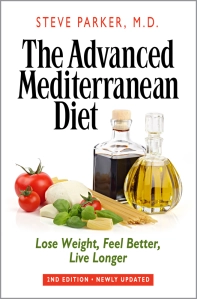
Much of this is consistent with my book, The Advanced Mediterranean Diet: Lose Weight, Feel Better, Live Longer (2nd Edition).  The AMD is a diet/weight loss book, with little reason to seriously address breast-feeding and cancer survivors.  The association between salt intake and stomach cancer is news to me.  Stomach cancer is not very common in the United States, where I and most of my audience live.  Overweight people following the Advanced Mediterranean Diet will be far ahead of the game if they get their BMI just down to 24.9.  I’m not convinced 18.5 would be any healthier, and many studies suggest the opposite.

Steve Parker, M.D.

References: Food, Nutrition, Physical Activity, and the Prevention of Cancer: A Global Perspective

Overweight Youth Point To Increase In Heart Disease

No doubt you have noticed the expanding girths of  U.S. yoots.  What are the health implications?  Research published in the New England Journal of Medicine suggests a disturbing answer.

Heavy youths tend to stay heavy as they age.  Researchers looked at the incidence of overweight adolescents in the year 2000 and then estimated the prevalence of obesity in the year 2020.  Thirty to 44% of 35-year-olds in 2020 are expected to be obese.

Using computer simulation, investigators estimated that by 2035 the prevalence of coronary heart disease will increase by 5 to 16% because of the increased obesity.  In other words, the increasing obesity in these young and middle-aged adults will result in over 100,000 excess cases of coronary heart disease.

That is, if current trends continue.  But I see nothing on the horizon likely to alter that societal trend in the near future.  I’m doing my part.  How about you?

Steve Parker, M.D.

References:  Bibbins-Domingo, K, et al.  Adolescent Overweight and Future Adult Coronary Heart Disease.  New England Journal of Medicine, 357 (2007): 2,371-2,379.

It’s Not Too Late to Get Healthier, Even if Middle-Aged

Are your eventual health problems a matter of fate by the time you reach middle age?

A study from the Medical University of South Carolina asked whether middle-aged folks could improve their health and longevity by making healthful changes in lifestyle.  15,708 study participants, ages 45-64, were surveyed with regards to four “healthy lifestyle” components, namely:

  • five or more fruits and vegetables daily
  • regular exercise
  • healthy weight range (BMI 18.5-29.9)
  • no current smoking

When first surveyed, 8.5% of the participants had all four of the healthy lifestyle components.  When surveyed six years later, 8.4% of the remainder had adopted these four healthy lifestyle features.  Overall death rate and cardiovascular disease events were monitored over the next four years.  Compared to the study participants who did not adopt a healthy lifestyle, the new adopters had a 40% lower incidence of death from all causes and 35% less cardiovascular disease events.

So middle-aged people can improve their longevity and avoid cardiovascular disease by making healthy lifestyle changes.  These improvements are very significant in degree and comparable to, if not better than, results seen with many expensive medications and invasive medical procedures.

Why not make some changes today?

Steve Parker, M.D.

References: King, Dana E., et al.  Turning Back the Clock: Adopting a Healthy Lifestyle in Middle Age.  American Journal of Medicine, 120(2007): 598-603.

Book Review: Six Weeks to OMG

I heard about this book before it was ever available in the U.S. and I thought it had the potential to be huge here.  So I read Six Weeks to OMG: Get Skinnier Than All Your Friends by Venice Fulton, published in 2012.  Per Amazon.com’s rating system, I give it two stars (“I don’t like it”).

♦   ♦   ♦

Judging from the wording and writing style, this book was written for not-too-bright girls and women from 12 to 22 years old.  Others need not bother with it.

Suggest a caption

Will it work for weight loss?  Yes, even without the author’s three cornerstone gimmicks: 1) Skip breakfast, but eat three meals daily, 2) Daily cold-water baths at 59 to 68°F for up to 15 minutes, and 3) Black coffee one or two cups every morning.  There’s no good scientific data to support those prescriptions.

The diet will work because it restricts your consumption of items that make us fat: concentrated sugars and refined starches.  It’s a low-carbohydrate diet—up to 60, 90, or 120 grams a day, depending on how fast you want to lose.

The diet consists mostly of high-protein animal-derived foods, low-carb vegetables, and up to three pieces of fruit daily.  Do not exceed 40 grams of carbohydrate per meal, even less is better, the author says.  Grains and dairy products aren’t mentioned much; it’s easy to blow your carb limit with them.  High-carb vegetables are listed, so you can avoid them.

Mr. Fulton emphasizes some important, valid points.  High protein consumption helps control appetite.  Trans fats are bad.  Eat cold-water fatty fish twice weekly.  Eat off a small plate (maximum of 9-inch diameter).  No snacking.  He says good things about weight training, while failing to mention it’s more much important long-term maintenance than for active weight loss.

He says some things that are just plain wrong, such as 1) everyone can be skinny, 2) there are only eight essential amino acids, 3) exercise is fairly helpful with weight loss, and 4) weight training just once every 10 days is adequate.

I’ll confess I didn’t read every word of the book.  The writing style is just too irritating unless you’re a not-too-bright 12 to 22-year-old.  For instance, every page had at least four exclamation marks!

Here are some of the dumbed-down sentences that unintentionally made me laugh out loud:

  • “The key to success is understanding stuff.”
  • “If you have problems controlling your appetite, the main reason is that you eat too often.”
  • “The person in the mirror, that’s you.”
  • “Human beings are part of the universe.  And that’s full of laws.  The laws of physics, chemistry and biology are three well-known laws.”

If you want a low-carb weight loss diet, you’re better off with Protein Power, The New Atkins For a New You, or the Low-Carb Mediterranean Diet.

Steve Parker, M.D.